
Wagering Requirements Explained: What a Bonus Costs
A wagering requirement is the amount you must bet before bonus money can be withdrawn: 35x on a A$100 bonus means A$3,500 of bets, which on a 96% pokie costs A$140 on average (turnover x house edge). That formula describes the casino's long-run take, not your likely result. In our simulation of 40,000 players with a A$100 deposit and a A$100 bonus at 35x, only 17.6% finished the wagering, and the typical player ended with nothing.
A wagering requirement (also called a playthrough or rollover) is a turnover target: bonus money stays locked until you have bet a set multiple of it. The standard way to price one is turnover x house edge, and it gives a clean number, A$140 for a 35x A$100 bonus on a 96% pokie. But that number assumes you always make it to the end. When we simulated 40,000 players taking a A$100 deposit plus a A$100 bonus at 35x, only 17.6% completed the wagering. The rest ran out of money along the way and stopped betting, so the average player kept about A$130 of the A$200, better than the formula predicts, while the median player finished with A$0. The formula overstates the average cost and understates the chance of walking away with nothing. This page shows both calculations and the terms that move them.
One bonus, priced step by step
| Step | Example: 100% match, 35x the bonus |
|---|---|
| Your deposit | A$100 |
| Bonus credited | A$100 |
| Wagering requirement | 35x the bonus |
| Turnover needed | 35 x A$100 = A$3,500 |
| Spins at A$2 each | 1,750 |
| House edge on a 96% pokie | 4% |
| Expected cost of the wagering | A$3,500 x 4% = A$140 |
| Expected balance at the end, if you could always keep playing | A$200 - A$140 = A$60 |
A wagering requirements calculator you can do by hand
- Find the base. Read whether the multiple applies to the bonus only, or to the deposit plus the bonus. The second doubles the turnover on a 100% match.
- Work out the turnover. Base x multiple. If the game you want counts less than 100% towards wagering, divide by its weighting: at 10%, every A$1 bet counts as 10c.
- Price it. Turnover x (1 - RTP) is the expected cost. Compare it with the bonus: if the cost is close to or above the bonus, the offer is worth little on average.
| Offer on a A$100 bonus | Turnover | RTP of the game | Expected cost |
|---|---|---|---|
| 35x the bonus, 97% pokie | A$3,500 | 97% | A$105 |
| 35x the bonus, 96% pokie | A$3,500 | 96% | A$140 |
| 40x the bonus, 96% pokie | A$4,000 | 96% | A$160 |
| 35x the bonus, 94% pokie | A$3,500 | 94% | A$210 |
| 35x the bonus, live blackjack at 10% weighting | A$35,000 | about 99.4% | A$210 |
| 35x deposit plus bonus (A$200), 96% pokie | A$7,000 | 96% | A$280 |
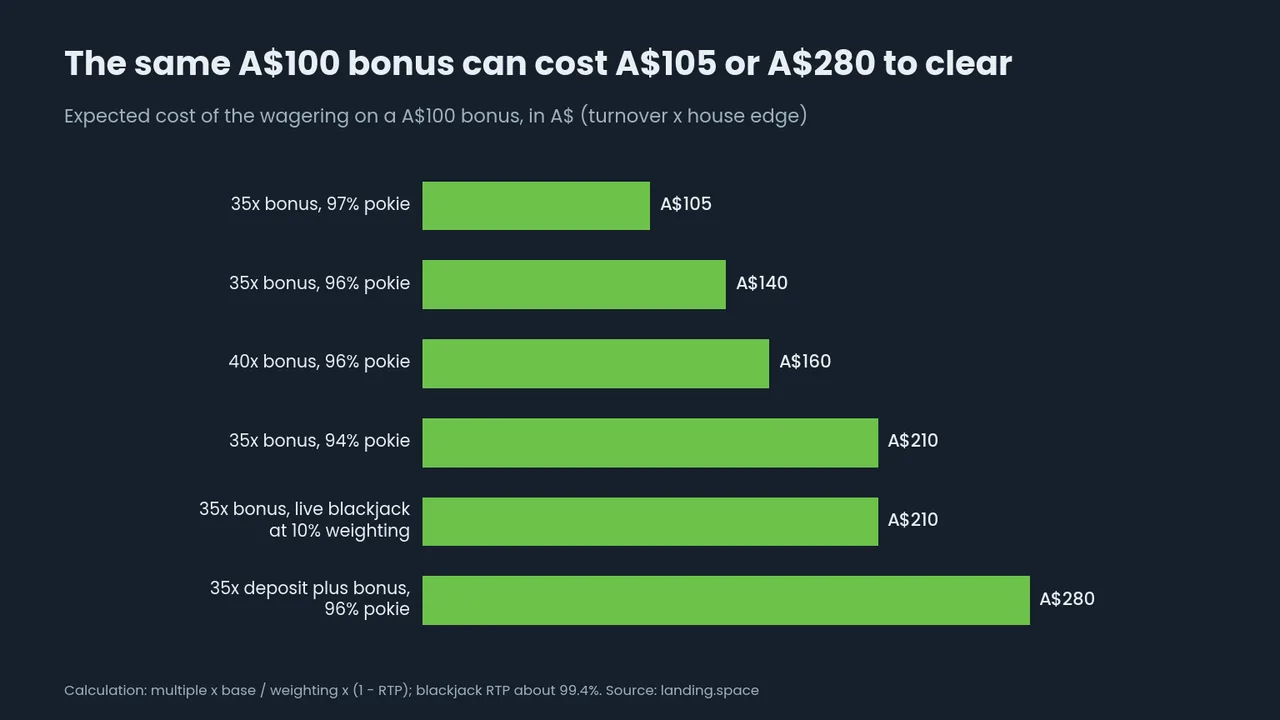
So what is a 40x wagering requirement? On a A$100 bonus it means A$4,000 of bets and about A$160 of expected cost at 96%. If the 40x applies to deposit plus bonus, it becomes A$8,000 and A$320, more than the whole A$200 balance. That is why the base matters more than the headline multiple. Low wagering requirements help in a predictable way: on a A$100 bonus at 96%, every 5x less saves A$20 of expected cost. The blackjack row shows the other trap: a game with a tiny house edge can still be expensive when it only counts 10% towards the target.
What the formula misses: 40,000 simulated players
The formula prices the full turnover, but a player who runs out of money stops wagering. To see what that does, we simulated 40,000 players for each case: a A$100 deposit and a A$100 bonus pooled into a A$200 balance, A$2 spins, stopping either when the wagering was done or when the balance fell below one A$2 bet. The game is the same declared medium-volatility pay-table model we use in our guide to how pokies work, scaled to each RTP; it is not a real game. We applied no max cashout, no max-bet rule and no time limit, so real offers can only be tighter.
| Wagering on the A$100 bonus | Finished the wagering | Average cash left | Median cash left | Average for those who finished | Formula: A$200 minus expected cost |
|---|---|---|---|---|---|
| 20x, 96% RTP | 30.2% | A$151 | A$0 | A$499 | A$120 |
| 35x, 94% RTP | 14.1% | A$108 | A$0 | A$769 | minus A$10 |
| 35x, 96% RTP | 17.6% | A$130 | A$0 | A$741 | A$60 |
| 35x, 97% RTP | 19.8% | A$147 | A$0 | A$744 | A$95 |
| 50x, 96% RTP | 13.0% | A$124 | A$0 | A$952 | A$0 |
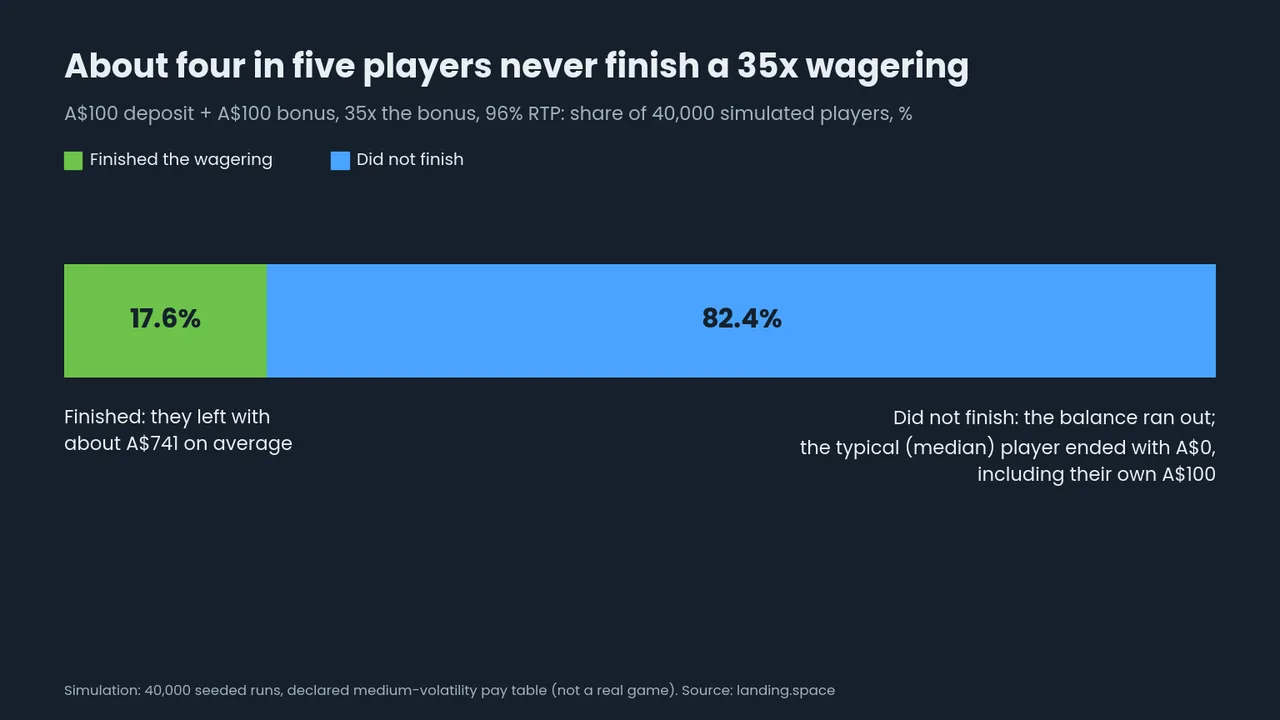
Two things happen at once. First, the average is kinder than the formula: at 35x and 96% the average player lost about A$70 of the A$200, not A$140, because a bust ends the wagering and nobody can lose more than the balance they hold. The 94% row makes the point sharply, since the formula there asks for more than the whole balance. Second, the average hides a split outcome. Four in five players finished with nothing, including their own A$100, and the minority who got through left with about A$740 on average. A bonus under wagering behaves less like a discount and more like a ticket with roughly a one-in-six chance of paying.
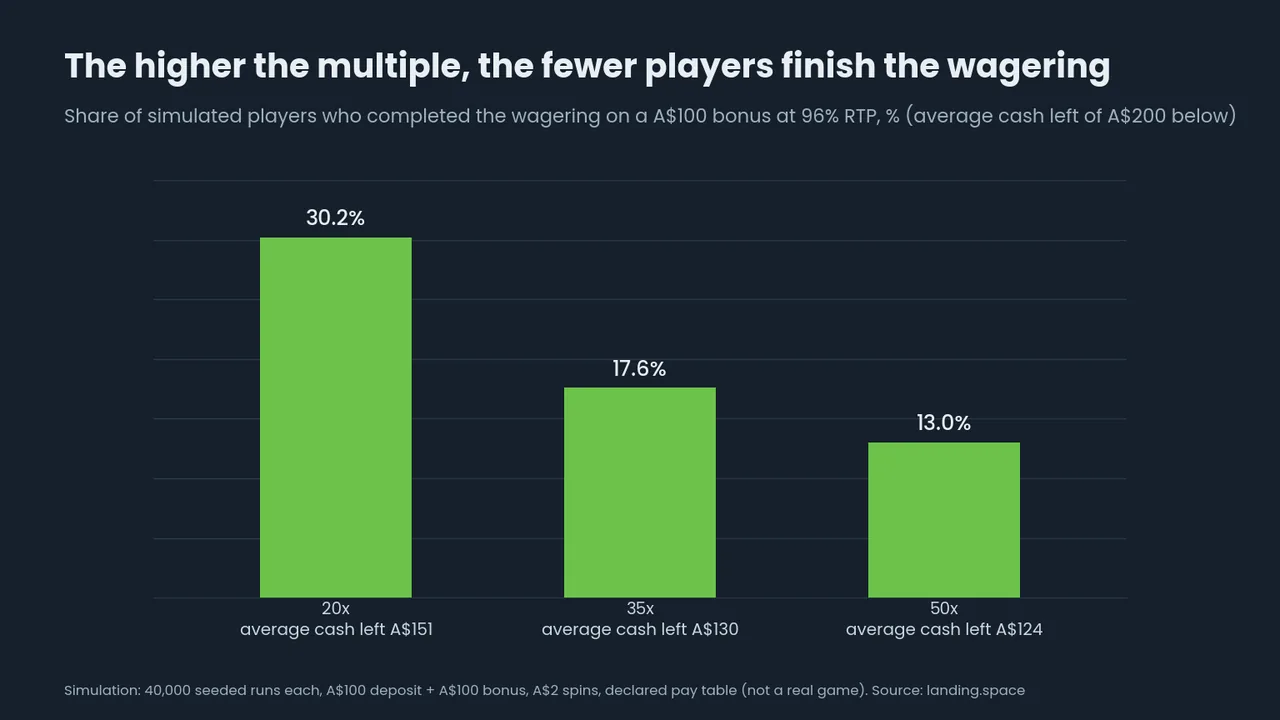
The multiple changes the odds of that ticket more than the average. Going from 20x to 50x cuts the completion rate from 30.2% to 13.0%, while the average cash left only drops from A$151 to A$124. Those who do finish a 50x bonus leave with more (about A$952 against A$499 at 20x), because only the players who hit a big win early can survive that much turnover. Low wagering requirements matter mainly because they make finishing more likely, not because they save a lot of money on paper.
The terms that change the maths
| Term | What it means | Why it matters |
|---|---|---|
| Wagering base | The multiple applies to the bonus, or to deposit plus bonus | Deposit plus bonus doubles the turnover on a 100% match |
| Game weighting | The share of each bet that counts towards the target | Check the weighting list: a game that counts 10% needs ten times the betting |
| Max bet while wagering | A cap on the stake per spin or hand until the wagering is done | Going over it can void the bonus and the winnings from it |
| Max cashout | A ceiling on what you can withdraw from bonus winnings | It cuts into exactly the branch where the bonus pays; in our simulation, completers averaged A$741 |
| Time limit | Days allowed to finish the wagering | A$3,500 at A$2 is 1,750 spins; a short window pushes you to bet faster or bigger |
| Sticky bonus | The bonus amount itself can never be withdrawn and is removed at cashout | Only winnings above it are yours, so the real value is lower than the headline |
| Non-sticky bonus | Your own cash is played first and the bonus only starts when it is gone | If you win early on your own money, you can usually withdraw and give up the bonus |
| No-wager offer | Winnings from the bonus or free spins are paid as cash straight away | The limits move elsewhere: check the spin value, the max cashout and the expiry |
| No-deposit bonus | Credit or spins given without a deposit | Check its own wagering, max cashout and verification rules before playing |
These definitions are general. Each casino words its terms differently, and we did not review any specific operator's bonus terms for this page. "No deposit bonus no wagering requirements" and "no wagering free spins" are both searches for offers where the wagering line is empty; when it is, the value depends on the other rows in this table, and on how much each spin is worth. The same goes for "casino bonus no wagering requirements": a small cash bonus with no wagering can be worth more on average than a large one at 50x.
Bonuses from offshore casinos: who checks the terms
Online casino bonuses offered to Australians come from offshore sites, because the Interactive Gambling Act does not allow online casino services to be offered to people in Australia, a rule aimed at the companies that offer or advertise them. That means no Australian regulator reviews those bonus terms, and the ACMA notes that regulators cannot help if winnings are withheld. Before accepting a bonus, save a copy of the terms as they stood on the day, and check the rules that apply to you. When we compare bonuses on our best online casinos Australia page and on new online casinos, the wagering base, the multiple and the caps are what we look at first, and the games you choose to clear a bonus with are covered in our online pokies guide.
Frequently asked questions
What does 35x wagering mean?
Are no-wagering bonuses better?
Can I play blackjack or roulette to clear a bonus?
What happens if I withdraw before finishing the wagering?
Is a 20x bonus worth taking?
Do I pay tax on bonus winnings in Australia?
Read next
18+ only. General information, not legal, tax or financial advice. Simulation results use a declared pay-table model, not real games, and real bonus terms vary by casino.