
Roulette strategy: what the Martingale really does
No roulette strategy beats the wheel: every bet on a single-zero wheel carries the same 2.70% house edge, whatever order you place them in. In our simulation of 200,000 Martingale sessions (A$5 on red, A$500 bankroll, stop at +A$50), 83.1% reached the target, but the other 16.9% lost about A$293 each, so the average session ended about A$8 down. The one choice that lowers the cost is the wheel: single zero at 2.70% rather than double zero at 5.26%.
Search for a roulette strategy and most of what comes back is some form of the Martingale: bet on red, double after every loss, go back to the starting bet after a win. It feels unbeatable because it usually works. We put a number on "usually" and on what happens the rest of the time, using a fixed, declared model instead of anecdotes: A$5 base bet on red, a A$500 bankroll, a A$1,000 table maximum, and a session that ends either at A$50 profit or the moment the next doubled bet cannot be covered. The result is the pattern every progression shares: frequent small wins, rare large losses, and an average that stays below zero.
Martingale on a single-zero wheel: 200,000 sessions
| Martingale, A$5 on red, A$500 bankroll | Single zero (European) | Double zero (American) |
|---|---|---|
| Sessions that reached +A$50 | 83.1% | 80.7% |
| Sessions stopped because the next bet could not be covered | 16.9% | 19.3% |
| Average result of a stopped session | about -A$293 | about -A$293 |
| Average result across all sessions | -A$8.07 | -A$16.20 |
| Average session length | 18.6 spins | 18.8 spins |
The doubling ladder, step by step
- Spin 1: bet A$5. A win ends the cycle at +A$5.
- After 1 loss: A$5 down, next bet A$10.
- After 2 losses: A$15 down, next bet A$20.
- After 3 losses: A$35 down, next bet A$40.
- After 4 losses: A$75 down, next bet A$80.
- After 5 losses: A$155 down, next bet A$160.
- After 6 losses: A$315 down, next bet A$320. From a fresh A$500 bankroll only A$185 is left, so the session is over.
- After 7 losses: A$635 down, next bet A$640. After 8: A$1,275 down, and the ninth bet of A$1,280 is above the A$1,000 table maximum whatever your bankroll.
This ladder works as a Martingale calculator for any base bet: multiply the figures by your stake divided by A$5. Every completed cycle wins exactly one base bet, A$5, and it takes about ten of those to reach A$50. Six losses in a row starting from any given spin has a probability of (19/37) to the power of 6, about 1.83%, where "loss" means black or the zero. That sounds rare. It is rare per attempt, and a session makes many attempts.
The table above shows how the two sides balance. Most sessions end quickly and pleasantly, with ten small wins in about 19 spins. About one in six ends with a run that takes nearly the whole bankroll. The average stopped session loses about A$293 rather than the full A$315 because some of the target had usually been banked before the bad run arrived. Put together, the average session ends A$8.07 down on the single-zero wheel, which matches the 2.70% edge applied to about A$300 of total bets. The system does not dodge the edge; it runs a lot of money through it to chase A$50.
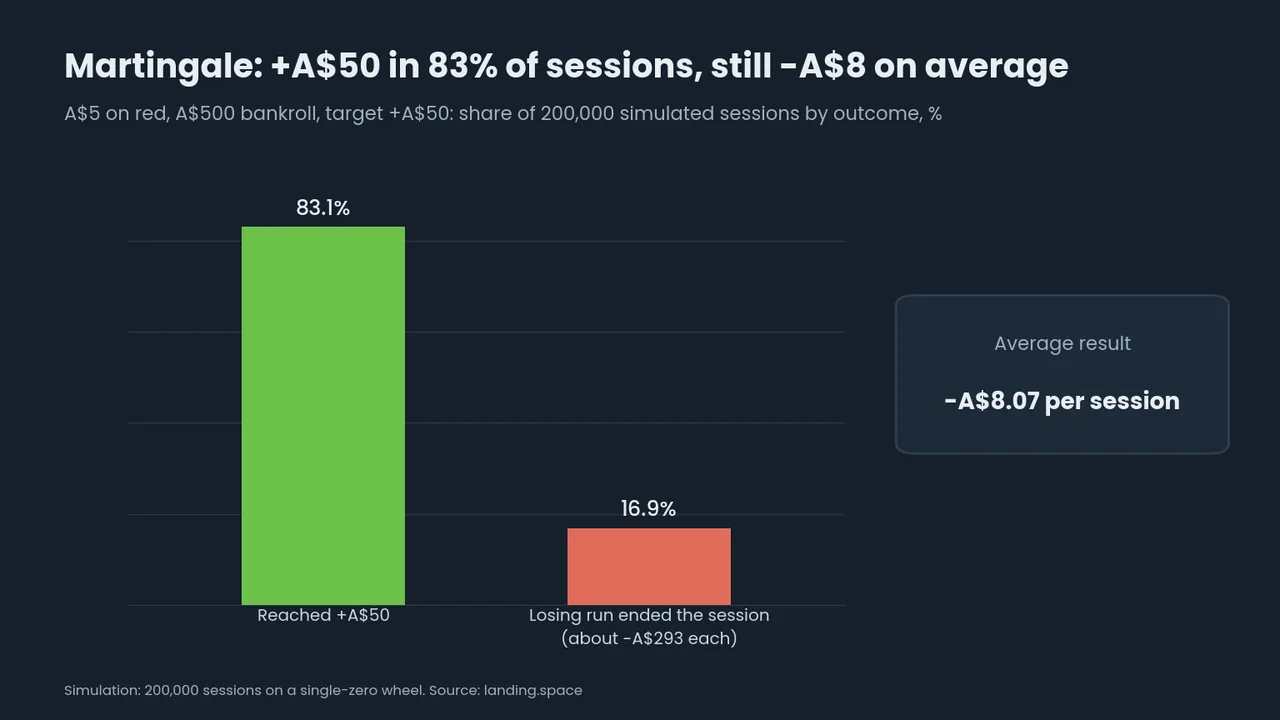
On a double-zero wheel the same plan reaches its target slightly less often, 80.7% of the time, and the average session loses A$16.20, roughly double. The ladder is identical; only the extra green pocket changed.
The gentler D'Alembert system, which adds A$5 to the bet after a loss and takes A$5 off after a win, does not escape either. Under the same bankroll, target and stop rule (simulated for 100,000 sessions, with a 2,000-spin cap per session), it reached +A$50 in 85.8% of sessions, more often than the Martingale, but the average session lost A$19.51. Slower progressions survive longer, which means more spins and more money through the same 2.70%.
How often long losing runs turn up
Our calculation of losing streaks is exact rather than simulated: it tracks the current run of non-red results spin by spin. The results explain why the Martingale cannot be rescued with a bigger bankroll or a smaller base bet.
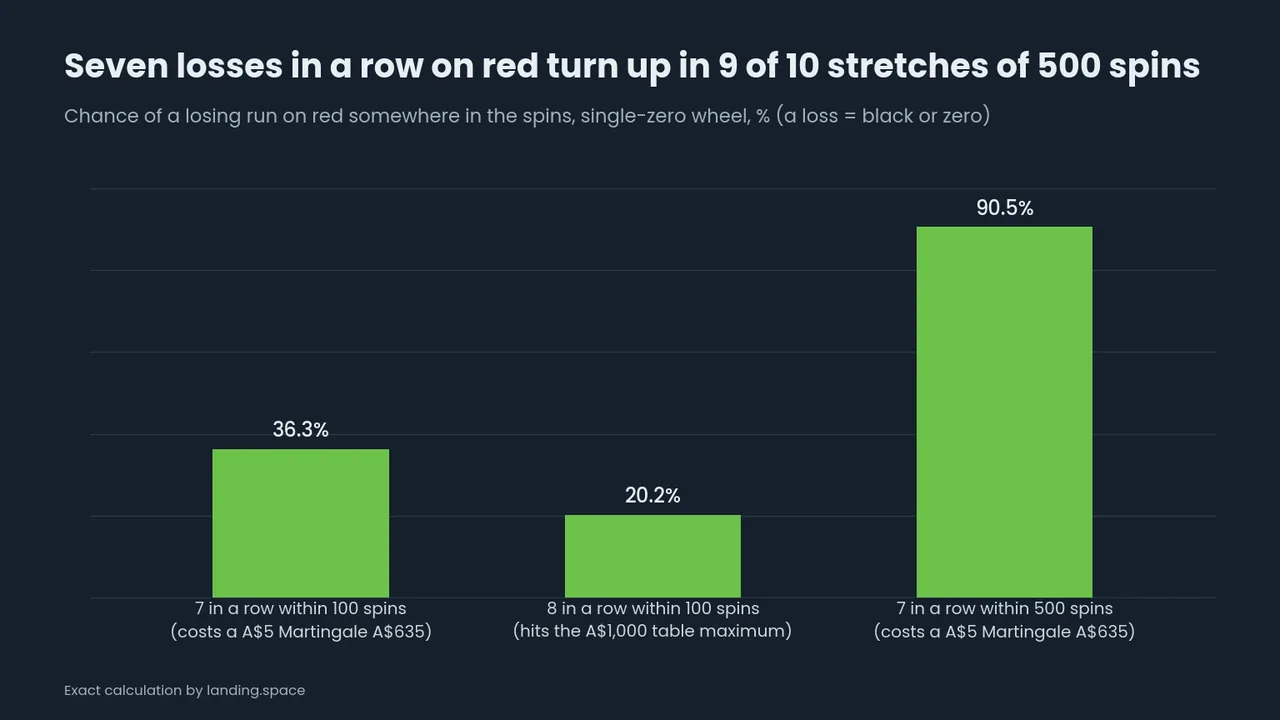
Seven losses in a row, which costs a A$5 Martingale player A$635, turns up somewhere in 100 spins more than a third of the time and in 500 spins nine times in ten. Eight in a row, the run that hits the A$1,000 table maximum, appears in one of every five 100-spin stretches. 500 spins is a few long sessions, not a lifetime of play. The table limit exists precisely so that no bankroll can double its way out of these runs.
Flat betting A$5 on red: the odds of being ahead
The honest comparison is the dullest system of all: the same A$5 on red every spin. We calculated the chance of finishing ahead exactly with the binomial distribution; the average result is simply stake times spins times 1/37.
| Spins | Chance of being ahead | Average result |
|---|---|---|
| 10 | 34.4% | -A$1.35 |
| 37 | 43.4% | -A$5.00 |
| 100 | 35.5% | -A$13.51 |
| 370 | 28.4% | -A$50.00 |
| 1,000 | 18.8% | -A$135.14 |
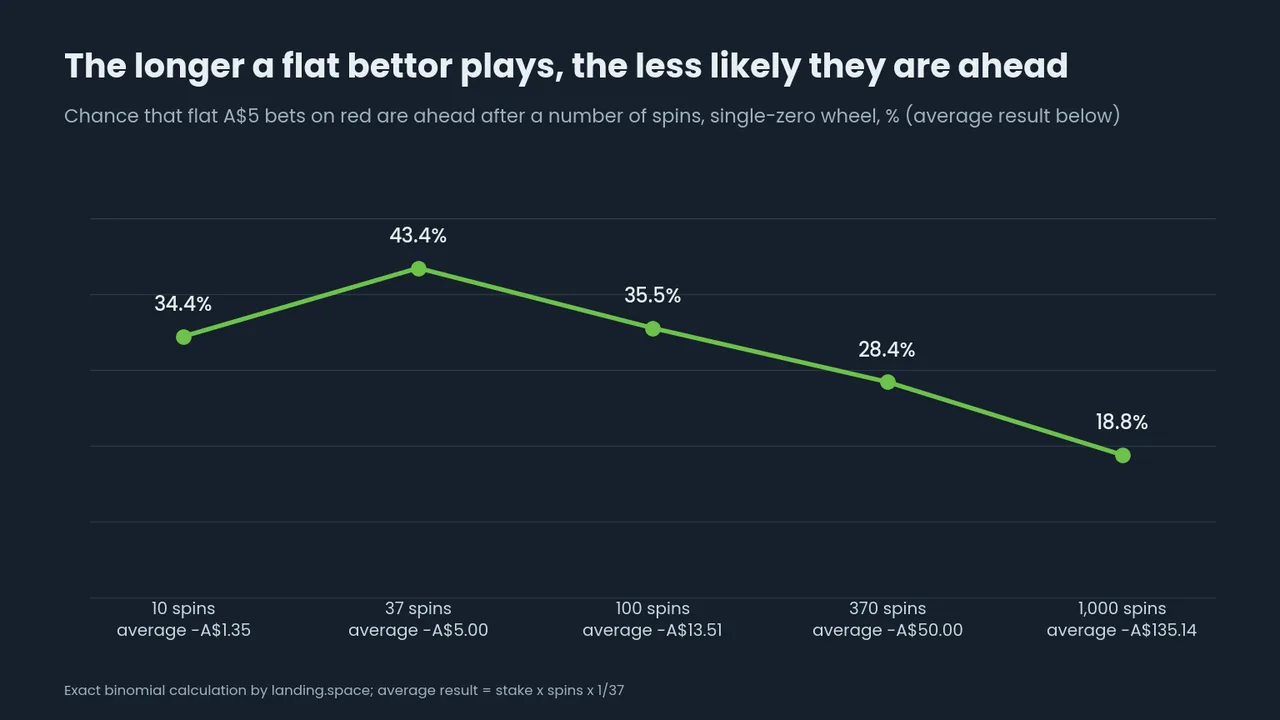
The 10-spin figure is lower than the 37-spin one only because an even number of spins allows a draw, five wins and five losses, which does not count as ahead. From there the curve falls steadily. After 370 spins the average loss is A$50, the same amount the Martingale player was chasing, and fewer than three players in ten are in front. Flat betting loses less per session than it seems to, but it never pretends to be a way to win.
Roulette strategy chart: every bet, same edge
On a single-zero wheel each payout is set a little below the true odds, by the same margin. A straight-up bet covers one number of 37 and pays 35 to 1, when fair odds would be 36 to 1. The result is identical for every bet on the layout: you get back 36/37 of what you stake over time, a return of 97.30% and an edge of 2.70%.
| Bet | Pays | Numbers covered | Chance to win (single zero) | House edge (single zero) | House edge (double zero) |
|---|---|---|---|---|---|
| Straight up | 35:1 | 1 | 2.70% | 2.70% | 5.26% |
| Split | 17:1 | 2 | 5.41% | 2.70% | 5.26% |
| Street | 11:1 | 3 | 8.11% | 2.70% | 5.26% |
| Corner | 8:1 | 4 | 10.81% | 2.70% | 5.26% |
| Six line | 5:1 | 6 | 16.22% | 2.70% | 5.26% |
| Column or dozen | 2:1 | 12 | 32.43% | 2.70% | 5.26% |
| Red/black, odd/even, 1-18/19-36 | 1:1 | 18 | 48.65% | 2.70% | 5.26% |
| Top line 0, 00, 1, 2, 3 (double zero only) | 6:1 | 5 | 13.16% (of 38) | not offered | 7.89% |
So "the roulette strategy with the best odds" is not a bet, it is a wheel. The choice of bet changes how often you win and how big the wins are, never what you lose on average. The choice of wheel roughly halves that loss: A$10 a spin for 100 spins costs A$27.03 on average on a single-zero wheel and A$52.63 on a double-zero wheel. The five-number top line on American tables is the one bet that is worse than the rest, at 7.89%.
If you play online, check the game info panel before the first spin. It shows the RTP, which should read about 97.3% for a single-zero game and about 94.7% for a double-zero game. Where a lobby offers both versions, at the sites in our overview of the best online casinos in Australia or in the crypto casinos guide alike, the names can look similar; we did not check lobbies game by game, so the info panel is what counts.
Fibonacci, betting thirds and other patterns
The Fibonacci system raises the bet along the sequence 1, 1, 2, 3, 5, 8, 13 units after each loss and steps back two places after a win. We did not simulate it separately, and there is no need to: it is a slower Martingale, with smaller jumps and longer recovery, and like the D'Alembert above it trades a lower chance of a big loss for more spins at 2.70%. Labouchere, Paroli and reverse Martingale reshape the same distribution in other directions.
"Betting thirds" usually means covering two dozens or two columns at once. With A$5 on each of two dozens you win on 24 of 37 numbers, 64.86% of spins, for a net A$5, and lose A$10 on the other 13. That averages -A$0.27 a spin, exactly 2.70% of the A$10 staked. The tiers du cylindre call bet, the "third of the wheel", uses six split bets to cover 12 numbers and lands on the same 2.70%. Any pattern of chips, colour sequences or tracking of past numbers ends in the same place, because each spin is independent of the last.
What you can actually control at the wheel
If a roulette strategy that always wins existed, the table maximum would not be there. What is in your hands is the price of the entertainment: play a single-zero wheel, pick a stake where a losing session does not matter, and decide in advance how many spins or minutes you will play, because the average loss grows with every spin. Treat any profit target as a reason to stop, not as a promise the system will deliver.
On the legal side: under the Interactive Gambling Act, online casino games including roulette are services that companies must not offer or advertise to people in Australia, so the online wheels available to Australians run from offshore. That means missing protections, most practically that no Australian regulator can help you recover withheld winnings and that a blocked site can leave you unable to reach your account. Check the rules that apply to you.
Frequently asked questions
Is there a roulette strategy that always wins?
Does the Martingale work in the short term?
How much bankroll does a Martingale need?
Which roulette bet has the best odds?
Is European or American roulette better?
Can past results or hot numbers help?
Read next
18+ only. General information, not legal, tax or financial advice. Simulated and calculated results use the declared model on this page; any real session can end far above or below the averages. Free, confidential help: National Gambling Helpline 1800 858 858.