
How Pokies Work in Australia: The Maths and the Myths
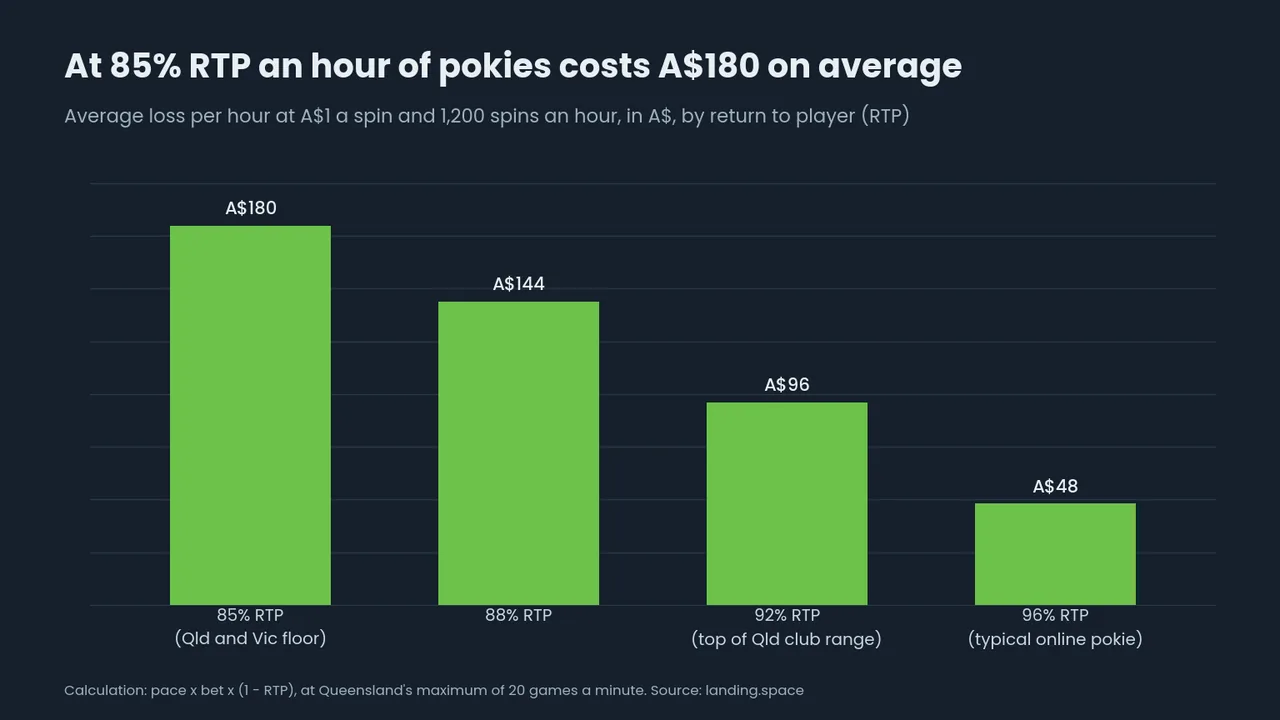
A pokie is a random number generator with a pay table set to hand back a fixed share of everything bet over the machine's life: 85% to 92% in Queensland clubs and hotels, and generally around 85% or more in Victoria. Every spin is independent, so there are no hot or due machines and no strategy that beats the edge; the only things you control are the RTP you pick, your bet and your time. At Queensland's maximum pace of 20 games a minute and A$1 a spin, an 85% machine costs about A$180 an hour on average, a 96% online pokie about A$48.
Pokies, the Australian name for poker machines, are designed to return less than you put in, and the clearest way to see what that means is to put a price on an hour. Queensland allows up to 20 games a minute, which is 1,200 spins an hour. At A$1 a spin (Gambling Help Queensland's own example is 10 lines x 10 credits on a 1c machine) that is A$1,200 through the machine every hour, and the average loss is one line of arithmetic: pace x bet x (1 - RTP). That gives about A$180 an hour at 85% RTP, the floor in Queensland and Victoria, A$96 at 92%, the top of the Queensland club and hotel range, and A$48 at 96%, the figure we use for a typical online pokie. Everything below, from how long a bankroll lasts to the jackpot odds and the myths, follows from that line.

The price of an hour: average loss by RTP and bet
| Average loss per hour (1,200 spins) | A$0.50 a spin | A$1 a spin | A$2.50 a spin | A$5 a spin |
|---|---|---|---|---|
| 85% RTP (Qld and Vic minimum territory) | A$90 | A$180 | A$450 | A$900 |
| 88% RTP | A$72 | A$144 | A$360 | A$720 |
| 92% RTP (top of the Qld club and hotel range) | A$48 | A$96 | A$240 | A$480 |
| 96% RTP (our typical online pokie) | A$24 | A$48 | A$120 | A$240 |
How long A$100 lasts at A$1 a spin
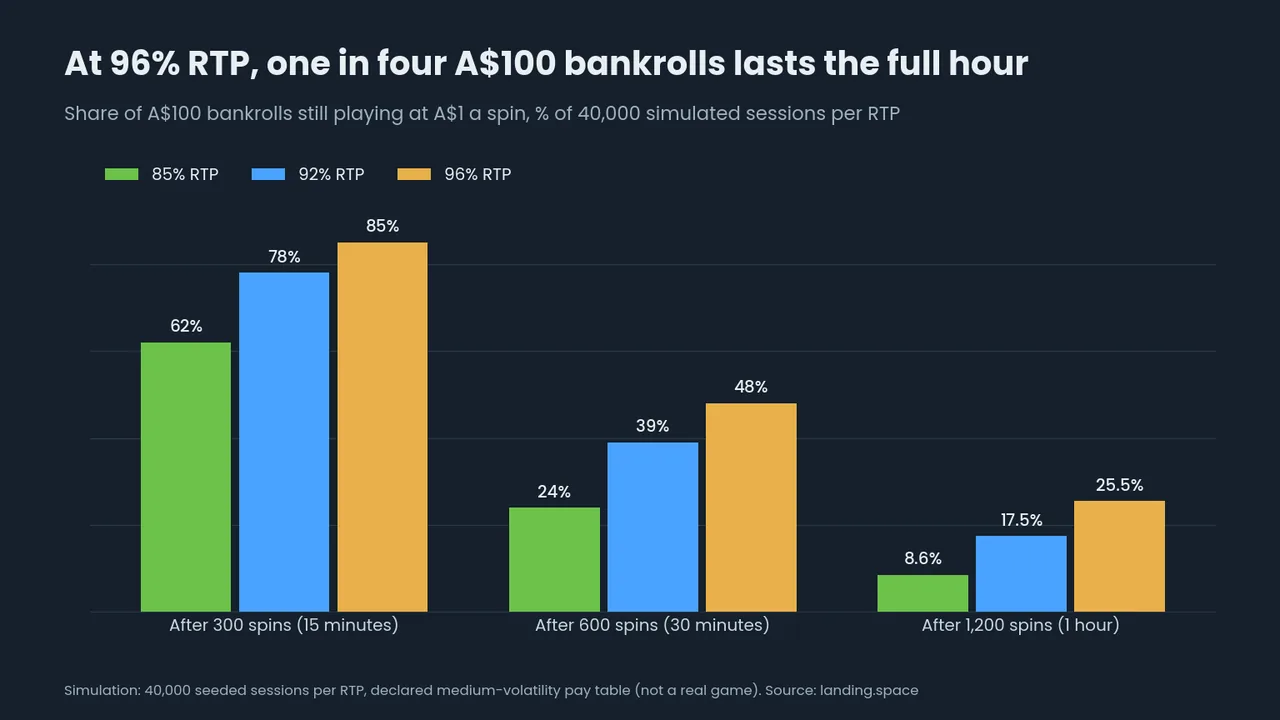
The hourly table is an average over very long play. A real session has a budget, and it ends when the budget runs out. To see how that plays out, we simulated 40,000 sessions at each of three RTPs: a A$100 bankroll, A$1 spins, stopping when the balance could no longer cover a spin or after 1,200 spins, one hour at the Queensland maximum pace. The pay table is a model we declared, not a real game: ten prize levels from half the bet up to 2,000 times the bet in a medium-volatility shape, with the probabilities scaled so the long-run return is exactly 85%, 92% or 96%. Real machines have different shapes, so read the results as the maths at work, not a forecast for any title.
| A$100, A$1 spins, up to 1,200 spins | 85% RTP | 92% RTP | 96% RTP |
|---|---|---|---|
| Median spins before the A$100 is gone | 356 (about 18 min) | 469 (about 23 min) | 583 (about 29 min) |
| Still playing after the full hour | 8.6% | 17.5% | 25.5% |
| Ahead of the A$100 after the hour | 6.0% | 12.0% | 17.4% |
| Average balance at the end | A$29 | A$52 | A$73 |
| Typical (median) balance at the end | under A$1 | under A$1 | under A$1 |
At 85% the expected hourly loss of A$180 is bigger than the whole A$100 budget, so the machine rarely needs the full hour: half of all sessions are over in about 18 minutes. Moving to 96% buys time rather than profit. The typical player still ends with nothing, but after roughly half an hour instead of a quarter, and one in four is still playing when the hour is up. Only about one session in six finishes ahead even at 96%, and one in seventeen at 85%.
The same model shows why a session can feel better than it is. Between 41% and 46% of spins pay something, but only 11% to 13% pay more than the A$1 you bet. A 50c win on a A$1 spin is a 50c loss, however it is presented on screen.
RTP is a lifetime figure, not a promise for tonight
The return to player on a venue pokie describes the machine, not your visit. Gambling Help Queensland explains that the return is achieved over the life of the machine, usually three to four years, and the Victorian Gambling and Casino Control Commission (VGCCC) makes the same point: RTP is measured over the machine's lifetime, not a single session. Over a few hundred spins, anything can happen; over millions, the percentage wins.
| Where | Return to player rule |
|---|---|
| Queensland clubs and hotels | Machines run RTP variations between 85% and 92% |
| Queensland casinos | 85% or higher |
| Queensland, any venue | The variation can be changed once a month; the same game name and denomination in a venue means the same variation |
| Victoria | Machines must meet a minimum RTP, generally around 85% or higher |
| New South Wales | We did not verify a minimum, so we do not quote one |
| Offshore online pokies | Set by the game and the site; no Australian regulator tests them |
So which pokie wins the most?
Over the long run, the one with the highest RTP, and nothing else. In a Queensland club or hotel the best you can hope for is the 92% end of the range, which still costs about A$96 an hour at A$1 a spin. The monthly variation rule means a machine that "paid well" last month may not even be running the same settings now. Online, a 96% game costs about a quarter of what an 85% one does per hour, but it is still a cost. If you still want to play online, our online pokies guide lists the games we looked at and how to find the RTP before you spin.
Pokie myths, checked against the regulators
| What people believe | What the regulators and help services say |
|---|---|
| A machine that has not paid for a while is due | Each spin is random and independent. There is no pattern, cycle or due win. |
| Some machines run hot | No machine is hot or cold; the next spin does not know the last one. |
| The venue knows when a machine will pay | It does not. The outcome comes from the random number generator. |
| A near miss means a win is close | Near misses mean nothing; two jackpot symbols and a blank is simply a loss. |
| Changing your bet size tricks the machine | The odds of each outcome do not change with the bet; only the cost per spin does. |
| Playing longer improves your chances | Longer play means more money through the machine and, on average, a bigger loss. |
| Pokies are rigged | They are random, but built to return less than is bet. The edge is the design, and it is published as the RTP. |
One rule is worth knowing precisely. In Queensland, a deterministic or mystery jackpot must go off before it reaches a set level. That tells you the jackpot will be paid; it does not tell you it will be paid to you, because every other spin feeding it is racing towards the same ceiling.
Top-prize odds next to Lotto, Keno and Powerball
Gambling Help Queensland puts the chance of a pokie's top prize, playing maximum lines, at up to 1 in 7 million a spin. For comparison it gives Gold Lotto division one at 1 in 8.1 million and Powerball at 1 in 134.5 million. We added a 10-spot Keno jackpot, which we calculated exactly: picking 10 numbers when 20 of 80 are drawn gives 1 in 8.9 million.
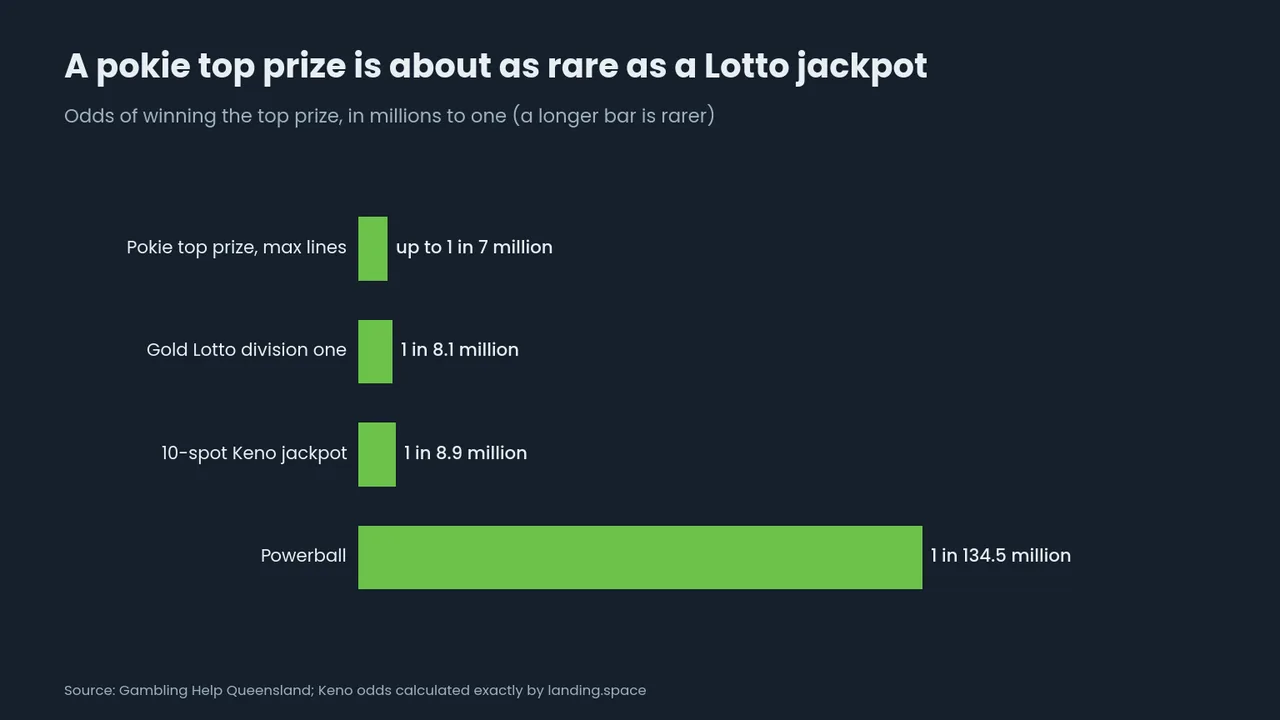
The difference is the speed. A Lotto ticket is one chance a draw; a pokie gives you 1,200 chances an hour, and charges for every one. Someone playing two hours a week at the Queensland maximum pace makes 124,800 spins a year, so at 1 in 7 million they would wait on average about 56 years for a single top prize (7,000,000 / 124,800), paying the hourly price all along. That is the honest answer to "how to win big on pokies".
Online pokies: random, but tested by whom?
Online pokies also run on random number generators, and the same maths applies: RTP x turnover decides the average, volatility decides the ride. What changes is the oversight. Australian venue machines sit inside state rules on RTP and jackpots. Online casino games cannot legally be offered to people in Australia, so the sites Australians use are offshore and no Australian regulator tests their games. The ACMA is plain about what that means in practice: regulators cannot help you if winnings are withheld, and a site can be blocked, leaving you unable to get into your account. We did not check any offshore game's certification for this guide. If you are comparing sites rather than games, our best online casinos Australia page covers how we assess them, and bonuses add a second layer of maths that we cost out in wagering requirements.
How to beat the pokies, the honest version
Nobody beats a pokie over time; that is what the RTP guarantees. What you can change is how much a session costs and how long it lasts. These are the only pokies tips the maths supports:
- Price your session before you start. Pace x bet x (1 - RTP): at A$1 a spin and 85%, budget A$180 an hour, not A$100.
- Pick the highest RTP you can find. It is the only setting that lowers the average cost; 96% costs about a quarter of 85% per spin.
- Lower the bet, not the odds. Halving the bet halves the hourly cost. Raising it after losses only speeds things up.
- Set a time and money limit and use the tools. The VGCCC points Victorians to YourPlay for setting limits on venue pokies; online, a timer on your phone is a start.
- Treat anything left as luck, not skill. Only 6% to 17% of our simulated hours ended ahead.
For comparison, a blackjack game with basic strategy returns far more of each bet than the pokies above, as our blackjack strategy guide shows. The AIHW puts Australia's net gambling losses at A$31.5 billion in 2022-23, about A$1,527 per adult, and A$15.76 billion of that was on gaming machines. Victorians alone lost over A$3 billion on pokies in 2024-25.
Frequently asked questions
What does pokies mean in Australia?
Can you win on pokies?
What are the odds on pokies?
Is there a pokies strategy that works?
Do poker machines pay more at certain times?
What is the minimum RTP on pokies in NSW?
Read next
18+ only. General information, not legal, tax or financial advice. Session figures come from our own seeded simulation with a declared pay-table model, not from any real machine or game.