

Wild Casino
- 25 free spins a day for 10 days
- Bitcoin deposits from $10
- Live casino and cash tournaments
Welcome Bonus
250 Free Spins on a $10 Deposit

A no deposit bonus lets you play at an online casino without putting in your own money: a free chip, free spins or a code that unlocks either. The headline amount is the least important number on the card. We ran 100,000 simulated players on each of two slot models through a typical offer, and the number that decided what a bonus was worth was the max cashout, followed by the wagering requirement. This page lists the offers we have checked and shows how to read them.


Ad: we earn a commission if you sign up through this link. 21+ (18+ where state law allows). The casino's terms apply.
The cards above show each casino's current welcome offer, which needs a first deposit. When one of these casinos runs a no-deposit offer, it gets its own row here with the full terms: the wagering requirement, the maximum cashout, the time limit, the games allowed, whether you must verify your ID before withdrawing, the code if one is needed, and the date we checked it.
Expected loss is wagering times house edge. When it is well above the bonus, most players lose the balance before the wagering is done. Because a no-deposit bonus never risks your own money, the average value still stays above zero: it comes from the few players who finish. Our simulation below shows how much that is.
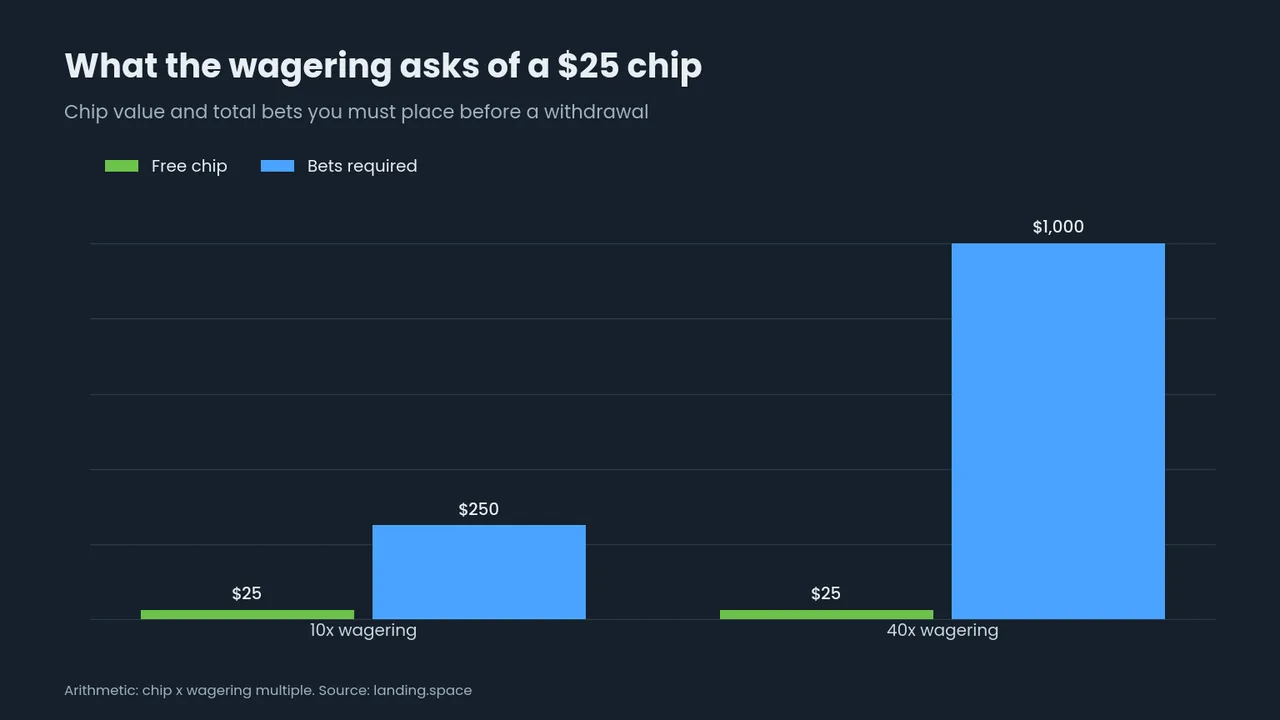
Take a common shape of offer: a $25 free chip with a 40x wagering requirement. You have to place $1,000 in bets before anything can be withdrawn, and whatever is left at the end is cut down to the max cashout. We simulated that chip with four different caps, 100,000 players each, on two slot models with a 96% return to player: one high-volatility, one low-volatility.
| $25 chip, 40x wagering | Average value, high volatility | Average value, low volatility | Players who hit the cap |
|---|---|---|---|
| Max cashout $50 | $2.19 | $6.03 | 4.2% / 9.5% |
| Max cashout $100 | $4.19 | $9.37 | 3.8% / 4.2% |
| Max cashout $200 | $7.82 | $10.99 | 3.4% / 0.3% |
| No max cashout | $18.18 | $11.09 | - |
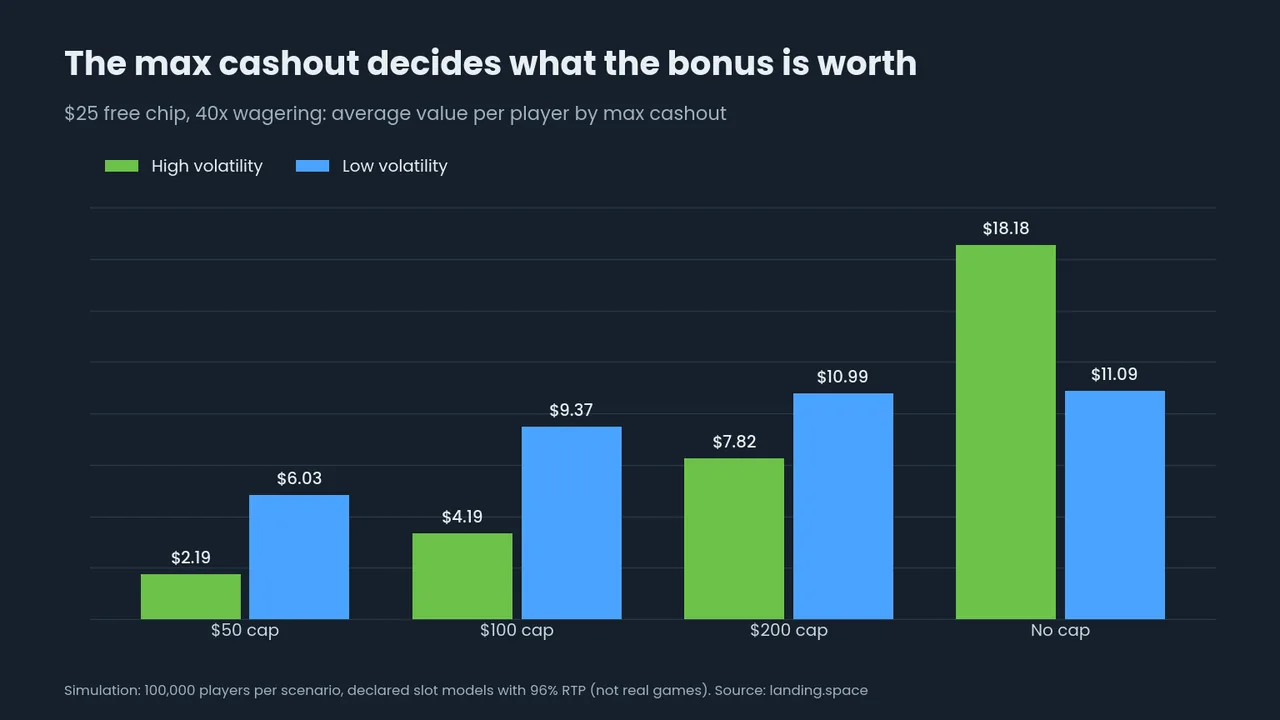
On the high-volatility model the same chip is worth $2.19 with a $50 cap and $18.18 with no cap. The wagering is identical; only the ceiling moved. The reason is simple: most players lose the chip before the wagering is done, and the few who finish are the ones who hit a big win on the way. A low cap takes that win away. On the low-volatility model the cap matters less, because fewer players run far above it, but a $50 cap still cuts the value by almost half.
So when two offers look alike, compare the max cashout first. A $25 chip with a $200 cap is a better offer than a $50 chip with a $50 cap on almost any terms. Our lists show the cap on every row for that reason.
Method: 100,000 simulated players per scenario, $0.50 bets, play until the wagering is done or the balance drops below one bet, cashout capped at the max cashout. The two slot models are declared models with 96% RTP, not real games; real slots differ, the direction of the result does not.
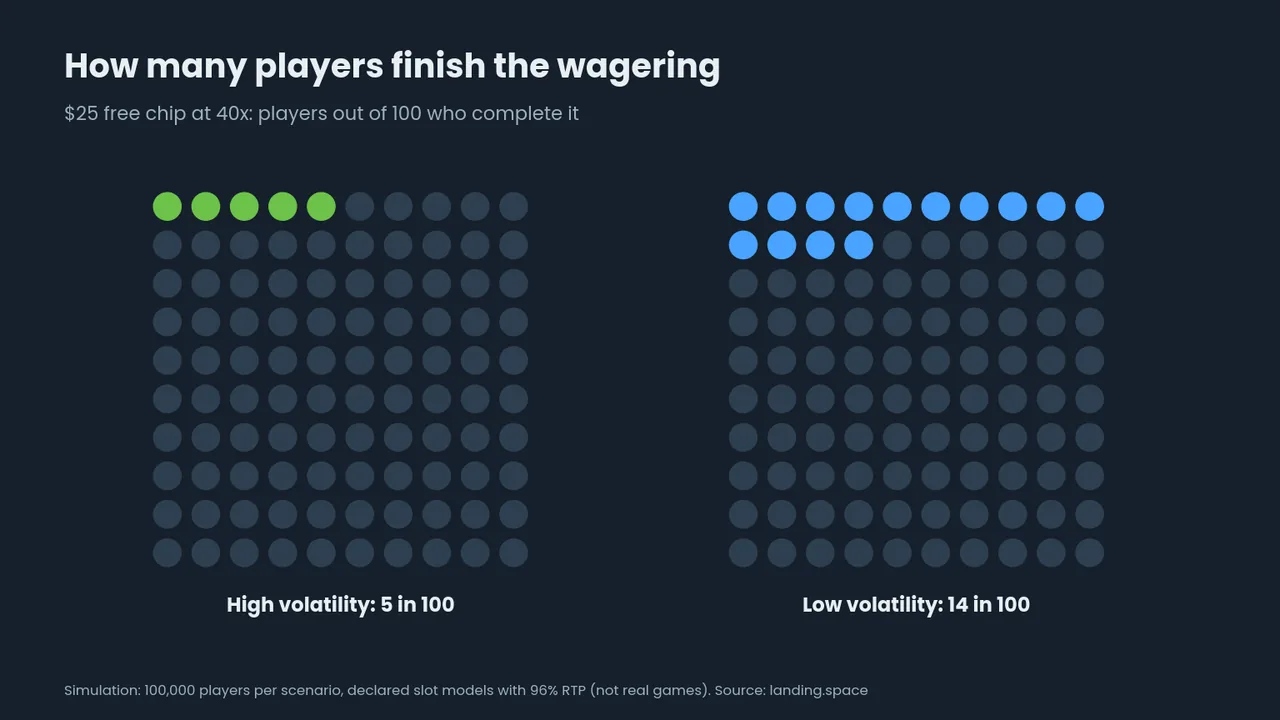
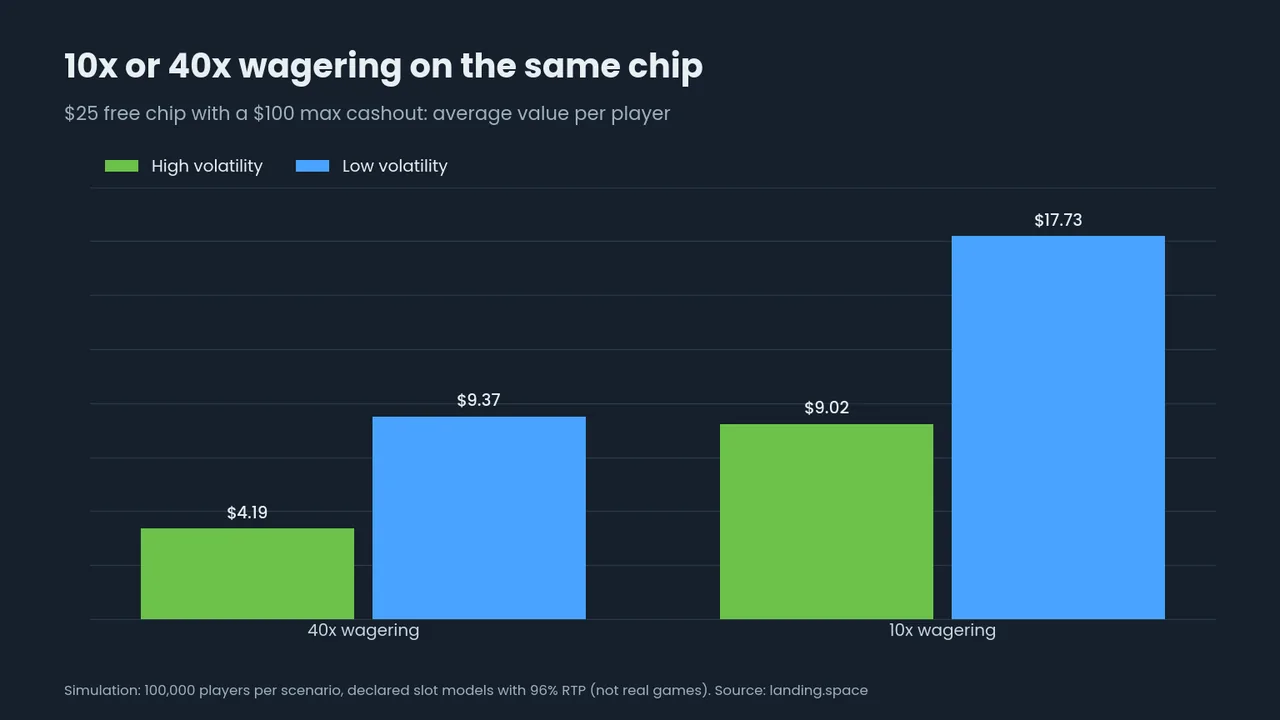
After the cap comes the wagering requirement. The same $25 chip with a $100 cap is worth $4.19 to $9.37 at 40x in our simulation and $9.02 to $17.73 at 10x. At 10x, 15 in 100 players finish on the high-volatility model and 41 in 100 on the low-volatility one; at 40x it is 5 and 14.
Wagering requirements on no-deposit offers are usually higher than on deposit bonuses, and some apply to the free-spin winnings rather than to a chip. How those two cases differ, and why a high multiple does not push the value all the way to zero, is explained in our guide on how no deposit bonuses work. If you want spins rather than cash, the free spins no deposit page does the same maths for spin value and wagering on winnings, and the free chip page compares $50, $100 and $200 chips.
Some no-deposit offers are credited automatically when you register. Others need a code, and a few need both a code and a confirmation step such as verifying your email or phone number. In our list every row says either "No code needed" or shows the code with a copy button. Three rules save most of the frustration:
"No deposit bonus codes USA" is one of the most searched phrases in this space, and many lists are padded with codes nobody has looked at in months. We only list a code we found in the casino's own terms or promotion page, and we remove it when it stops appearing there.
No-deposit offers are mostly aimed at new sign-ups, but existing players get them too: birthday chips, free spins in a newsletter, a code in the loyalty section or a reward after a quiet month. These change often and are usually personal, so a public list cannot cover them well. If an existing-player offer runs as a standing promotion, it goes in our list like any other, with the same terms shown. Treat an unexpected "free chip" email the same way you would treat a new offer: read the wagering and the max cashout before you accept it, because accepting can lock your balance to the bonus terms.
Winnings from a no deposit bonus are real money once the terms are met, which is why the searches for "no deposit bonus real money" and "instant withdrawal" are so common. Between the free chip and the money in your account there are usually four steps: finish the wagering, stay under the max cashout, pass the ID check and, at some casinos, make a first deposit before the withdrawal is released.
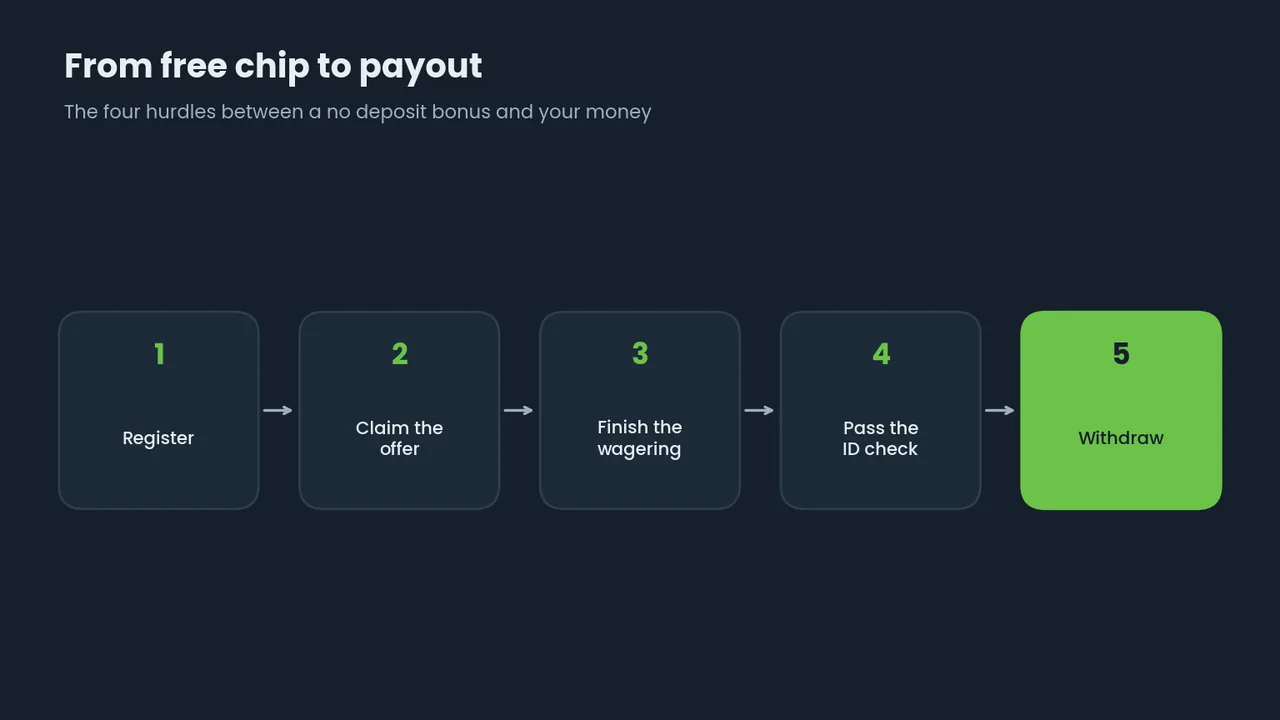
"Instant withdrawal" on a no-deposit page usually describes how fast a casino pays once everything is approved, not how fast the approval happens. Almost every casino checks your identity before the first withdrawal. We walk through that step, and what to do when a payout stalls, in cashing out no-deposit winnings. Players who prefer crypto payouts will find the crypto-specific terms on the crypto no deposit bonus page.
New casinos use no-deposit offers to get their first players, so the freshest offers are often at the youngest sites. That is not a reason to avoid them, but it is a reason to read the terms more carefully: check who licenses the casino, what the withdrawal limits are and whether a deposit is required before the first cashout. When we add a new casino to the list we write the date next to the offer, so "new" on this page means a date you can see, not a label.
Real-money online casino is licensed in seven states: New Jersey, Pennsylvania, Michigan, West Virginia, Delaware, Connecticut and Rhode Island. In those states, bonus terms are regulated. Pennsylvania requires operators to file each promotion's terms with the Gaming Control Board five days before it starts, and both Pennsylvania and Michigan rules say winnings may not be capped once the terms are met.
Outside those states, the no-deposit offers you see come from casinos that no US state licenses. The Michigan Gaming Control Board and the Pennsylvania Gaming Control Board both say they cannot help players with disputes at such sites. What that means in practice, state by state, and how to check the rules where you live is in our guide to online casino legal states. Check your own state's law before you play.
An offer goes on this page only after we have read its terms ourselves. For each one we record the amount or spins, the wagering requirement and what it applies to, the max cashout, the time limit, the games allowed, whether an ID check or deposit is required before the first withdrawal, the code if there is one and the date we checked. The "wager to cash out" line on each row is calculated from those terms. When an offer ends or its terms change, we remove or correct it and change the date.
What we do not do: promise wins, call an offer risk-free, or list a code we did not find at the source. We have not made a withdrawal from a no-deposit bonus at every listed casino; where we have, the row says so.
A no deposit bonus is built to keep you playing. If you notice you are chasing losses with the next free chip or spending more time than you meant to, stop and talk to someone. The national helpline 1-800-MY-RESET (1-800-697-3738) takes calls and texts around the clock; more help is on our gambling help page. 21+ in the licensed states.

Leads the review desk and edits every review. Over a decade testing real-money casinos end to end.

Runs the data team behind our Safety Index and fact-checks every review against primary sources.

Certified responsible-gambling professional who keeps our content fair, honest and player-first.