
Blackjack basic strategy chart for Aussie players
Basic strategy is the mathematically best play for every hand against every dealer card: stand on hard 12 to 16 against a 2 to 6 (but hit 12 against a 2 or 3), hit those hands against a 7 to ace, always split aces and 8s, and never take insurance. On standard online rules it brings the house edge down to 0.57%, about A$5.70 lost per 100 hands at A$10, but it cannot turn the edge in your favour. The rule that moves the numbers most is the payout: at 6:5 instead of 3:2 the edge more than triples to 1.92%.
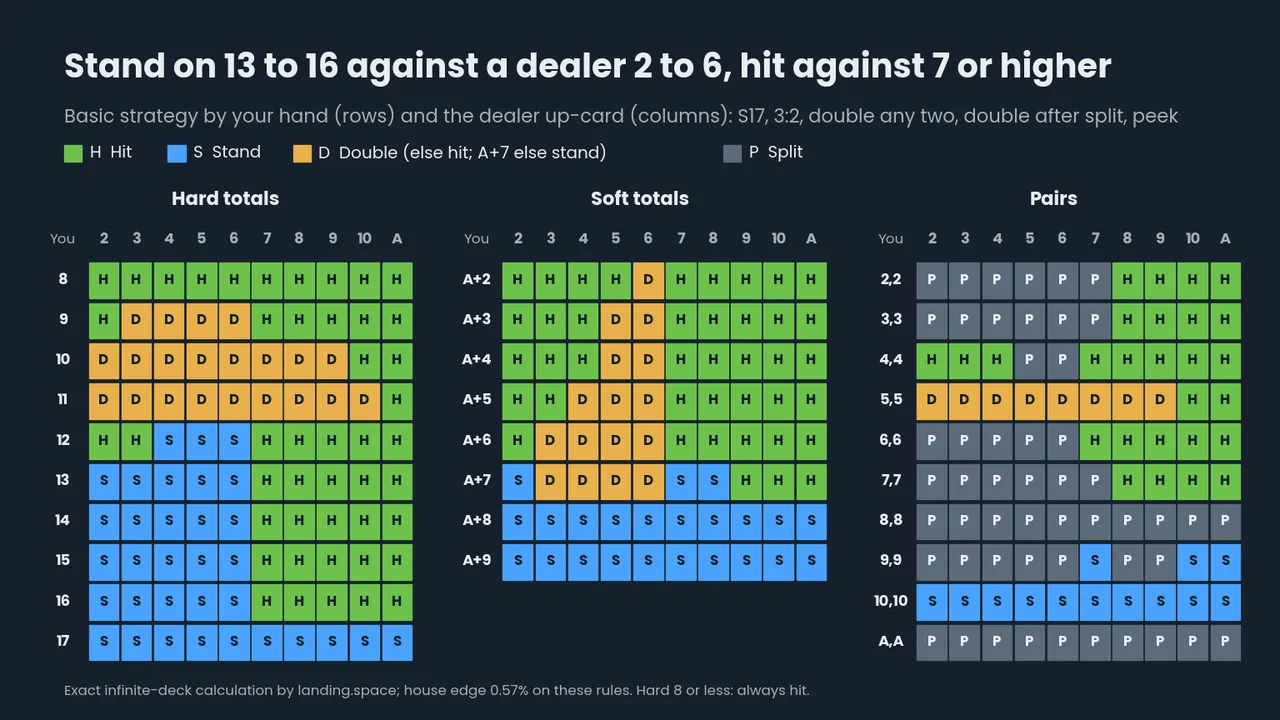
The three tables below are the complete basic strategy for the rules most online blackjack games use: dealer stands on soft 17, blackjack pays 3:2, you can double on any two cards and after a split, and the dealer checks for blackjack before you act. Find your hand in the left column and the dealer's face-up card along the top; the letter where they meet is the play. H hit, S stand, D double if allowed, otherwise hit (A+7: otherwise stand), P split. Read hard totals first unless you hold a pair or an ace that can still count as 11.
Hard totals chart: no ace, or an ace that must count as 1
| Your hand | 2 | 3 | 4 | 5 | 6 | 7 | 8 | 9 | 10 | A |
|---|---|---|---|---|---|---|---|---|---|---|
| 8 or less | H | H | H | H | H | H | H | H | H | H |
| 9 | H | D | D | D | D | H | H | H | H | H |
| 10 | D | D | D | D | D | D | D | D | H | H |
| 11 | D | D | D | D | D | D | D | D | D | H |
| 12 | H | H | S | S | S | H | H | H | H | H |
| 13 | S | S | S | S | S | H | H | H | H | H |
| 14 | S | S | S | S | S | H | H | H | H | H |
| 15 | S | S | S | S | S | H | H | H | H | H |
| 16 | S | S | S | S | S | H | H | H | H | H |
| 17 or more | S | S | S | S | S | S | S | S | S | S |
Soft hands chart: an ace still counting as 11
| Your hand | 2 | 3 | 4 | 5 | 6 | 7 | 8 | 9 | 10 | A |
|---|---|---|---|---|---|---|---|---|---|---|
| A+2 | H | H | H | H | D | H | H | H | H | H |
| A+3 | H | H | H | D | D | H | H | H | H | H |
| A+4 | H | H | H | D | D | H | H | H | H | H |
| A+5 | H | H | D | D | D | H | H | H | H | H |
| A+6 | H | D | D | D | D | H | H | H | H | H |
| A+7 | S | D | D | D | D | S | S | H | H | H |
| A+8 | S | S | S | S | S | S | S | S | S | S |
| A+9 | S | S | S | S | S | S | S | S | S | S |
A soft hand cannot bust with one more card, which is why the chart doubles soft 15 to soft 18 against a weak dealer card. A+7 (soft 18) is the hand most players get wrong: it stands against a 2, 7 or 8, doubles against 3 to 6 and hits against a 9, ten or ace. A+8 and A+9 always stand.
Back to the hard totals for a moment, because most hands you play land there. Two patterns cover most of that table: against a weak dealer card (2 to 6) you stop at 12 or 13 and let the dealer bust, and against a strong card (7 to ace) you keep drawing until 17. The exception people forget is 12 against a 2 or a 3, which is a hit. Hard 11 is doubled against everything except an ace; hard 10 against everything except a ten or an ace; hard 9 only against 3 to 6. Hard 16 against a ten is a hit on these rules because surrender is not part of the standard online game we modelled.
A note on close calls. Our chart hits A+2 against a 5 and A+4 against a 4, where many printed charts for six or eight decks double. The reason is the calculation method: we worked the chart out exactly for an infinite deck (every card equally likely on every draw), and these two cells sit right on the line. The difference in expected value between hitting and doubling is 0.74 cents per A$1 bet for A+2 against a 5 and under 0.1 cents for A+4 against a 4. If your printed card says double, you lose nothing worth counting by following it.
Pairs: when splitting pays
| Your hand | 2 | 3 | 4 | 5 | 6 | 7 | 8 | 9 | 10 | A |
|---|---|---|---|---|---|---|---|---|---|---|
| 2,2 | P | P | P | P | P | P | H | H | H | H |
| 3,3 | P | P | P | P | P | P | H | H | H | H |
| 4,4 | H | H | H | P | P | H | H | H | H | H |
| 5,5 | D | D | D | D | D | D | D | D | H | H |
| 6,6 | P | P | P | P | P | H | H | H | H | H |
| 7,7 | P | P | P | P | P | P | H | H | H | H |
| 8,8 | P | P | P | P | P | P | P | P | P | P |
| 9,9 | P | P | P | P | P | S | P | P | S | S |
| 10,10 | S | S | S | S | S | S | S | S | S | S |
| A,A | P | P | P | P | P | P | P | P | P | P |
The pair rules are the easiest to memorise. Always split aces and 8s: a pair of 8s is a hard 16, the worst hand in the game, while each 8 on its own starts a hand that can reach 18. Never split tens, because 20 already wins most of the time. A pair of 5s is not a pair at all for strategy purposes; play it as hard 10. The odd-looking row is 9,9: split against 2 to 6 and against 8 or 9, but stand against a 7 (your 18 already beats the dealer's likely 17) and against a ten or ace.
Why the chart works, and what it cannot do
Every cell in the chart is the play with the highest expected return for that exact situation. We calculated it rather than copying it: our script works through every two-card hand against every dealer up-card, with every possible draw for you and the dealer, and compares standing, hitting, doubling and splitting. The method is an exact infinite-deck calculation with one split per hand (resplits ignored), so the edges below are for that model; real shoes of four to eight decks give slightly different figures.
So does blackjack basic strategy work? It does what it claims: it is the best way to play each hand without tracking cards, and it cuts the house edge on standard rules to 0.57%. It does not make blackjack a winning game. A chart, a strategy card, a cheat sheet or a trainer app are all the same thing in different formats; a strategy calculator simply looks up the same cells. Online RNG blackjack reshuffles for every hand, so there is nothing to count beyond the chart itself.
The rule that costs most: a 6:5 payout
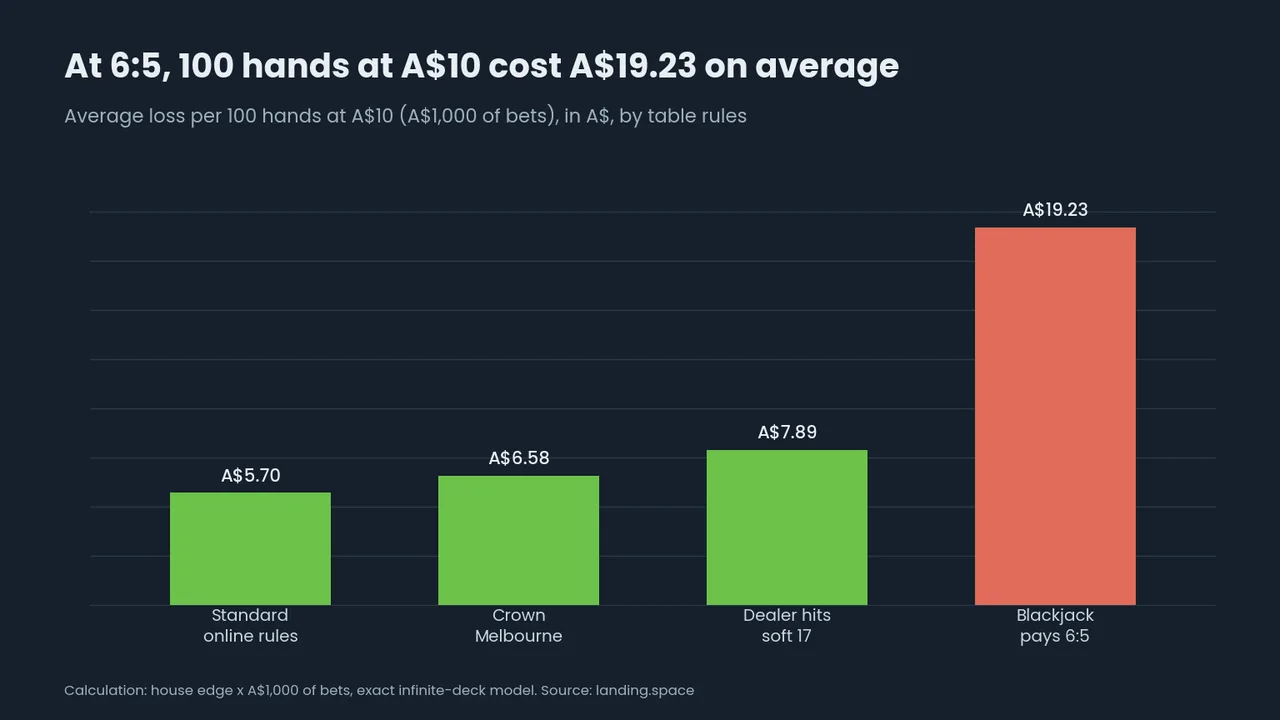
The chart assumes good rules. Change one of them and the house edge moves, sometimes by far more than any playing mistake you are likely to make. We ran the same exact calculation for each rule change on its own, with everything else kept at the standard online rules. The loss per 100 hands is the edge applied to A$1,000 of bets (100 hands at A$10).
| Rules | House edge with basic strategy | Average loss per 100 hands at A$10 |
|---|---|---|
| Standard online: stands soft 17, 3:2, double any two, double after split, dealer peeks | 0.57% | A$5.70 |
| Crown Melbourne rules v29.0 (details below) | 0.66% | A$6.58 |
| No peek, you lose doubles and splits to a dealer blackjack | 0.68% | A$6.82 |
| Dealer hits soft 17 | 0.79% | A$7.89 |
| Blackjack pays 6:5 | 1.92% | A$19.23 |
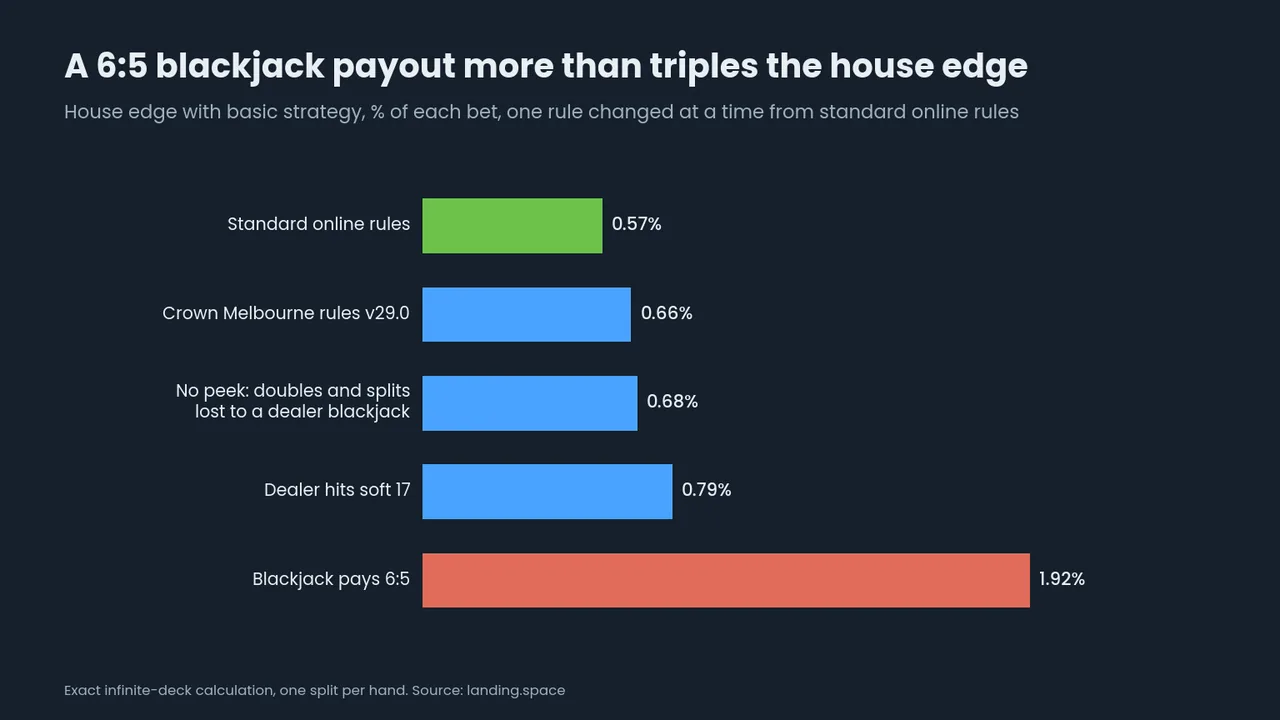
You get a blackjack about once every 21 hands. At 3:2 a A$10 blackjack pays A$15; at 6:5 it pays A$12. Losing A$3 on the best hand in the game, every time, triples the edge. No chart can repair that, so the payout line on the table felt is the first thing to read, ahead of any strategy.
Crown Melbourne's table: no hole card, but your doubles are safe
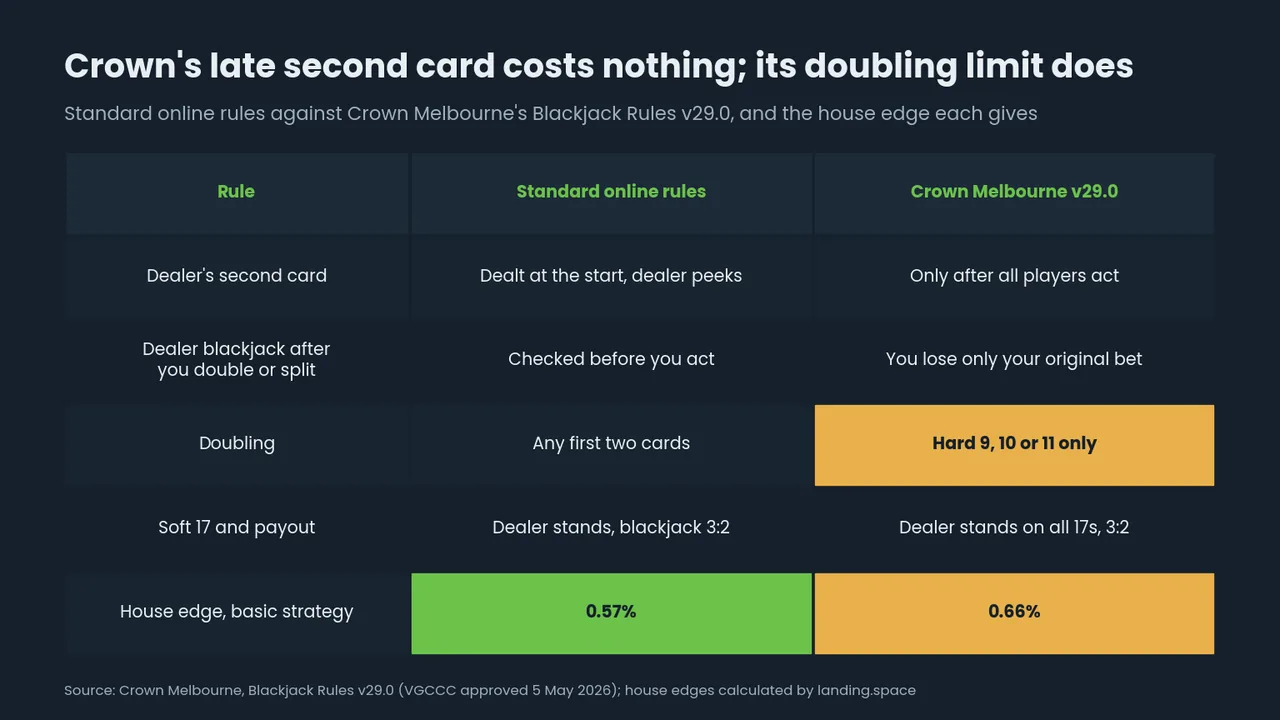
The one casino rule sheet we checked in Australia plays a different version of the game. Crown Melbourne's blackjack rules (version 29.0, approved by the VGCCC on 5 May 2026 and in force from 20 May 2026) use four to eight decks and give the dealer only one card at the start; the second card comes after all players have acted. Normally that "no hole card" style is bad news, because you can lose your doubles and splits to a dealer blackjack. Crown's rule sheet removes that risk: if the dealer makes blackjack after you have doubled or split, you lose only your original bet. For the maths that plays exactly like a dealer who peeks.
The dealer stands on all 17s, blackjack pays 3:2, insurance pays 2:1, you can split up to three hands (aces once, one card each) and split aces or tens cannot make a blackjack. The real restriction is doubling: only on a first two cards (or the first two of a split hand) totalling hard 9, 10 or 11. That lifts the edge from 0.57% to 0.66% in our calculation, and it changes 16 cells of the soft chart and none of the hard or pair cells:
- Soft doubles become hits: A+2 against 6, A+3 and A+4 against 5 and 6, A+5 against 4 to 6, A+6 against 3 to 6.
- A+7 against 3 to 6 becomes a stand, which is what the "otherwise stand" in the legend already tells you.
- Everything else is unchanged, including hard 9, 10 and 11 and every pair.
If you take the online chart to Crown and simply hit or stand where the table refuses a soft double, the cost is about 0.02% of your bets, because the table itself stops the only plays that differ. You do not need a second card.
Live blackjack online: same chart, if the rules match
Live dealer blackjack streamed from a studio uses a real shoe, but the strategy question is the same: the chart is right whenever the rules match the ones above. Before you sit down, open the rules panel of the table and check three lines: the blackjack payout, what the dealer does on soft 17 and whether the dealer peeks. If a live table has no peek and you lose everything you have doubled or split to a dealer blackjack, the edge in our calculation is 0.68%, and a few cells change: 11 against a ten, 8,8 against a ten or an ace, and A,A against an ace become hits. Where the rules panel says the dealer hits soft 17, the table still works; the edge is 0.79%.
A word on where Australians play online. Under the Interactive Gambling Act, online casino games such as blackjack are services that companies must not offer or advertise to people in Australia, so the online and live tables you find run from offshore. That leaves protections missing: no Australian regulator can help if winnings are withheld, and a site that gets blocked can lock you out of your account. Check the rules that apply to you. If you still play, our overview of the best online casinos in Australia notes the checks we make, and the new online casinos list covers younger sites. We did not audit blackjack rule sets at every operator, so the table rules panel is the thing to trust.
Before the first hand: a rules checklist
- Payout: 3:2 or walk away. A 6:5 table costs more than three times as much per hand.
- Soft 17: "stands on all 17s" is the better rule; "hits soft 17" adds about a fifth of a percent.
- Doubling: any two cards is standard online. Hard 9 to 11 only, as at Crown, means you hit the soft doubles.
- Peek or protection: the dealer should peek, or you should lose only your original bet to a dealer blackjack.
- Insurance and even money: skip both. With an ace showing, a ten comes 4 times in 13, and a 2:1 payout on that loses 7.69% of the insurance bet in our infinite-deck calculation.
Then set a stake that fits the session. At A$10 a hand on good rules the average cost is small, but the swings around it are much larger than the average in any single session, and the chart does nothing to stop a losing run. Decide your stop point before the first hand, not during a bad streak.
Frequently asked questions
Does blackjack basic strategy actually work?
What is the best blackjack strategy?
Is it allowed to use a strategy card while playing online?
Should I ever take insurance or even money?
How do I practise basic strategy?
Does basic strategy change with the number of decks?
Read next
18+ only. General information, not legal, tax or financial advice. House edges are long-run averages from an exact infinite-deck calculation on the stated rules; a single session can end far above or below them. Free, confidential help: National Gambling Helpline 1800 858 858.