
Gambling Help in Australia: Helpline, Blocks and Family
If gambling is costing you or someone close to you more than it should, call 1800 858 858. It is the National Gambling Helpline: free, professional, confidential and open 24/7, every day, and it is the same number Victoria's Gambler's Help and Queensland's Gambling Helpline publish. For debts, the Queensland service lists free financial counselling on 1800 007 007 (Monday to Friday, 8.30am to 4.30pm). To block licensed online betting in one step there is BetStop, which is free but does not cover online casino games.
You do not need to be sure you have a "gambling addiction" to ask for help, and you do not need to have hit bottom. People call because the betting has crept up, because money is missing, because they keep promising themselves this is the last time, or because they are worried about a partner, a parent or a mate. The good news is that in Australia the first step is the same wherever you live: one phone number, answered around the clock, at no cost. This page explains what that call looks like and what else helps, for the person who wants to stop and for the people around them.
One number for every state: 1800 858 858
- National: the ACMA lists 1800 858 858 as the National Gambling Helpline, free, professional and confidential, 24 hours a day, every day.
- Victoria: the VGCCC tells Victorians to "call Gambler's Help anytime on 1800 858 858", for counselling, help with finances, peer programs and First Nations support. Gambler's Help also runs a Youthline on 1800 262 376.
- Queensland: Gambling Help Qld publishes the same 1800 858 858 as its Gambling Helpline, open 24/7 to talk to a trained counsellor, get confidential support or crisis help, or book a counselling session.
- Online: the ACMA also points to Gambling Help Online for 24/7 chat and email, if typing is easier than talking.
- Elsewhere: we did not check the New South Wales or Western Australian service pages for this update, but the national line is the one number to remember whether you are in Sydney, Perth, Hobart or Darwin.
What happens when you call
According to Gambling Help Qld, the helpline is there for "anyone impacted by gambling", whether it is your own gambling or someone else's. On a call you can talk through what is happening, get crisis support if things feel urgent, and book ongoing counselling. That counselling, the main form of gambling addiction treatment these services offer, is free and can happen over the phone, by video call or face to face. The Queensland service says it is normal to need several sessions, and that counselling can continue for as long as you and your counsellor think it is useful. A first session is described as "very much like visiting a new doctor for the first time": some paperwork and a few questions, then a conversation about your situation and what you want to change. Counsellors are bound by confidentiality, so they cannot contact your family, friends or employer. Interpreters are available on request.
Why pokies come up in so many calls
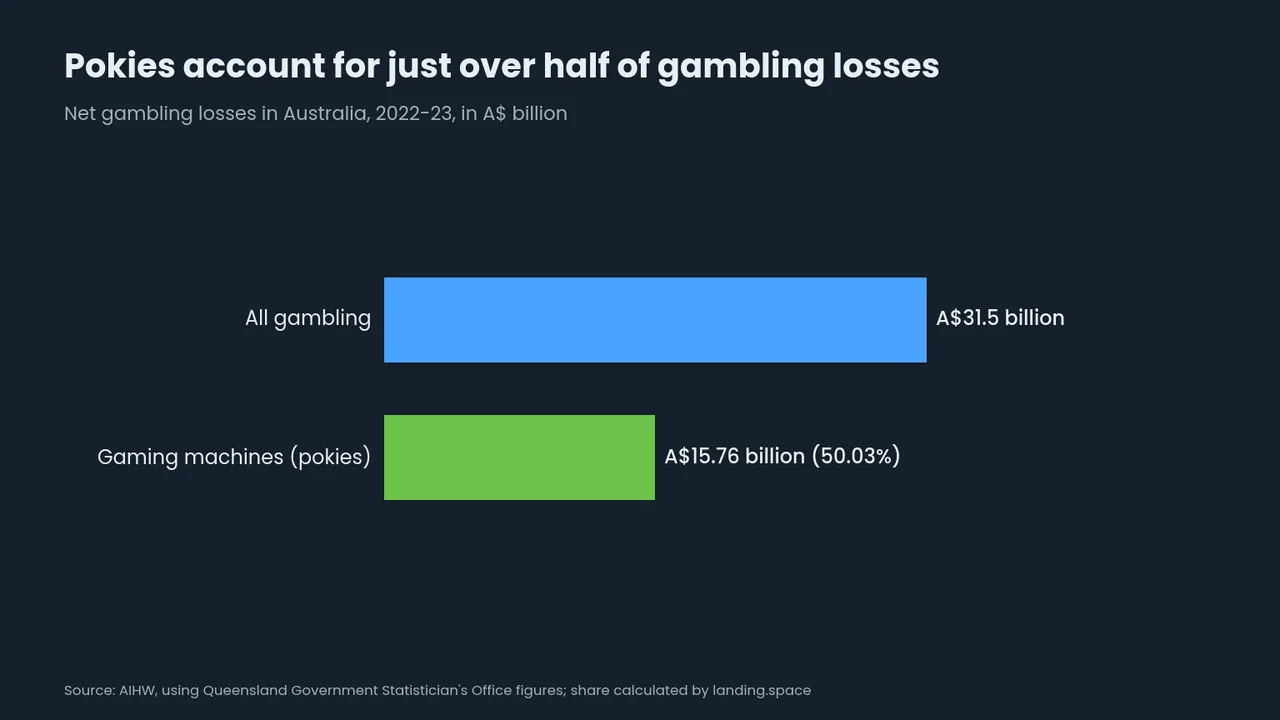
If you are trying to work out how to stop gambling on pokies, you are far from alone. The Australian Institute of Health and Welfare, using Queensland Government Statistician's Office figures, puts total net gambling losses in 2022-23 at A$31.5 billion, about A$1,527 per adult. Of that, A$15.76 billion was lost on gaming machines. Divide one by the other and pokies account for just over half of everything Australians lose on gambling (50.03%). In Victoria alone, the VGCCC says people lost over A$3 billion on pokies in 2024-25.
The VGCCC is also clear on how the machines work: each spin is random and independent, there is no pattern or cycle, and no machine is ever "due" to pay. The minimum return a Victorian machine must meet applies over its lifetime, not over your session. Knowing this does not make urges go away, but it takes the air out of the thought "one more go and it will come back".
Signs worth taking seriously
Gambling Help Qld describes gambling harm as gambling that negatively affects your finances, relationships, mental or physical health, job, studies or wellbeing. These are some of the signs it lists. They are not a diagnosis, and a counsellor is the right person to talk them through with, but if several feel familiar, that is reason enough to call:
- Borrowing money or taking out loans to gamble, or selling belongings.
- Gambling with money meant for rent, bills or food.
- Chasing losses by continuing to gamble, or seeing gambling as a way to fix money problems.
- Spending more time gambling or thinking about it, and losing interest in usual hobbies.
- Feeling restless, anxious, irritable or withdrawn, with strong reactions to wins and losses.
- Becoming secretive or defensive about gambling, or avoiding the topic.
- Difficulty concentrating at work or study, or using work time to check bets.
Putting barriers between you and the bet
Willpower works better with help. Australia has several ways to block yourself from gambling, and each covers something different:
| Tool | What it covers | What it does not cover |
|---|---|---|
| BetStop (national, free) | All Australian-licensed online and phone wagering providers in one step, from 3 months to lifetime | Online casino games, illegally provided services, venues |
| Queensland venue self-exclusion | The venues you name; ask the Customer Liaison Officer, or Gambling Help can help you do it remotely | Online betting (use BetStop for that) |
| Victorian venue self-exclusion | The venues you choose, for a minimum period, through programs for hotels, clubs and the casino | Online betting |
| Blocking software | Gambling sites on your own devices; the Queensland service lists programs such as GamBlock and Net Nanny | Other devices you can reach |
In Queensland, venue self-exclusion means filling in a self-exclusion notice (Form 3A) with a recent photo; the venue then gives you a self-exclusion order (Form 3B), and the exclusion takes effect straight away. You can only apply to cancel it after at least 12 months. BetStop is a separate register from these state and territory schemes, so you sign up to each one on its own. Be aware that BetStop does not reach online casinos, which are not licensed in Australia, so blocking software on your phone is a useful second layer.
Riding out an urge
Gambling Help Qld describes a trigger as something that sets off the thought of gambling, and an urge as the strong desire to act on it. Its practical answer is a three-step approach:
- Delay. Wait at least 15 minutes before acting. Urges often rise and fall like waves.
- Distract. Do something else: go for a walk, cook, or talk to someone.
- Decide. Once the urge has passed or eased, choose what to do next.
The same page suggests setting limits or taking a complete break, telling friends or family so you are not doing this alone, and avoiding your known triggers where you can. For many people that means deleting betting apps, not walking past the pub with the gaming room on the way home, and not carrying the card they gamble with.
Getting on top of the money
Debt is often the part that keeps people awake. Financial counselling is free, independent and unbiased, and counsellors help with managing debts and dealing with financial difficulty. The number the Queensland service lists is the National Debt Helpline, 1800 007 007, Monday to Friday 8.30am to 4.30pm; after hours it points back to 1800 858 858. Victoria's Gambler's Help also offers help with finances. A few steps are worth taking early, ideally with a counsellor: list what you owe and to whom, stop borrowing to cover losses, and consider handing day-to-day control of cash to someone you trust for a while.
Cutting down gambling ads
Betting ads are a common trigger, and the rules are changing. The Interactive Gambling Amendment (Gambling Reform) Bill 2026 passed on 19 August 2026, and most of it commences on 1 January 2027. It brings restrictions on gambling advertising on TV, radio, online and in venues, plus a global register for opting out of gambling ads. Until then, one thing already works: while you are on BetStop, licensed wagering providers must not send you marketing.
When it is your partner or someone in your family
Gambling help for partners and family is not an afterthought. The helpline and free counselling are open to anyone harmed by someone else's gambling, and you can call even if the person gambling is not ready to. A few practical ideas: pick a calm moment to talk, describe what you have noticed rather than labelling the person, and protect your own finances, for example by separating accounts. Look after yourself too, because living with someone else's gambling is exhausting.
Frequently asked questions
Is the gambling helpline really free and open all night?
Will my family or boss find out if I get counselling?
Can I get help for my husband, wife or partner's gambling?
Is there help with debts caused by gambling?
Does BetStop block online pokies and casino sites?
Is counselling a one-off session?
18+ only. General information, not legal, medical or financial advice. If gambling is affecting you or someone close to you, call the free 24/7 National Gambling Helpline on 1800 858 858; in an emergency call 000.