
Online Casino Legal States and No-Deposit Offers
Licensed online casinos, and with them licensed no-deposit bonuses, exist in only seven states: New Jersey, Pennsylvania, Michigan, West Virginia, Delaware, Connecticut and Rhode Island. Maine passed a law in January 2026 but has no live sites yet. Everywhere else, including Missouri and Minnesota, the no-deposit offers you see come from sites no US state licenses, and US regulators say they cannot help with disputes there. Players must be 21+ in the licensed states, and whether online casino is legal is decided by each state, so check your own state's law.
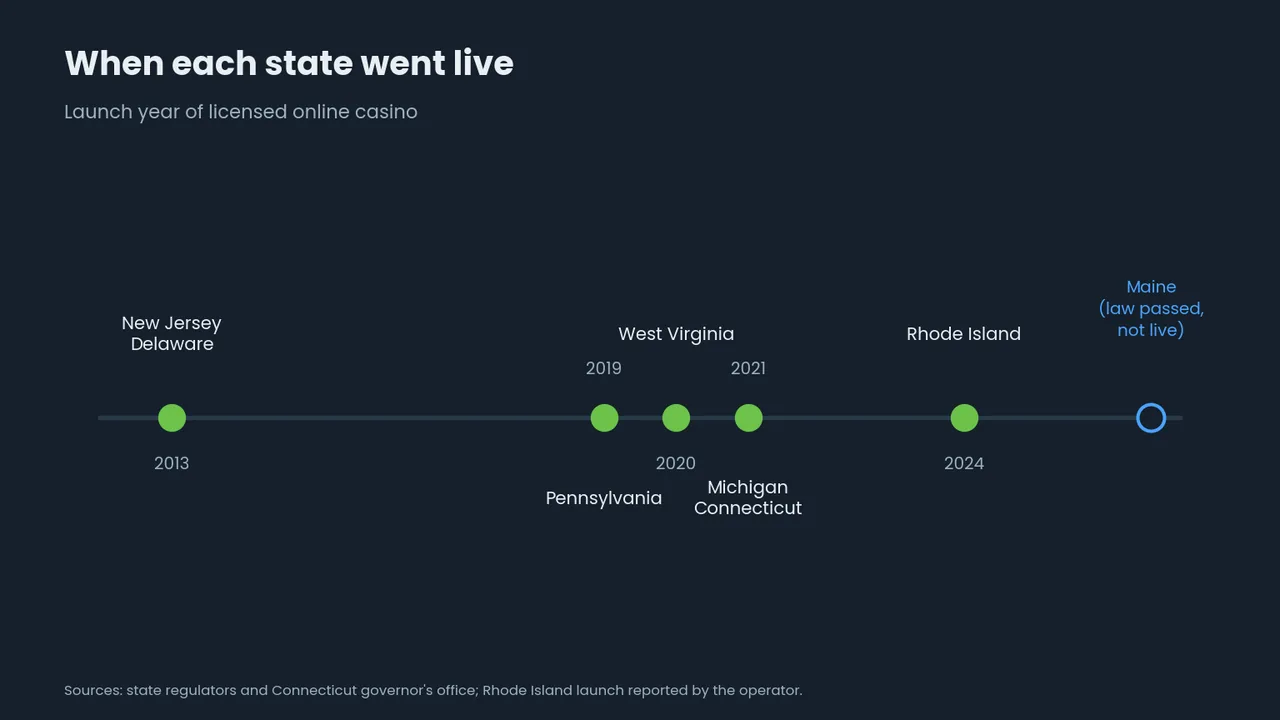
Whether online casino is legal is decided state by state, and in September 2026 the answer is yes in seven: New Jersey, Delaware, Pennsylvania, West Virginia, Michigan, Connecticut and Rhode Island. Those seven are also the only places where a no-deposit bonus comes from a casino a US regulator licenses, where the bonus terms have to meet state rules, and where a state agency will hear your complaint if a withdrawal goes wrong. Maine has passed a law but is not live yet. In the other 42 states, the no-deposit offers a player sees come from sites that no US state licenses, and the regulators in Michigan and Pennsylvania say plainly that they cannot help with problems there. The table shows who licenses what, and when each state went live.
| State | Regulator | Online casino live since |
|---|---|---|
| New Jersey | Division of Gaming Enforcement | 2013 |
| Delaware | Delaware Lottery | 2013 |
| Pennsylvania | Gaming Control Board | 2019 |
| West Virginia | West Virginia Lottery | 2020 |
| Michigan | Gaming Control Board | 2021 |
| Connecticut | Department of Consumer Protection, Gaming Division | Oct 2021 |
| Rhode Island | Rhode Island Lottery | 2024 |
| Maine | Law LD 1164 (became law Jan 2026) lets the Wabanaki Nations offer online casino | Not live yet |
Outside the seven: where the offers come from
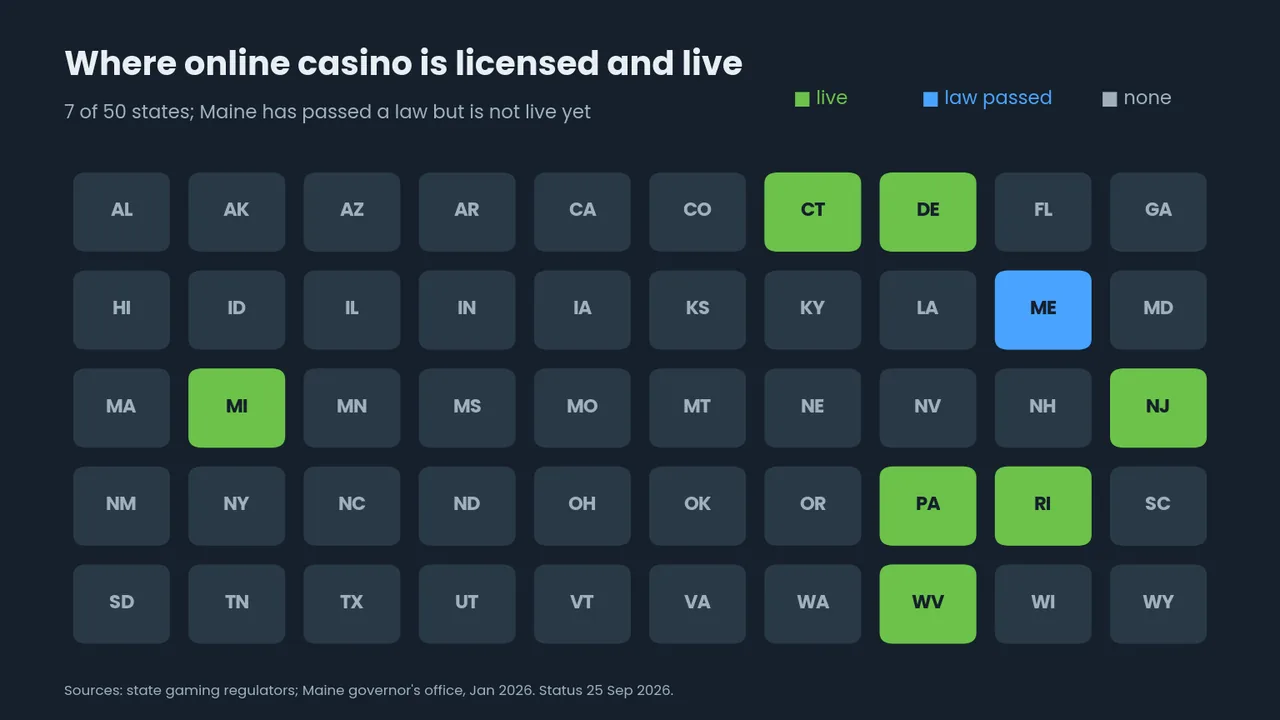
If you search for a "real money online casino Missouri no deposit bonus" or the Minnesota equivalent, you will find offers, but neither state is on the list above. Any casino offering real-money play there is a site that no US state licenses. The same holds in every state outside the seven. That changes what a no-deposit bonus is: its terms are whatever the site writes, and nobody in the US reviews them before or after you play. In April 2026 the Michigan Gaming Control Board sent cease-and-desist orders to 45 offshore operators and named the risks it sees for players: unfair or manipulated games, withheld winnings, misuse of personal and financial data, and "no meaningful avenue for dispute resolution". It told players to check its list of licensed operators. The Pennsylvania Gaming Control Board put it in one line in September 2025: "Player protections are required only through licensed operators", and it cannot help with problems at an offshore platform.
How the seven states got here
The map filled in slowly. New Jersey and Delaware opened in 2013, six years before Pennsylvania followed in 2019. West Virginia went live in 2020, Michigan and Connecticut in 2021, and Rhode Island in 2024. Three of the seven are run through the state lottery (Delaware, West Virginia and Rhode Island), two through a gaming control board (Pennsylvania and Michigan), one through the attorney general's Division of Gaming Enforcement (New Jersey) and one through a consumer-protection department (Connecticut). Maine is the next name on the timeline: LD 1164 became law in January 2026 and lets the Wabanaki Nations offer online casino, but no site is live there yet.
What state rules demand of bonus terms
The practical gain from a license shows up in the small print. The three states whose rules we checked set out what a bonus must say, and in two of them what it may not do:
| Rule | Pennsylvania (58 Pa. Code 813a.3) | Michigan (R 432.649) | New Jersey (DGE advertising standards) |
|---|---|---|---|
| Terms on file with the regulator | Filed with the PGCB 5 days before launch | Not in our summary | Affiliate promotions must be filed with the DGE |
| Wagering requirements | Stated by game | Stated by game type | No unrealistic wagering; example: $150,000 of play to redeem a $1,000 bonus |
| Withdrawal limits | Must be stated | Must be listed | Not in our summary |
| Cap on winnings once terms are met | Not allowed | Not allowed | Not in our summary |
| Cancellation | Terms must state it | Terms must state it; players may cancel a bonus | Not in our summary |
| Other items | Eligible games; the operator answers for promotions run by a marketing affiliate | "Clear and unambiguous"; expiry, eligibility, order in which funds are used, eligible games | No claims that an offer carries no risk when players deposit their own money |
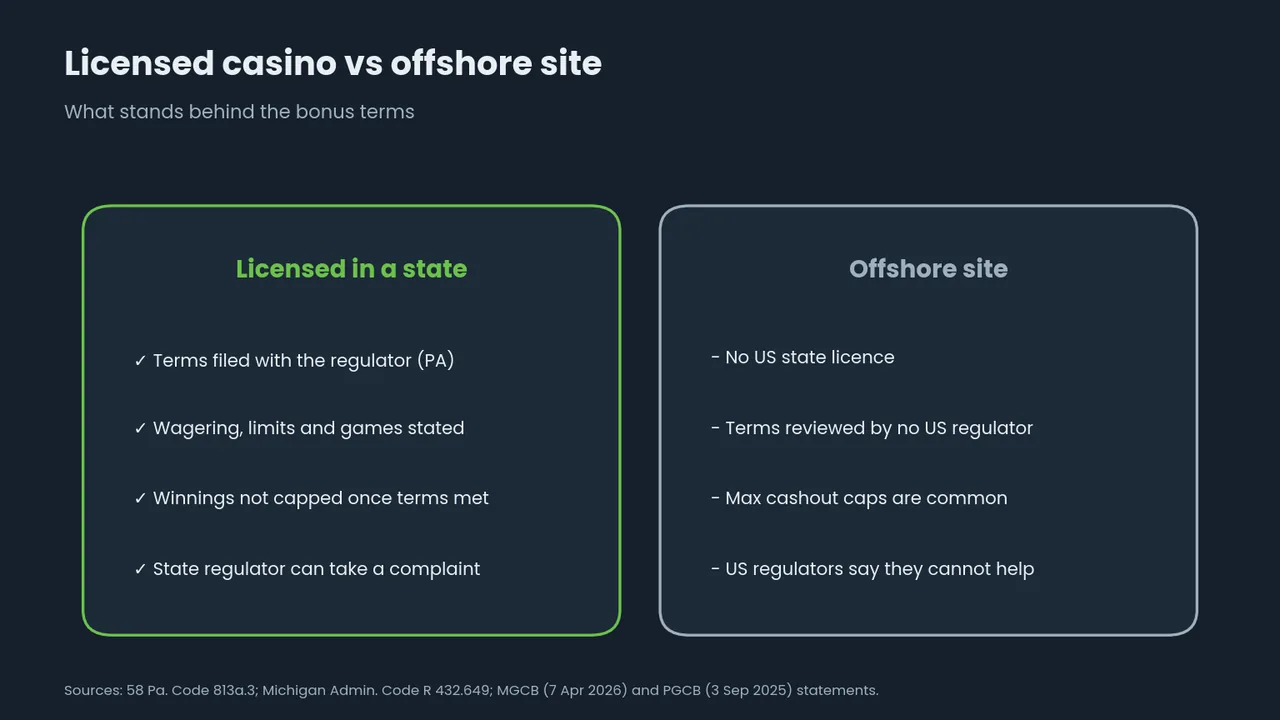
For a no-deposit player, three of those rows matter most. The ban on capping winnings once the terms are met removes the max cashout as it works at offshore sites, which is often the biggest limit on a no-deposit offer; we explain how that cap cuts a balance in our guide to cashing out no-deposit winnings. The requirement to state wagering by game means the weighting of each game is written down before you play. And the New Jersey example puts a number on "unrealistic": $150,000 of play for a $1,000 bonus is 150x. How that turnover is counted, and what a multiple costs on average, is covered in how no-deposit bonuses work; for the same maths on dollar amounts, see free chip no deposit offers and free spins no deposit offers. We checked the rules of three states; we did not review the rules of Delaware, West Virginia, Connecticut or Rhode Island for this page.
Michigan, Pennsylvania and West Virginia offers: what to check
Searches such as "no deposit bonus casino Michigan", "no deposit bonus codes Michigan", "no deposit bonus PA" and "no deposit bonus online casino WV" come from the licensed states themselves, and the checks there are simple. First, confirm the operator is on the regulator's list: the Michigan board tells players to use its licensed-operator list, and Pennsylvania and West Virginia regulate through the Gaming Control Board and the West Virginia Lottery. Second, read the terms for the items in the table above. A code does not change them: in Michigan and Pennsylvania the terms behind a code still have to list the wagering by game and the withdrawal limits, and in Pennsylvania they sit on file with the regulator before the offer runs. Third, keep a copy of the terms on the day you claim. We did not check which licensed casinos currently run no-deposit offers in any state for this page.
Federal law: what it covers and what it leaves to states
Two federal laws come up whenever online casino is discussed. The Unlawful Internet Gambling Enforcement Act of 2006 (UIGEA, 31 U.S.C. 5361-5367) is aimed at gambling businesses and the payment systems that serve them. The Wire Act covers sports betting only, as the First Circuit confirmed in NH Lottery Commission v. Rosen on 20 January 2021. Neither creates a national license for online casino, so the question of whether online casino is legal, and what that means for players, is answered by each state. The honest answer to "is online casino legal in my state?" is therefore: if your state is one of the seven, licensed sites exist; if not, check your own state's law, because this page does not summarise it. What we can say is what is missing outside the seven: a regulator that has seen the bonus terms, and somewhere to take a dispute. When we list offers on our no deposit bonus casinos page, the licensing status is the first thing we record for each one.
One state-level change is often mentioned alongside these laws. California (AB 831, from 1 January 2026) and New York (S5935A, December 2025) banned online sweepstakes casinos, and both laws also cover media affiliates that promote them. We do not list or link to sweepstakes sites.
Taxes on gambling winnings from 2026
The IRS treats gambling winnings as fully taxable, and that includes winnings from a bonus once you withdraw them. Losses are deductible only if you itemize, and only up to the amount of your winnings, so the IRS asks you to keep records of both (IRS Topic 419). From tax years beginning after 31 December 2025, a federal law enacted on 4 July 2025 (P.L. 119-21, section 70114) allows only 90% of losses to be deducted, still capped at your winnings. The effect is easiest to see with round numbers:
| Winnings | Losses | Deductible for 2025 | Deductible from 2026 |
|---|---|---|---|
| $1,000 | $500 | $500 | $450 |
| $1,000 | $1,000 | $1,000 | $900 |
| $1,000 | $1,200 | $1,000 | $1,000 (90% is $1,080, capped at winnings) |
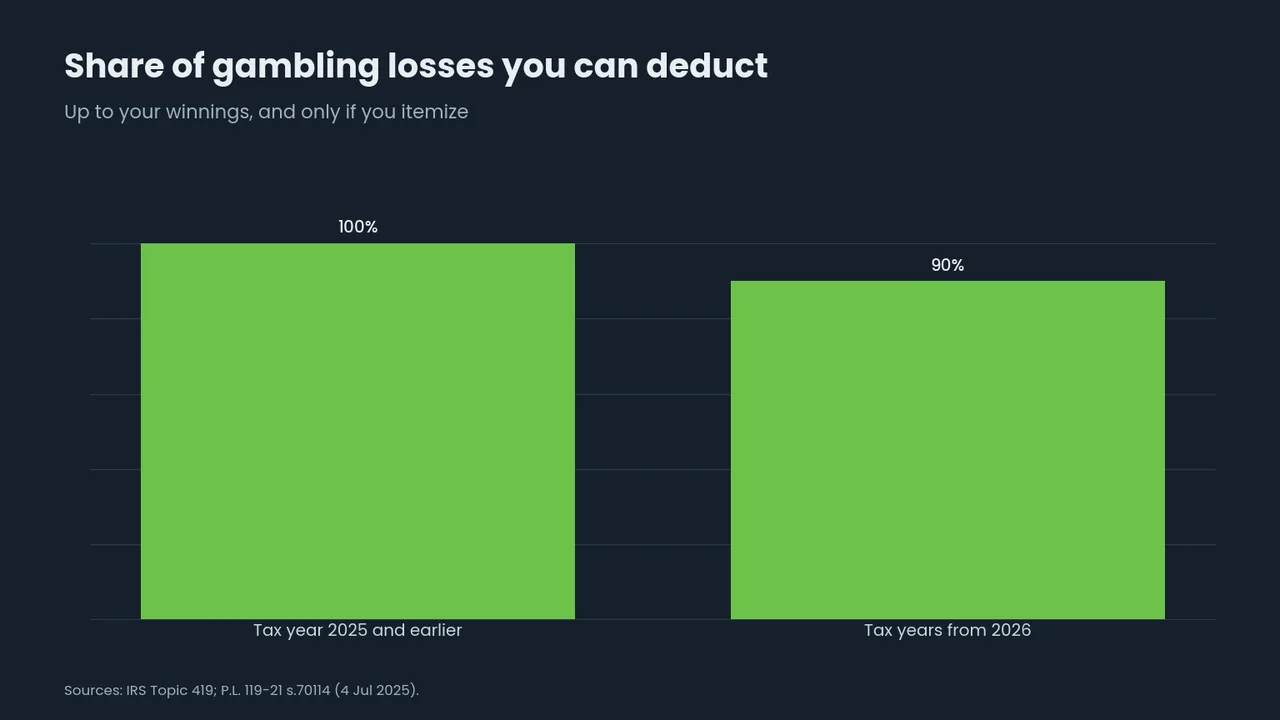
The middle row is the one to notice: a player who wins $1,000 and loses $1,000 in the same year broke even, but from 2026 can deduct only $900, so $100 of winnings is taxable. Congress is considering a change to this rule, but as of 25 September 2026 the 90% limit is the law. This is general information, not tax advice; a tax professional can tell you how it applies to you.
Checking your own state in four steps
- Find your state in the table. If it is one of the seven, licensed online casinos exist and you must be 21+.
- Check the regulator's list. A licensed operator appears on the list of the regulator named in the table.
- Read the terms against the rules. Wagering by game, withdrawal limits, eligible games and cancellation should all be there.
- Outside the seven, read your state's own law. Know that a dispute with an offshore site has no US regulator to go to.
Frequently asked questions
Is online casino legal in my state?
Are there licensed no-deposit bonuses in Missouri or Minnesota?
Do Michigan no-deposit bonuses have a max cashout?
Does federal law ban online casinos?
Do I have to pay tax on no-deposit bonus winnings?
Who do I complain to about a licensed online casino?
Read next
21+ in the licensed states. General information, not legal or tax advice. Laws change and vary by state; check the law in your own state and the regulator named on this page before you play.