

Wild Casino
- 25 free spins a day for 10 days
- Bitcoin deposits from $10
- Live casino and cash tournaments
Welcome Bonus
250 Free Spins on a $10 Deposit

Two numbers decide what no deposit free spins are worth: the value of each spin and the wagering on what the spins win. In our simulation, 50 spins at $0.25 with no wagering were worth $10.88 to $11.99 on average. The same 50 spins with 60x on the winnings were worth $2.03 to $4.84, and with 30x on $0.10 spins only 4 to 14 players in 100 cashed out anything at all. This page shows how to read those two numbers before you claim.


Ad: we earn a commission if you sign up through this link. 21+ (18+ where state law allows). The casino's terms apply.
The cards above show each casino's current welcome offer, which needs a first deposit. When one of these casinos runs a no-deposit offer, it gets its own row here with the full terms: the wagering requirement, the maximum cashout, the time limit, the games allowed, whether you must verify your ID before withdrawing, the code if one is needed, and the date we checked it.
Expected loss is wagering times house edge. When it is well above the bonus, most players lose the balance before the wagering is done. Because a no-deposit bonus never risks your own money, the average value still stays above zero: it comes from the few players who finish. Our simulation below shows how much that is.
| 50 free spins, $100 cap | Face value | Average value, high-volatility model | Average value, low-volatility model | Players who cash out anything (high / low) |
|---|---|---|---|---|
| $0.10 spins, no wagering | $5 | $4.74 | $4.80 | almost 100% / 100% |
| $0.10 spins, 30x on winnings | $5 | $1.98 | $2.79 | 4.3% / 13.5% |
| $0.10 spins, 60x on winnings | $5 | $1.58 | $2.12 | 2.4% / 7.7% |
| $0.25 spins, no wagering | $12.50 | $10.88 | $11.99 | almost 100% / 100% |
| $0.25 spins, 30x on winnings | $12.50 | $2.78 | $6.62 | 4.2% / 13.6% |
| $0.25 spins, 60x on winnings | $12.50 | $2.03 | $4.84 | 2.5% / 8.0% |
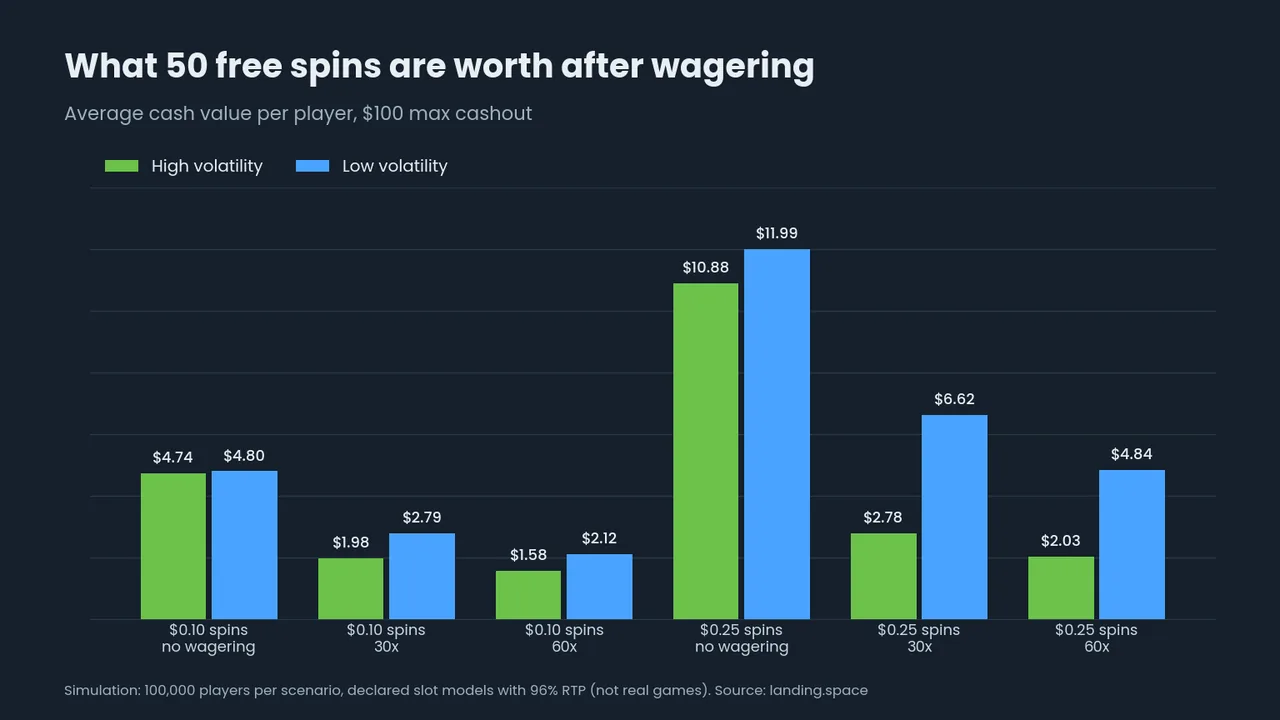
The table ranks offers differently from the headline. Raising the spin value from $0.10 to $0.25 more than doubles what the spins are worth, but only while the winnings are free to withdraw. Add 60x on the winnings and the $0.25 spins drop to $2.03 in the high-volatility model, less than half of what $0.10 spins with no wagering are worth ($4.74). A wagering requirement on free spin winnings does not trim the value a little; it removes most of it, because most players lose the winnings while trying to clear it.
Searches for free spins that win real money in the USA assume the spins pay out. With no wagering, they almost always do, just not much: 50 spins at $0.10 return a few dollars on average. With wagering on the winnings, the picture changes. At 30x on $0.10 spins, only about 4 players in 100 cashed out anything in the high-volatility model, and about 14 in 100 in the low-volatility model.
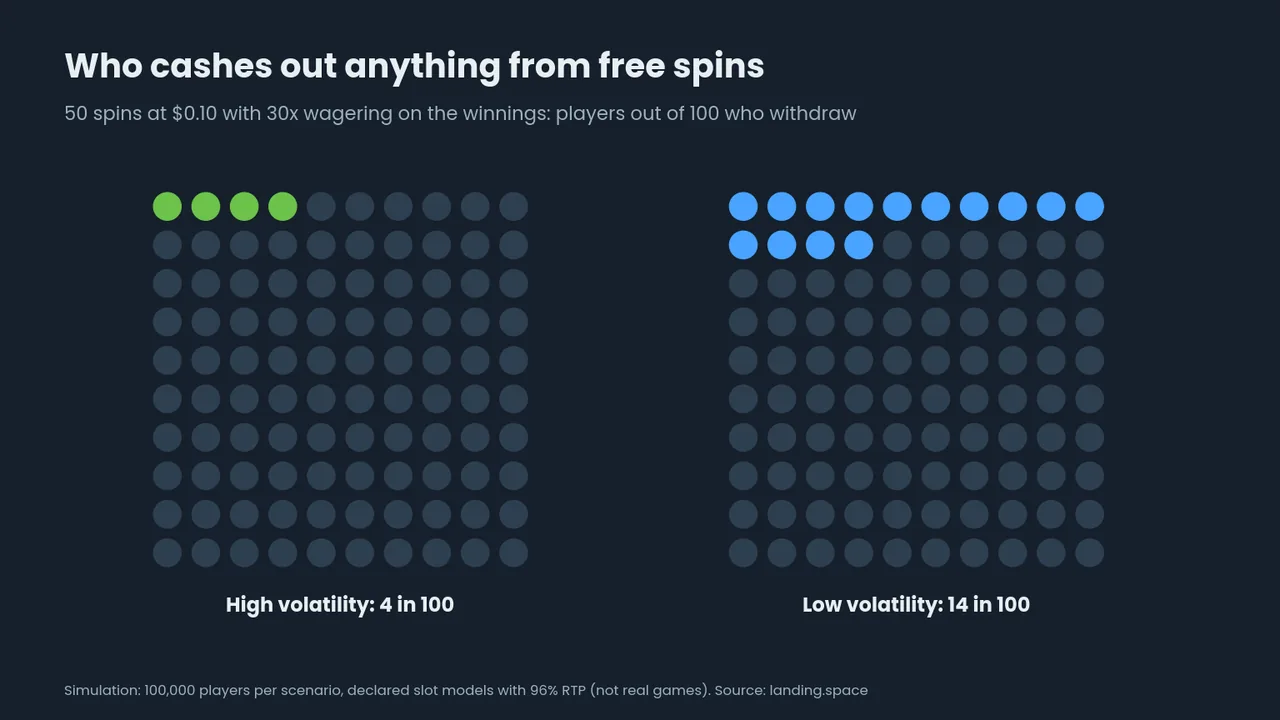
The few who do get through are paid well by comparison, which is why stories of big free spin wins are real but rare. Dividing the average value by the share of players who cash out, a player who cleared 30x on $0.10 spins took home about $46 on average in the high-volatility model and about $21 in the low-volatility model. The high-volatility slot produces fewer finishers with bigger balances; the low-volatility slot produces more finishers with smaller ones. Either way, the realistic expectation for one set of wagered free spins is $0.
Method: 100,000 simulated players per offer and model. Both slot models are declared calculation models with 96% RTP, one high and one low volatility, not real games. Players spin the 50 free spins, then wager any winnings at $0.20 per bet ($0.10 spins) or $0.50 per bet ($0.25 spins) until the wagering is done or the balance is below one bet. Cashouts are capped at $100. Real slots have other distributions; the direction of the result holds.
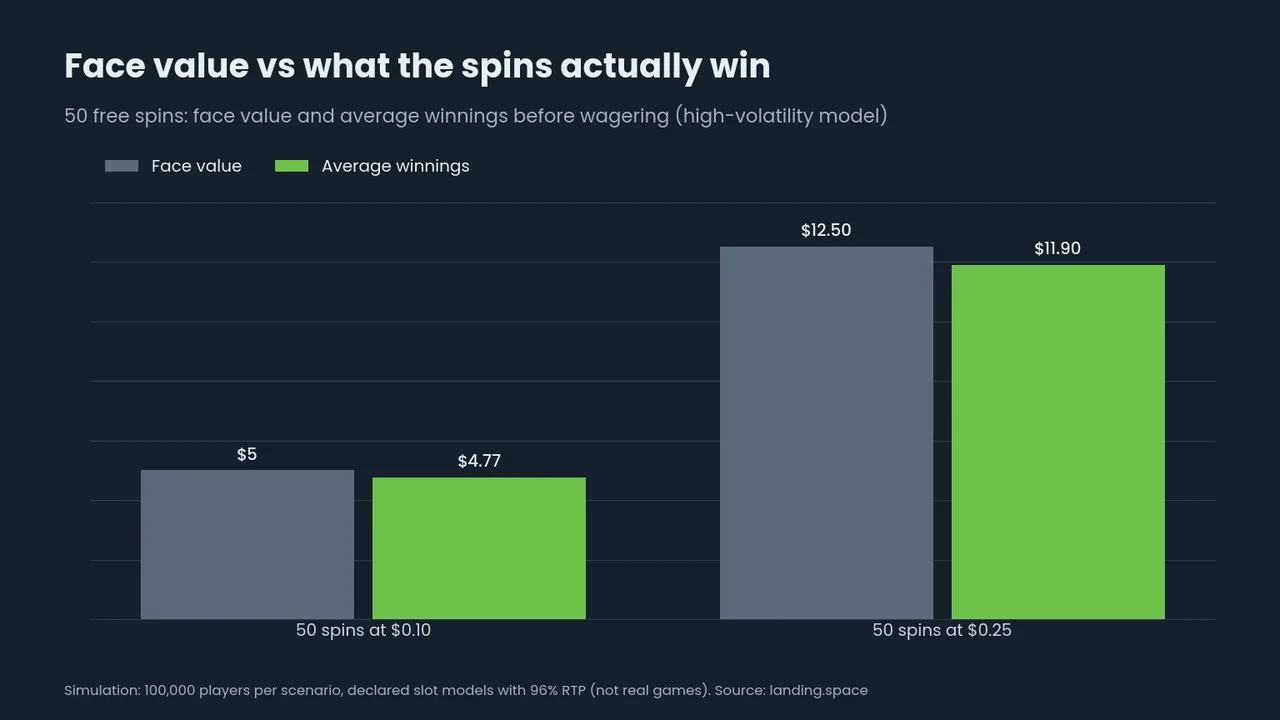
A free spin has no fixed value; the offer sets it. Before any wagering, a spin returns on average the slot's RTP times its value. In both of our models that is 96%, so 50 spins at $0.10 averaged $4.77 in winnings (high-volatility model) and 50 spins at $0.25 averaged $11.90. Those winnings are then the base for any wagering requirement, and the wagering is where the money goes.
| 50 spins at | Average winnings | Wagering needed at 30x | Wagering needed at 60x | Expected loss while wagering at 30x |
|---|---|---|---|---|
| $0.10 | about $4.80 | $144 | $288 | $5.76 |
| $0.25 | about $12 | $360 | $720 | $14.40 |
The expected loss is the wagering times the house edge, 4% on a 96% RTP slot. At 30x it is already larger than the winnings themselves, which is why most players run out of balance before they finish. At 60x it doubles again. So a higher spin value only helps when the wagering is low or zero; with heavy wagering, a bigger base just means more to bet through.
Free spins on sign up, also called free spins on registration, reach the account in one of three ways: automatically once the account is open, after you enter a bonus code at sign-up, or after an extra step such as confirming an email address or phone number. The terms of the offer say which. If a code is needed, it usually has to be entered when you register, not afterwards.
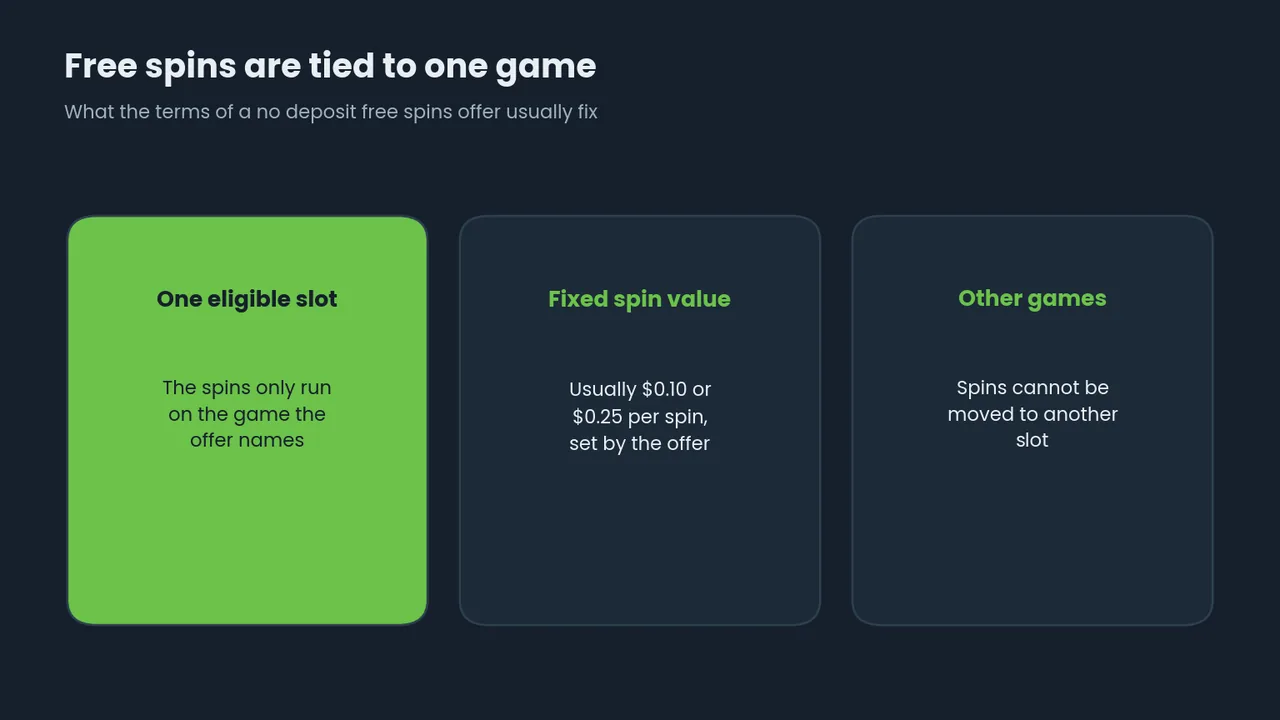
Offers usually tie the spins to a single eligible slot and play them at a fixed bet. You cannot raise the stake or move the spins to another game. What happens to the winnings afterwards is a separate question: with no wagering they go to your cash balance; with wagering they become bonus money that may be playable on other games, often with table and live games excluded or counted at a fraction. Pennsylvania and Michigan rules require licensed operators to state eligible games and the wagering requirement by game in the terms, which is a sensible standard to hold any offer to.
No-wager free spins are the simplest offer to value. The winnings are yours once the spins are played, limited only by the cap and by the time you have to use them. In our simulation they were worth close to their face value: $4.74 to $4.80 for 50 spins at $0.10 and $10.88 to $11.99 for 50 spins at $0.25, and nearly every player walked away with something.
That makes a small no-wager offer worth more on average than a larger offer with heavy wagering. 50 no-wager spins at $0.10 beat 50 spins at $0.25 with 60x in both of our models. When you compare offers, sort by wagering first and by spin value second; the number of spins comes last. How wagering works in general, including game weighting and the order in which cash and bonus funds are used, is covered in our guide on how no deposit bonuses work.
Many no deposit free spins limit what can be withdrawn. In our examples the cap is $100. On no-wager spins it rarely matters: it cut the average value of 50 spins at $0.25 from $11.90 in winnings to $10.88 in the high-volatility model, because only a rare big hit goes over $100, and it cut almost nothing in the low-volatility model. On wagered spins it matters more, because the few players who finish the wagering are the ones with large balances, and the cap removes whatever they hold above it.
Pennsylvania and Michigan rules say a licensed operator may not cap winnings once the bonus terms are met. An offer that limits what you can withdraw after the wagering is done is therefore not running under those two states' rules. Real-money online casino is licensed in seven states; everywhere else, check your own state's law before you play, and read the cap as part of the offer's size.
The count scales the offer, nothing more. At a fixed spin value and 96% RTP, 25 spins at $0.10 average about $2.40 in winnings, 50 spins about $4.80 and 100 spins about $9.60. We simulated 50 spins only; for 25 or 100 spins, the averages above are simple arithmetic, and the same wagering logic applies. Twice the spins with twice the winnings means twice the wagering in dollars, so 100 spins with 60x on the winnings are not a better deal than 50 spins with no wagering.
Treat large round counts with the same checks: the value of each spin, the wagering on the winnings, the cap and the expiry. An offer of 100 spins at $0.10 is $10 of play; an offer of 50 spins at $0.25 is $12.50.
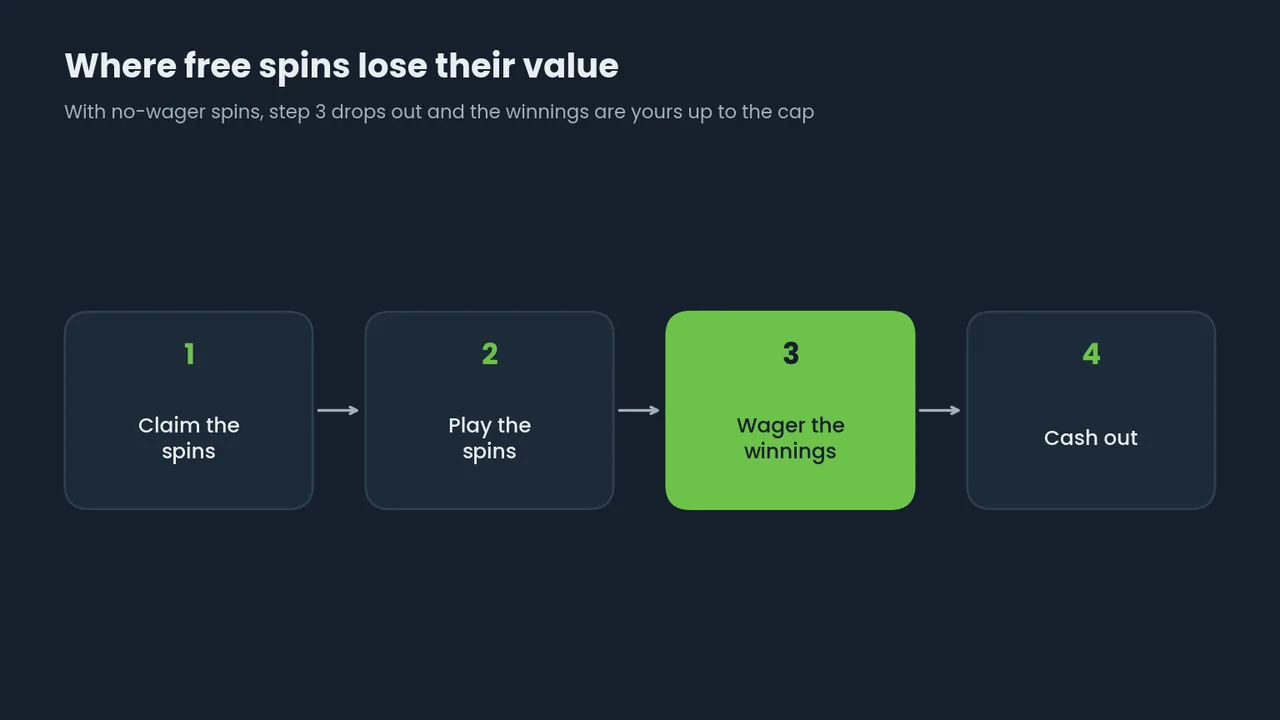
Every free spins offer runs through the same four steps. Three of them take minutes. The third, wagering the winnings, is where almost every offer is decided, and it only exists when the terms attach a requirement to the winnings.
Before the cash out, expect an identity check: an ID document and sometimes proof of address or of the payment method. Register with your real details, since a mismatch between the account and your documents can hold up a withdrawal, and open one account per casino. The no deposit bonus casinos overview explains how we list offers.
A free chip is bonus cash rather than spins: a fixed amount, such as $50 or $100, that can usually be played on more than one game. In the examples we model, it carries 60x wagering on the whole amount and a max cashout. Free spins with no wagering are the reverse: small, tied to one slot, but paid out as cash. In our simulation a $50 chip at 60x with a $100 cap was worth $5.21 to $7.88 on average, about the same as 50 no-wager spins at $0.10 and less than 50 no-wager spins at $0.25. The comparison in dollars for chips of different sizes is on our free chip no deposit page.
What we did not check: we have not claimed these offers and tested a withdrawal ourselves. The values on this page come from the stated terms and our simulation, not from play at the listed casinos.
Free spins are built to get you playing, and the step after them is usually a deposit. If you notice that you chase the next offer, play longer than you planned or spend money you meant for something else, stop and talk to someone. 1-800-MY-RESET (1-800-697-3738) answers calls and texts 24/7, with chat at 1800myreset.org; more options are on our gambling help page. 21+.

Leads the review desk and edits every review. Over a decade testing real-money casinos end to end.

Runs the data team behind our Safety Index and fact-checks every review against primary sources.

Certified responsible-gambling professional who keeps our content fair, honest and player-first.