

Wild Casino
- 25 free spins a day for 10 days
- Bitcoin deposits from $10
- Live casino and cash tournaments
Welcome Bonus
250 Free Spins on a $10 Deposit

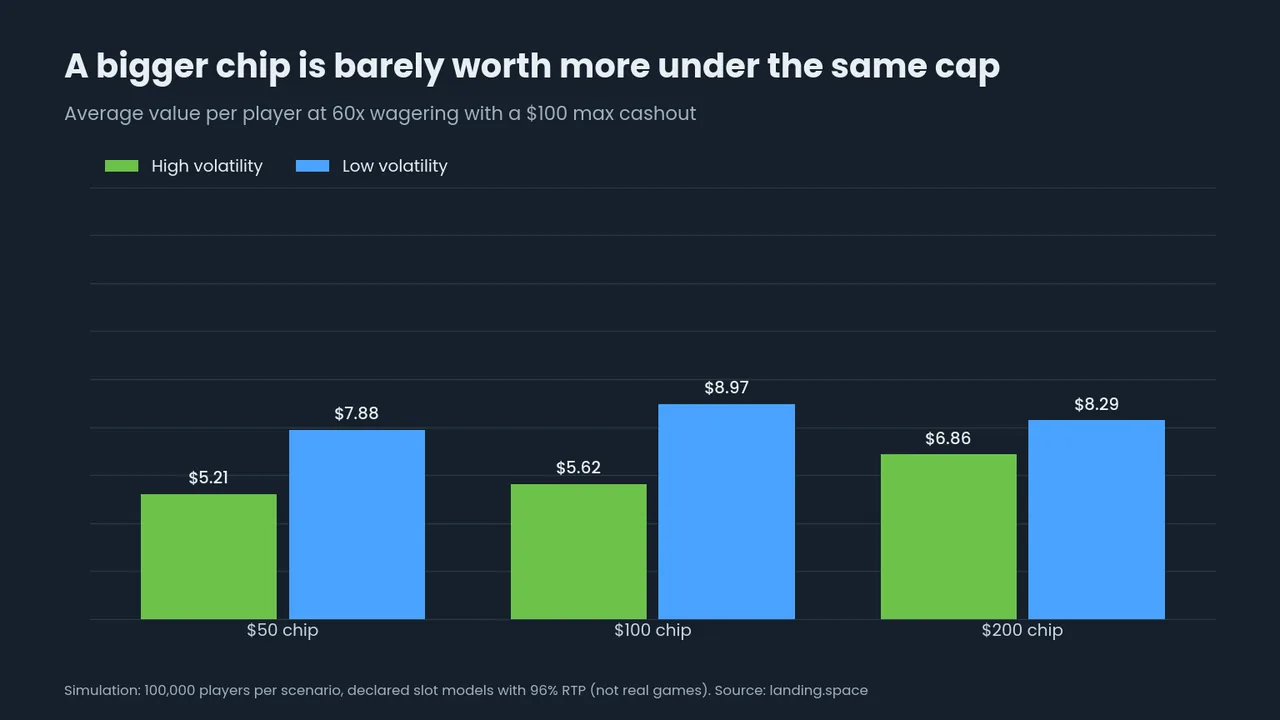
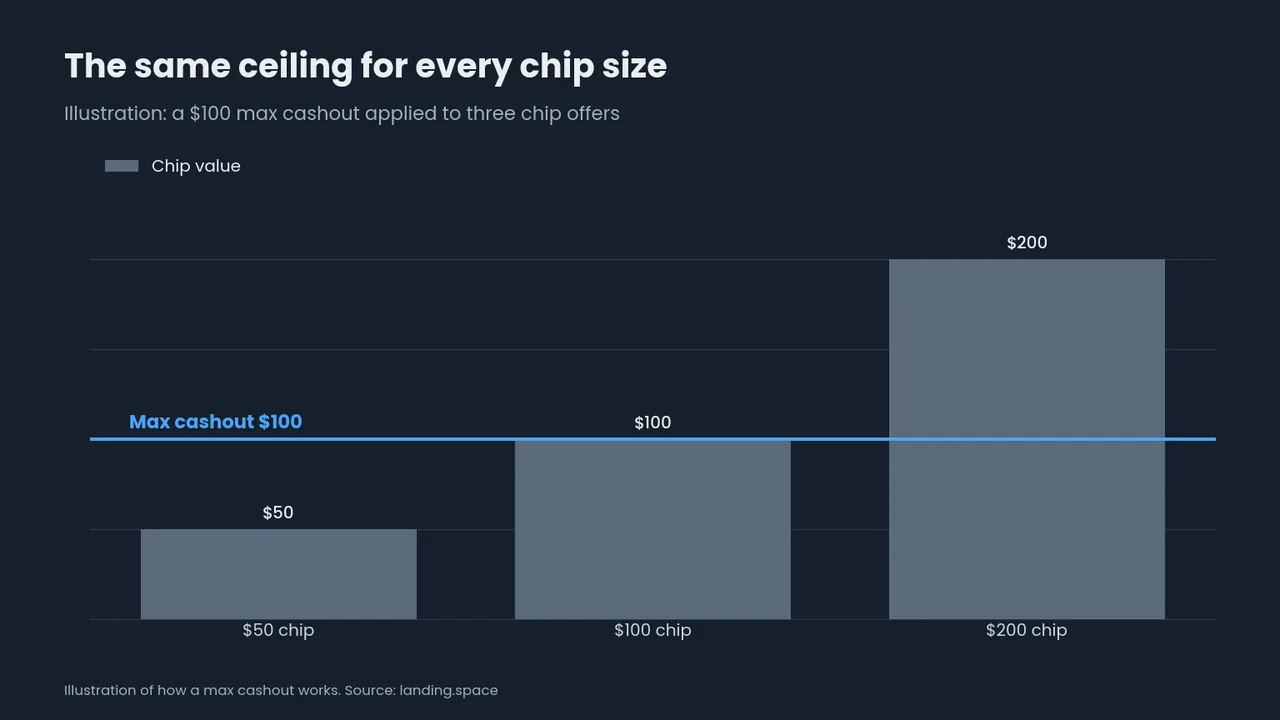
A $200 free chip sounds like twice the offer of a $100 chip. It is not, as long as both carry the same max cashout. In our simulation at 60x wagering and a $100 cap, $50, $100 and $200 chips were worth on average $5.21, $5.62 and $6.86 in the high-volatility model, and $7.88, $8.97 and $8.29 in the low-volatility model. The cap sets the prize; the chip size mostly sets how much you have to bet to reach it.


Ad: we earn a commission if you sign up through this link. 21+ (18+ where state law allows). The casino's terms apply.
The cards above show each casino's current welcome offer, which needs a first deposit. When one of these casinos runs a no-deposit offer, it gets its own row here with the full terms: the wagering requirement, the maximum cashout, the time limit, the games allowed, whether you must verify your ID before withdrawing, the code if one is needed, and the date we checked it.
Expected loss is wagering times house edge. When it is well above the bonus, most players lose the balance before the wagering is done. Because a no-deposit bonus never risks your own money, the average value still stays above zero: it comes from the few players who finish. Our simulation below shows how much that is.
A free chip is bonus cash credited without a deposit: a round amount such as $50, $100 or $200 that you play like a balance, usually on slots. It cannot be withdrawn as it is. First it has to be wagered a set number of times, and then only the part up to the max cashout can be withdrawn. Those two terms, not the chip amount, decide what the offer is worth.
| Chip, 60x | Wagering needed | Players who finish (high / low) | Average value, $100 cap (high / low) | Average value, $200 cap (high / low) |
|---|---|---|---|---|
| $50 | $3,000 | 5.4% / 9.7% | $5.21 / $7.88 | $9.79 / $11.13 |
| $100 | $6,000 | 5.7% / 9.6% | $5.62 / $8.97 | $10.96 / $15.64 |
| $200 | $12,000 | 6.9% / 8.7% | $6.86 / $8.29 | $13.54 / $15.10 |
Quadrupling the chip from $50 to $200 raised its average value by $1.65 in the high-volatility model and by 41 cents in the low-volatility model, where the $200 chip was even worth a little less than the $100 chip. The reason is that the wagering grows with the chip. A $200 chip at 60x means $12,000 of bets, four times as much as a $50 chip, so the extra starting balance is mostly spent on the extra wagering. The few players who make it through run into the same $100 ceiling whatever they started with.
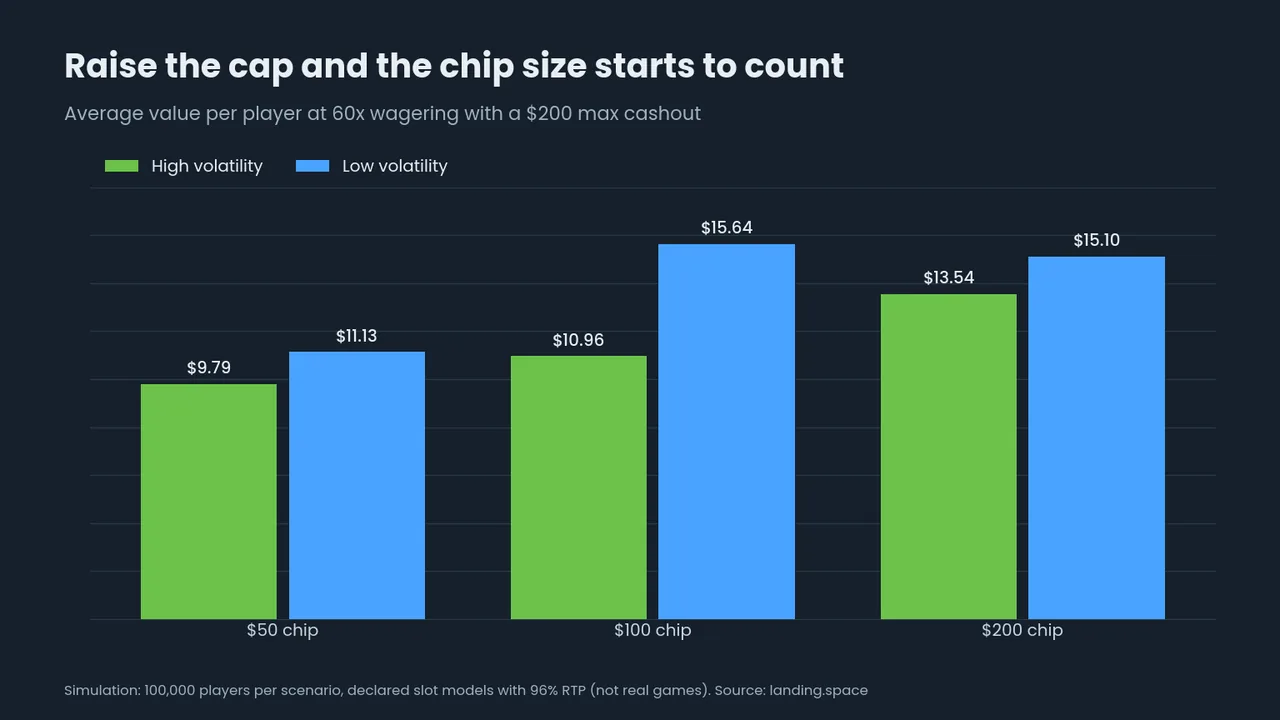
If the chip size barely moves the value, the cap does. Doubling the max cashout from $100 to $200 almost doubled the average value of every chip in the high-volatility model, from $5.62 to $10.96 for a $100 chip. In the low-volatility model the $100 chip went from $8.97 to $15.64. Comparing two offers, a $100 chip with a $200 cap was worth more than a $200 chip with a $100 cap in both models.
So when you read a free chip offer, find the max cashout before you look at the amount. A $100 no deposit bonus and a $200 no deposit bonus with the same cap are close to the same offer in dollars, while two $100 chips with different caps are not.
Method: 100,000 simulated players per chip, cap and model. The two slot models are declared calculation models with 96% RTP, one high and one low volatility, not real games. Bets of $0.50 on the $50 chip and $1 on the $100 and $200 chips; play continues until the 60x wagering is done or the balance is below one bet, and the cashout is capped. The 60x terms are our example, not a claim about any particular offer. Real slots have other distributions; the direction of the result holds.
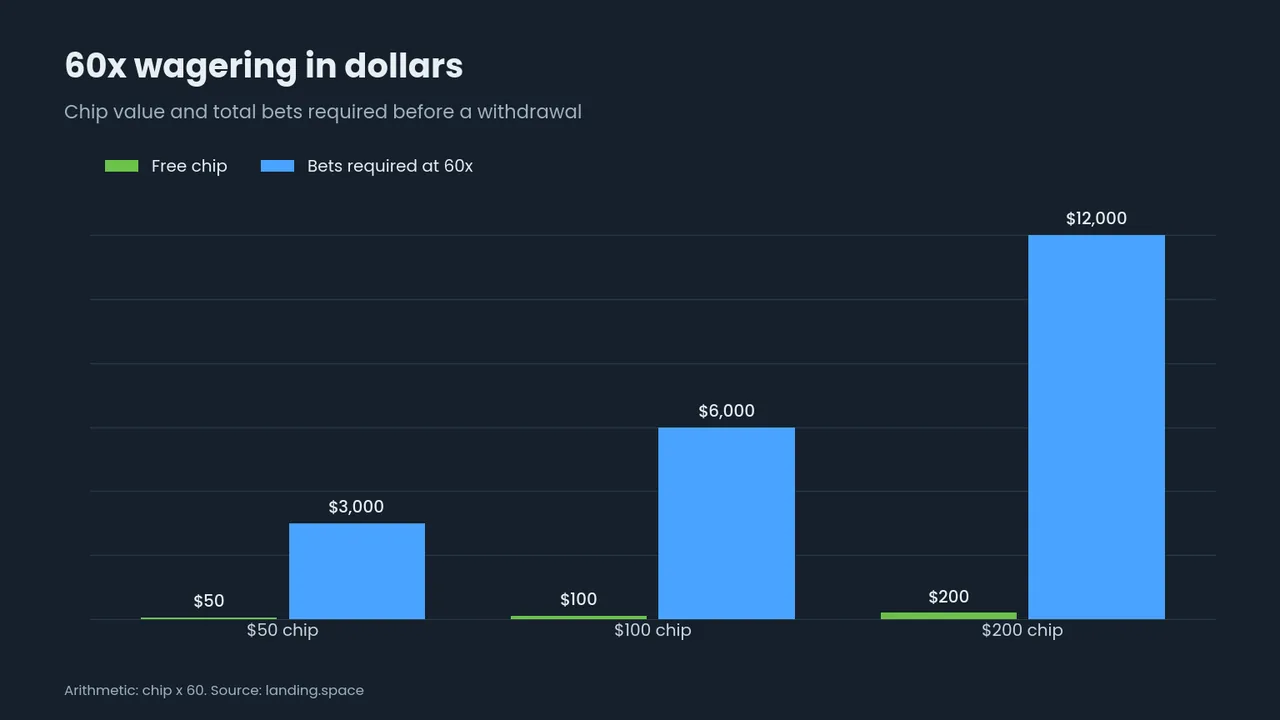
Our example term is 60x on the full chip amount. Worked out in dollars, it is a long session. The expected loss while wagering is the amount wagered times the house edge, which is 4% on a 96% RTP slot.
| Chip | Wagering at 60x | Bet in our simulation | Bets needed | Expected loss while wagering |
|---|---|---|---|---|
| $50 | $3,000 | $0.50 | 6,000 | $120 |
| $100 | $6,000 | $1 | 6,000 | $240 |
| $200 | $12,000 | $1 | 12,000 | $480 |
In every row the expected loss is more than twice the chip. That does not mean you lose $240 of your own money, since without a deposit you can only lose the chip. It means most players lose the whole chip before finishing. For scale, New Jersey's regulator gives $150,000 of play to redeem a $1,000 bonus, which is 150x, as its example of an unrealistic wagering requirement in advertising.
In the high-volatility model, 5 in 100 players finished 60x on a $50 chip, 6 in 100 on a $100 chip and 7 in 100 on a $200 chip. The low-volatility model let more players through, about 9 to 10 in 100, but with smaller balances at the end. The remaining 90 to 95 in 100 lost the chip along the way and withdrew nothing.
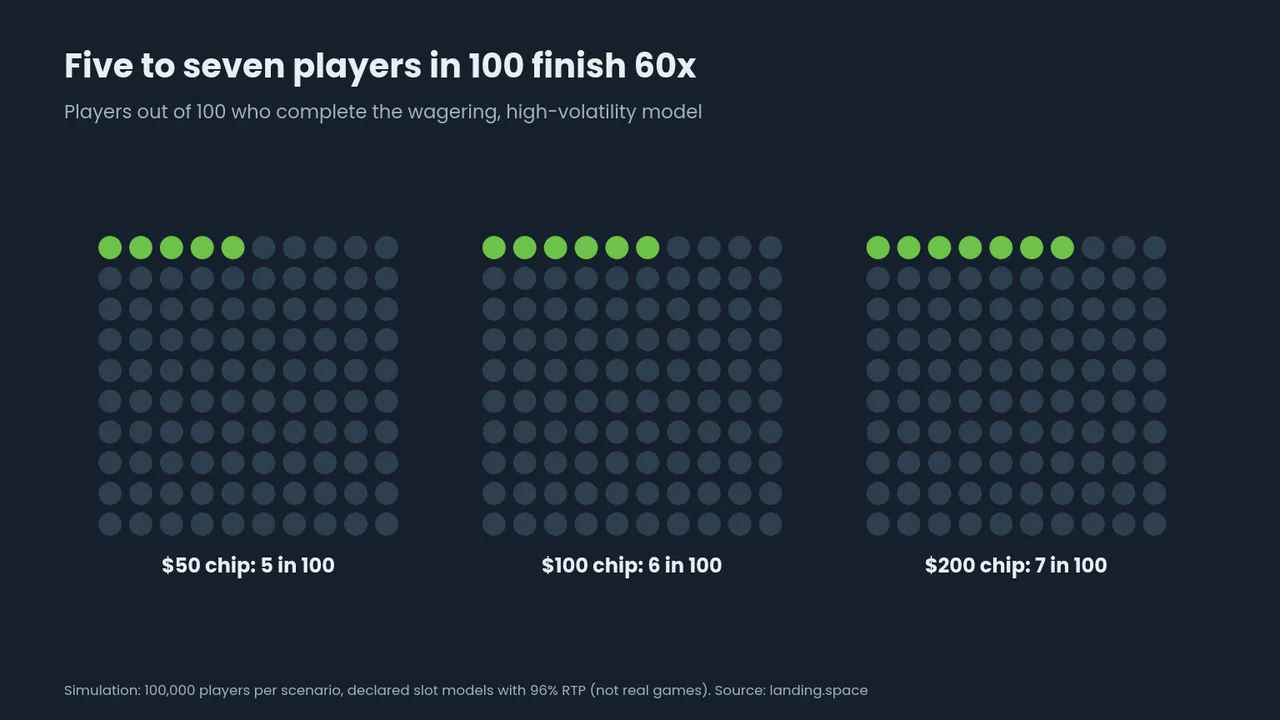
Those who finish in the high-volatility model almost all hit the cap. On a $100 chip with a $100 cap, 5.7% of players finished and 5.5% finished at or above $100, so the cap, not the balance, set nearly every payout. That is the practical meaning of the average: a small chance at the cap, and a large chance of nothing.
Searches for a $100 no deposit bonus, a 200 no deposit bonus or a $50 no deposit bonus casino compare the amounts. Under one max cashout, the amounts sit under the same ceiling. A larger chip gives you a slightly better chance to survive the first swings, and it asks for proportionally more wagering in return.
To compare two chips, read their terms in this order:
Some terms keep the cap after the wagering is done. Pennsylvania and Michigan rules do not allow a licensed operator to cap winnings once the bonus terms are met, and Michigan's rules also let players cancel a bonus. An offer that keeps its max cashout after the wagering is done is not following those rules. Online casino law is set state by state, so check what applies where you live before you register.
Chip offers can set a maximum bet while the bonus is active, so read that line before the first spin. If the terms set a limit, a bet above it can give the casino grounds under its own terms to void the bonus and anything won with it, even after the wagering is done.
Staying under the limit costs you nothing in expected value. The expected loss is 4% of whatever you wager at 96% RTP, whether you bet $0.50 or $5, because the total wagered is fixed by the 60x. What the bet size changes is the number of spins and the size of the swings: $6,000 of wagering is 6,000 spins at $1 or 1,200 spins at $5. We simulated only the bets in the method note, so we give no values for other bet sizes. Also check which games count: table games are often excluded or weighted at a fraction, which multiplies the dollars you have to bet.
Some offers advertise instant withdrawal. At best that describes how fast a payment goes out once it is approved. It does not skip the wagering, and it does not skip the identity check to expect before a first withdrawal: an ID document and often proof of address or of the payment method. At this step, account details that do not match your documents can hold up the payout.
Three habits help. Use your real name and address when you register, keep one account per casino, and read the withdrawal methods and any minimum withdrawal before you start wagering, not after. If the terms require a deposit before a first withdrawal, the chip is no longer a pure no deposit offer. The steps from finished wagering to money in your account are laid out in our guide to cashing out no deposit winnings.
A free chip gives you more freedom: a bigger balance and usually a choice of games. Free spins give you less freedom and, when they carry no wagering, far more certainty. In our simulation, 50 no-wager spins at $0.25 were worth $10.88 to $11.99, more than any chip here with a $100 cap. Small spin packages such as 25 free spins no deposit follow the same rule: the spin value and the wagering on the winnings decide the value. Our no deposit free spins page has those numbers, and the no deposit bonus casinos overview lists the current offers of both kinds.
What we did not check: we have not played through a free chip at the listed casinos or tested a withdrawal from one. The values here come from the example terms and our simulation.
A no deposit chip costs nothing, but the offers that follow it usually ask for a deposit. If you find yourself depositing to win back a chip you lost, or gambling to fix money problems, take a break and get support. Call or text 1-800-MY-RESET (1-800-697-3738) at any hour, or chat at 1800myreset.org. Our gambling help page lists more services. 21+.

Leads the review desk and edits every review. Over a decade testing real-money casinos end to end.

Runs the data team behind our Safety Index and fact-checks every review against primary sources.

Certified responsible-gambling professional who keeps our content fair, honest and player-first.