

Wild Casino
- 25 free spins a day for 10 days
- Bitcoin deposits from $10
- Live casino and cash tournaments
Welcome Bonus
250 Free Spins on a $10 Deposit

A crypto casino no deposit bonus is usually compared by its size. In our simulation the size mattered less than the game you are allowed to wager on: the same $10 bonus at 40x was finished by 3.4% of players on a high-volatility slot model and by 42.5% on a 99% RTP dice model. Below is what that means, why many casinos block the easy route, and what changes when the payout arrives in bitcoin or another coin instead of dollars.


Ad: we earn a commission if you sign up through this link. 21+ (18+ where state law allows). The casino's terms apply.
The cards above show each casino's current welcome offer, which needs a first deposit. When one of these casinos runs a no-deposit offer, it gets its own row here with the full terms: the wagering requirement, the maximum cashout, the time limit, the games allowed, whether you must verify your ID before withdrawing, the code if one is needed, and the date we checked it.
Expected loss is wagering times house edge. When it is well above the bonus, most players lose the balance before the wagering is done. Because a no-deposit bonus never risks your own money, the average value still stays above zero: it comes from the few players who finish. Our simulation below shows how much that is.
We took one typical offer, a $10 no deposit bonus with 40x wagering ($400 of bets) and a $100 max cashout, and played it 100,000 times on each of three declared models: a high-volatility slot with 96% RTP, a low-volatility slot with 96% RTP and a dice game with 99% RTP that pays 2x on a 49.5% win. Nothing else changed. The bet was $0.50 in every case, and a player stopped either when the wagering was done or when the balance fell below one bet. In our simulation the share of players who finished the wagering went from 3.4% to 10.8% to 42.5%. The same bonus, with the same terms, was more than twelve times as likely to pay out on dice as on the high-volatility slot.
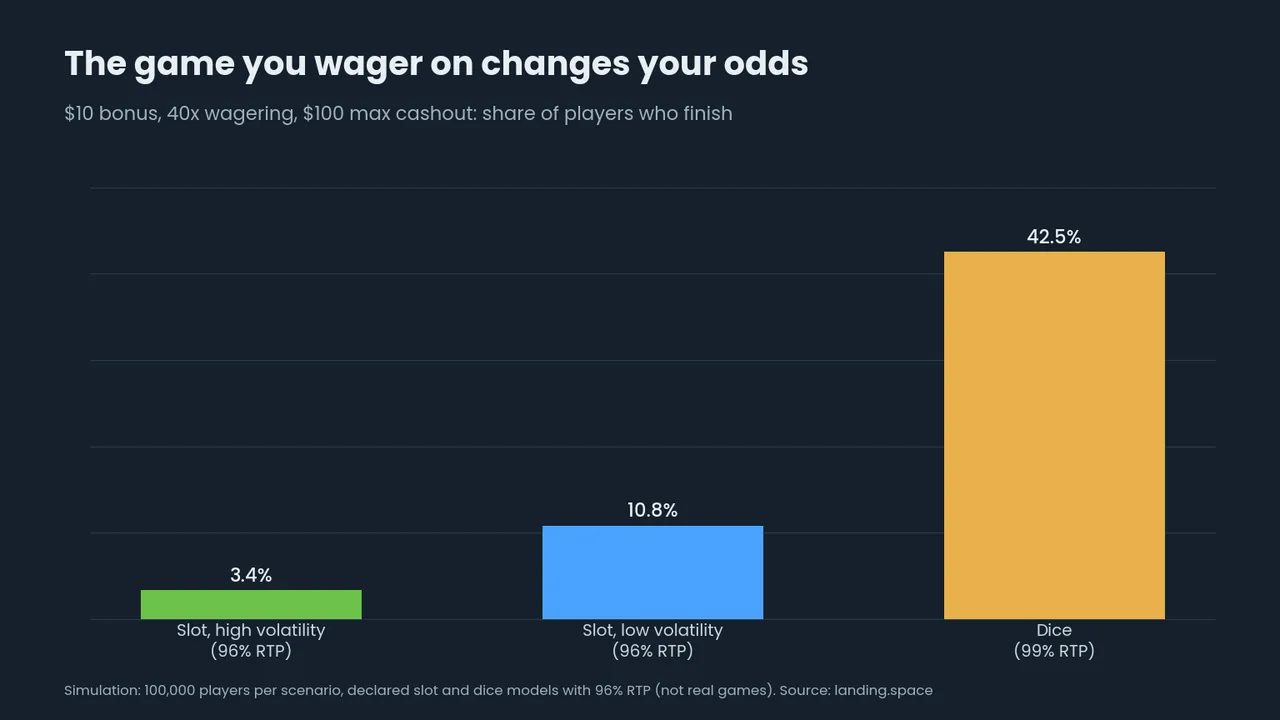
Two things drive the gap. The first is the house edge. The usual formula for the expected loss while wagering is turnover times house edge: $400 times 4% is $16 on a 96% slot, which is more than the whole bonus, while $400 times 1% is only $4 on 99% dice. The second is volatility. A high-volatility slot pays rarely and big, so most balances run dry before the big hit arrives. Even-money dice moves the balance up and down by small steps, so a $10 balance survives far longer. The price is that dice almost never produces a large win: nobody in the dice run reached the $100 cap.
| Game model | RTP | Finished 40x | Average value of the $10 bonus | Average for those who finished | Hit the $100 cap |
|---|---|---|---|---|---|
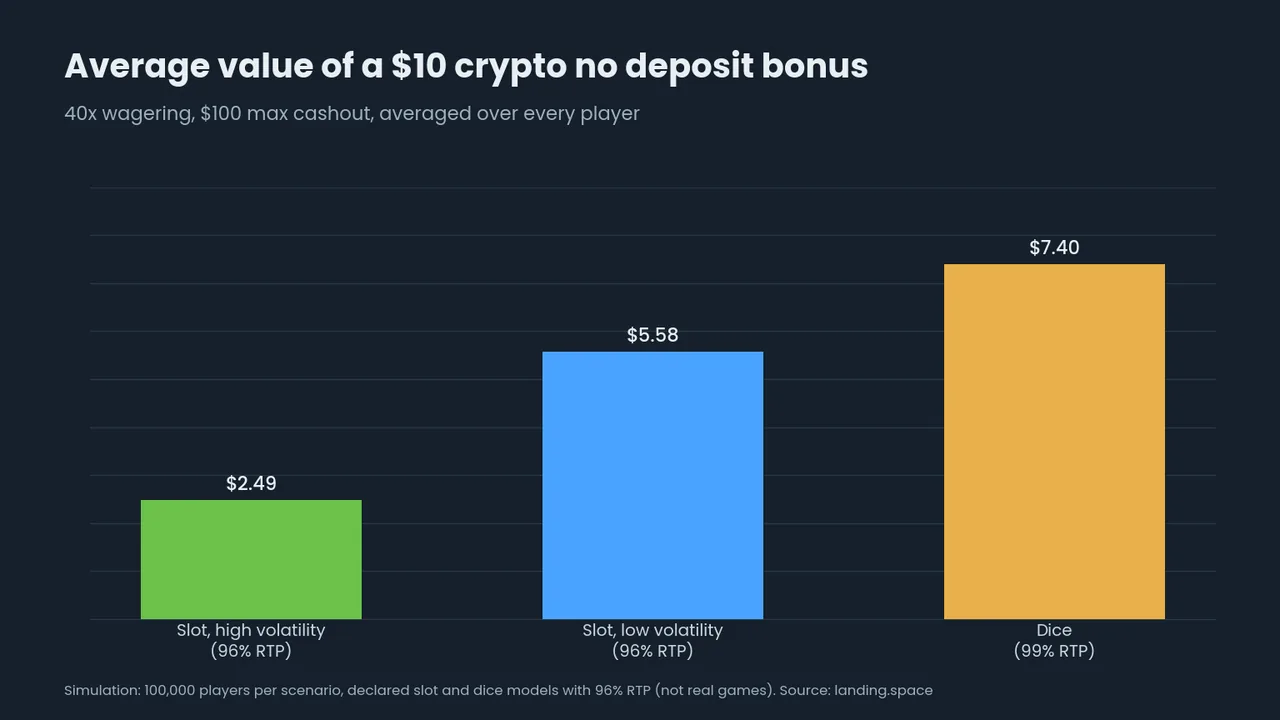
| High-volatility slot | 96% | 3.4% | $2.49 | about $74 | 1.7% |
| Low-volatility slot | 96% | 10.8% | $5.58 | about $52 | 1.2% |
| Dice, 2x on a 49.5% win | 99% | 42.5% | $7.40 | about $17 | 0.0% |
Averaged over every player, including the ones who lost the bonus, the $10 was worth $7.40 on dice in our simulation, against $5.58 on the low-volatility slot and $2.49 on the high-volatility slot. On dice the typical finisher walks away with a modest sum, about $17. On the slots, fewer people finish, but those who do bring more, about $74 on the high-volatility model.
Casinos know this arithmetic as well as we do. That is why many crypto casinos exclude house games such as dice from bonus wagering altogether, or count only a small part of each dice bet towards the target. The difference is large. If dice counts 10%, every $1 bet clears 10 cents, so the $400 target becomes $4,000 of dice bets, and the formula puts the expected loss at $40, four times the bonus. We did not simulate that case, but on those terms dice goes from the best choice to one of the worst. Some terms also void a bonus when the casino decides a player used a low-risk betting pattern. The only way to know which rule applies is to read the bonus terms before you play, and to check the list of eligible games, not just the headline.
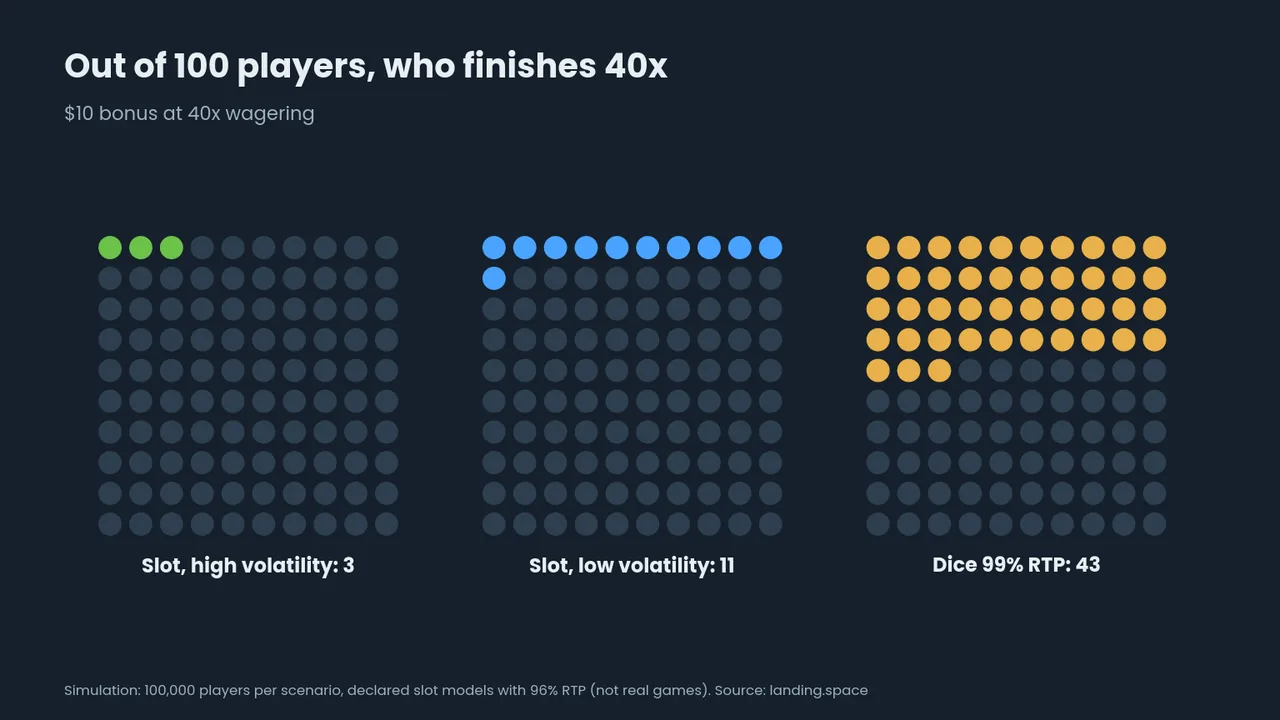
Method: in our simulation, 100,000 players per model, seed 20260926. The two slot models are declared pay tables with 96% RTP, one high and one low volatility; the dice model wins 49.5% of the time at 2x (99% RTP). They are models, not real games. Bet $0.50, play until 40x is done or the balance is below one bet, cashout capped at $100. Real games and real terms will give other numbers.
Because the game decides so much, the eligible-games section of the terms deserves more attention than the bonus amount. These are the lines that change the result the most, in the order we would read them:
| Term | What to look for | Why it matters |
|---|---|---|
| Eligible games | Whether dice, crash or other in-house games are allowed at all | The dice advantage above only exists if the terms allow dice |
| Game contribution | The percentage of each bet that counts towards wagering | At 10%, $400 of wagering becomes $4,000 of bets |
| Wagering multiple | 40x the bonus, or 40x bonus plus winnings | A $10 bonus at 40x needs $400 of bets |
| Max bet while wagering | A dollar or coin limit per bet | Going over it can cancel the bonus and its winnings |
| Max cashout | The most you can withdraw from the bonus | On the slot models it cuts off exactly the rare big wins |
| Expiry | Days to claim and days to finish wagering | 800 bets at $0.50 take time; a short window pushes bets up |
| Currency | Whether the bonus is fixed in dollars or in a coin | It decides who carries the price risk, see below |
If a line is missing from the terms, treat it as unknown rather than favorable. For a full walk through each of these terms and what the wagering multiple does to the value of a bonus, see how no deposit bonuses work.
Many bitcoin casino no deposit bonus offers aimed at US players are advertised in dollars: $10, $25, 50 free spins worth $0.10 each. The balance and the withdrawal, though, are often in bitcoin, ether, litecoin or another coin. That means there are two conversions, one when the bonus is credited or wagered and one when the withdrawal is paid, and the coin's price can move between them. That movement is your risk, not the casino's.
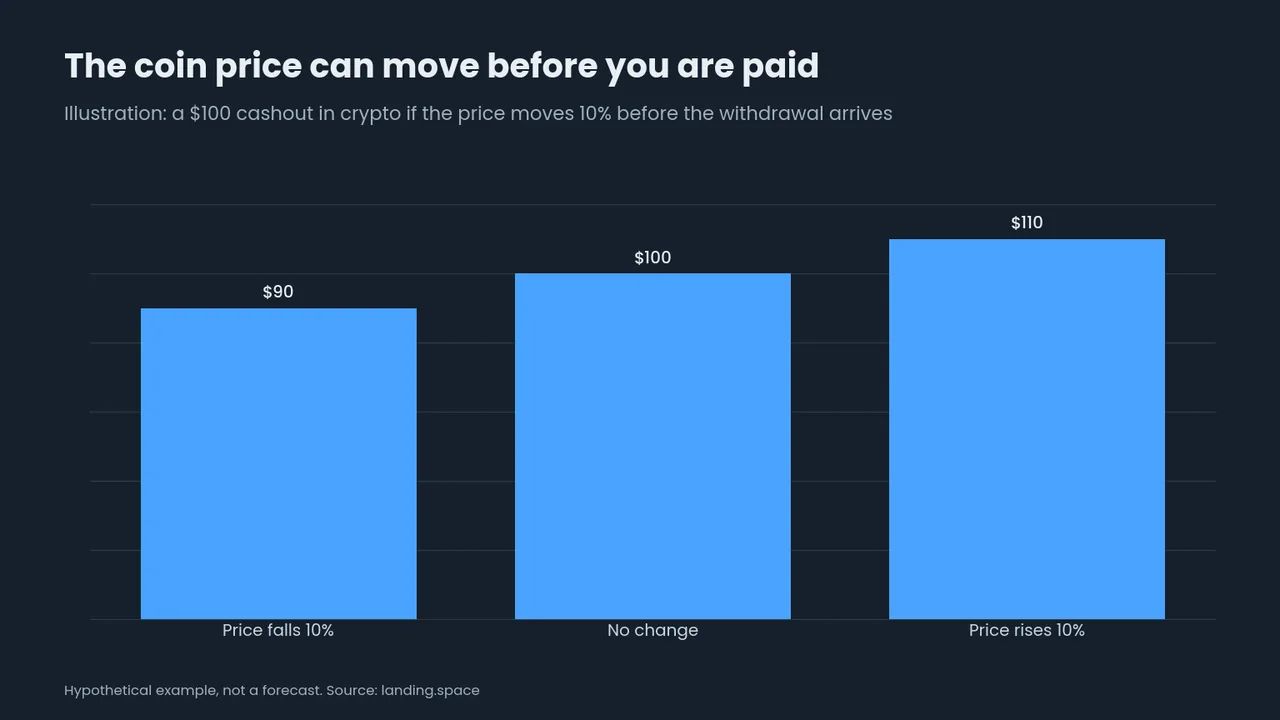
A hypothetical example: you finish the wagering and request a withdrawal worth $100 in a coin at today's price. If that coin falls 10% before you convert it back to dollars, you hold $90. If it rises 10%, you hold $110. Nothing about the bonus changed, only the market. Read three things in the terms: which coins the casino pays in, whether you can choose a coin designed to track the dollar, and at which moment the casino fixes the conversion rate, at the withdrawal request or at payout. If the terms do not say, assume the rate is set when the casino pays.
A crypto withdrawal has its own small print, separate from the bonus terms. Crypto casinos commonly set a minimum withdrawal per coin, and a small bonus balance can fall below it, which leaves the money stuck until you add more. Sending coins also costs a network fee, which may be taken from your withdrawal, and the fee is paid whatever the size of the amount, so it weighs more on a $20 cashout than on a $500 one. We do not quote figures here because they differ by casino, coin and day. Check both in the cashier before you start wagering, not after.
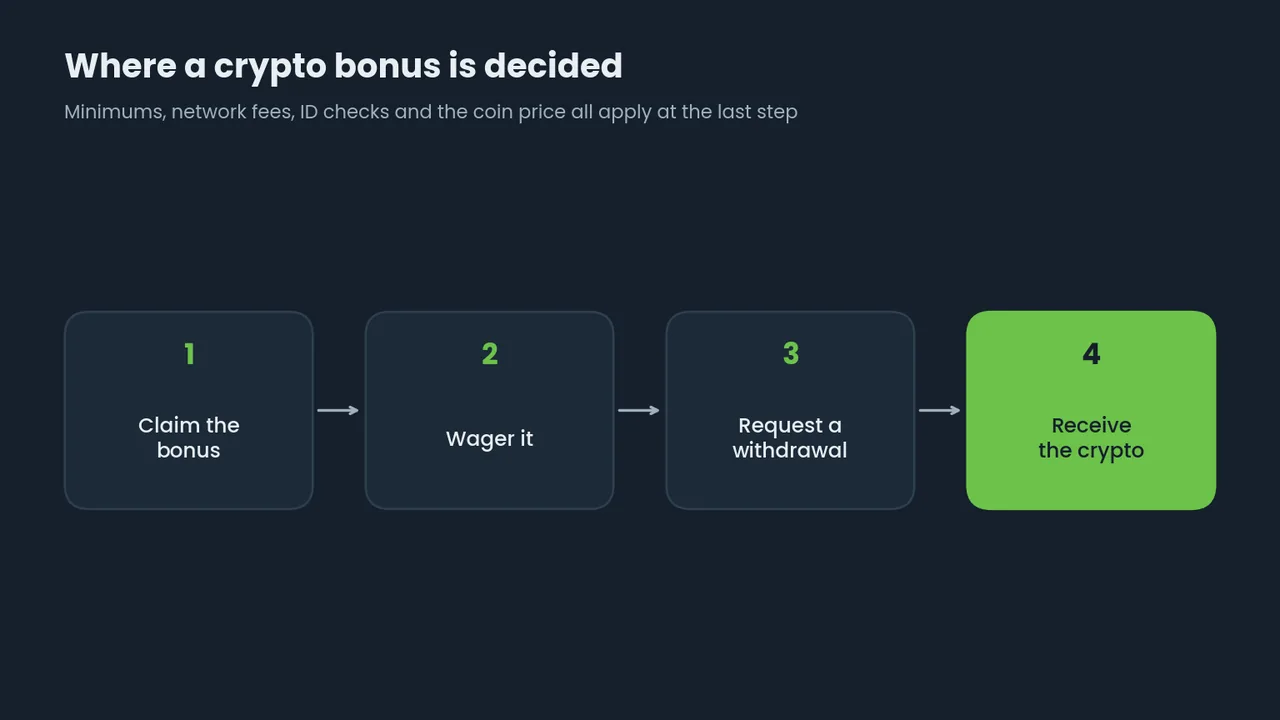
Crypto does not remove identity checks either. Many crypto casinos still reserve the right to ask for ID, proof of address or a selfie before a withdrawal, especially the first one or a larger one, and a no deposit bonus is a common trigger because it is where casinos see the most duplicate accounts. Sign up with your real details, use one account per casino and one wallet address you control, and double-check the network before you paste an address: coins sent on the wrong network may not arrive. More on the steps between a finished bonus and money in your hands is in our guide to cashing out no deposit winnings.
Free spins no deposit crypto casino offers work like any other free spins: a set number of spins at a fixed value on one slot, with the winnings usually under wagering. In our simulation, 50 spins at $0.10 with 30x wagering on the winnings and a $100 cap paid something to 4.3% of players on the high-volatility slot model and 13.5% on the low-volatility one, for an average value of $1.98 and $2.79. The same spins with no wagering were worth $4.74 and $4.80, and almost every player kept something. For spins, the wagering line matters more than the number of spins.
No deposit bonus codes for crypto casinos are usually entered at sign-up or in the cashier. Take codes only from the casino's own terms or from a list with a checked date, because codes are often tied to a link or an end date. Our list above shows whether a code is needed and when we last read the terms. New crypto casinos use no deposit offers to win sign-ups, so a new crypto casino no deposit bonus for USA players can be generous on the face of it; the eligible-games and payout lines are where that generosity is tested.
Real-money online casino is licensed and live in seven states: New Jersey, Delaware, Pennsylvania, West Virginia, Michigan, Connecticut and Rhode Island. Online casino legality is decided state by state, so check your own state's law before you play. A crypto casino that is not licensed in your state is outside the reach of any US regulator. The Michigan Gaming Control Board, which sent cease-and-desist orders to 45 offshore operators in April 2026, named the risks as unfair or manipulated games, withheld winnings, misuse of personal and financial data, and "no meaningful avenue for dispute resolution". The Pennsylvania Gaming Control Board puts it simply: "Player protections are required only through licensed operators." If a crypto payout is refused, there is no state office to take it to. Which states license online casinos, and what that means for bonuses, is covered on our online casino legal states page.
Taxes apply however you are paid. The IRS says gambling winnings are fully taxable, losses are deductible only if you itemize and only up to your winnings, and you should keep records. From tax years beginning after 31 December 2025, only 90% of losses are deductible, still capped at winnings. A record of the dollar value on the day each withdrawal arrives makes that easier.
An offer goes on the list only after we have read its terms. For each one we note the bonus in dollars and in the coin it is paid in, the wagering multiple, the eligible games and any contribution rates, the max cashout, the expiry, whether a code is needed, and the date we read it. We write no codes we did not find in the terms themselves, and we do not describe any bonus as a sure thing, because in our simulation most players end a no deposit bonus with nothing.
What we did not do: we did not make crypto withdrawals at the listed casinos, so we cannot confirm payout times, minimums or fees, and we did not test how each casino applies its ID checks. Where terms change, we update the line and the date. For no deposit offers paid in dollars rather than crypto, see our main list of no deposit bonus casinos.
A no deposit bonus is designed to keep you playing, and crypto makes it easy to deposit fast. If you notice you are chasing losses with new bonuses, or spending more time or money than you meant to, stop and talk to someone. 1-800-MY-RESET (1-800-697-3738) is free, confidential and open 24/7 by call or text, with chat at 1800myreset.org. More help is on our gambling help page. 21+ in the licensed states.

Leads the review desk and edits every review. Over a decade testing real-money casinos end to end.

Runs the data team behind our Safety Index and fact-checks every review against primary sources.

Certified responsible-gambling professional who keeps our content fair, honest and player-first.