
Lucky 15 Bets Explained: Cost, Returns & Calculator
A Lucky 15 is 15 bets on 4 selections: 4 singles, 6 doubles, 4 trebles and 1 four-fold accumulator. A €1 Lucky 15 costs €15 (each-way: 30 bets, €30). Because the singles are included, one winner is enough for a return - the feature that separates it from a Yankee.
A Lucky 15 is fifteen bets pretending to be one: four singles, six doubles, four trebles and an accumulator across four picks. One winner still pays something - which is why it owns Saturday racing. Here is how it and every other multiple actually settles.
Multiples are where betting slips stop being self-explanatory. The names sound like a variety act - Lucky 15, Yankee, Patent, Trixie, Goliath - the costs are multiples of whatever you thought you were staking, and the settlement rules only make sense once you see that each of these is simply a bundle of ordinary bets settled one by one. This guide unpacks the whole family: what each bet contains, what it costs, what it returns in every scenario, and a calculator that settles any Lucky 15 for you.

What is a Lucky 15 bet?
Pick four selections - four horses in four different races, say - and a Lucky 15 automatically strikes every bet that can be made from them: each one as a single (4 bets), every pair as a double (6), every trio as a treble (4), and all four together in an accumulator (1). Fifteen bets, each carrying your unit stake, each settled independently.
The design has a purpose. Pure multiples like the accumulator pay spectacularly and usually lose; singles pay modestly and often win. A Lucky 15 blends the two: a lone winner returns its single, two winners add a double, and a full house collects all fifteen bets at once, with the four-fold doing the heavy lifting. You are buying one lottery ticket and fourteen pieces of insurance on it - or four sensible bets and eleven pieces of upside, depending on your temperament.
How much does a Lucky 15 cost?
The stake you enter is the unit stake, paid on each of the 15 bets: a €1 Lucky 15 costs €15, a 50c one €7.50. Struck each-way, every bet doubles into a win part and a place part - 30 bets, so a €1 each-way Lucky 15 costs €30. The each-way version is genuinely popular with four big-priced picks, because the all-place accumulator at the place terms can carry the whole bet even when nothing wins.
How a Lucky 15 settles: a worked example
Four selections at 2/1, 3/1, 4/1 and 5/1, €1 units, €15 total. Suppose the 2/1 and 4/1 chances win and the other two lose.
Three of the fifteen bets contain no loser: the single on the 2/1 winner (returns €3), the single on the 4/1 winner (returns €5), and the double combining them (€1 at 2/1 onto 4/1: €3 rolls onto the second leg, returning €15). Every other bet includes a beaten horse and loses.
Total back: €3 + €5 + €15 = €23, an €8 profit on the €15 outlay. Two winners from four at fair prices roughly breaks even or better; the same two winners in a straight four-fold would have returned nothing. That is the Lucky 15 trade-off, and the calculator below runs any version of it.

Lucky 15 calculator
Enter the odds for all four selections, tick the winners, set your unit stake - the calculator settles all 15 bets.
Lucky 15 consolations and bonuses
The "Lucky" in the name refers to the sweeteners bookmakers traditionally attach. The two standard ones: a one-winner consolation, typically paying double (sometimes treble) the odds on your single when exactly one selection wins; and an all-winner bonus, adding 10-20% to total returns when all four win. Both are promotions rather than rules - rates differ by operator, some restrict them to racing, and a few offer none. Where they apply, they meaningfully shift the maths of the bet, so they are worth checking in the house rules before choosing where to place one. Our Irish casino reviews and casino rankings cover casinos rather than bookmakers, so for multiples terms go to the bookmaker's own rules.
Lucky 31 and Lucky 63
The same idea scaled up. A Lucky 31 covers five selections with 31 bets: 5 singles, 10 doubles, 10 trebles, 5 four-folds and a five-fold. A Lucky 63 covers six selections with 63 bets: 6 singles, 15 doubles, 20 trebles, 15 four-folds, 6 five-folds and a six-fold. Costs scale the same way - a €1 Lucky 63 is €63, each-way €126 - so unit stakes usually shrink as selections grow. The consolation and bonus structure typically carries over, often more generously at the bigger sizes.
What is an accumulator bet?
An accumulator is a single bet on several selections where each leg's full return becomes the stake on the next. Nothing is banked along the way: four 2/1 winners turn €10 into €30, €90, €270 and finally €810, but a single beaten leg - the first or the last - loses the whole bet. "Fold" counts the legs: a four-fold has four selections, a six-fold six.
Non-runners do not sink an acca: a void leg is removed and the bet shrinks by one fold. And the roll-on structure explains why accas are the natural home of short-priced selections - multiplying five prices of 1/2 gives a respectable 6.6/1 about a sequence that might well happen, whereas multiplying five 10/1 shots gives a price about an event that almost never does.
Trixie, Yankee, Canadian, Heinz, Goliath: the full-cover family
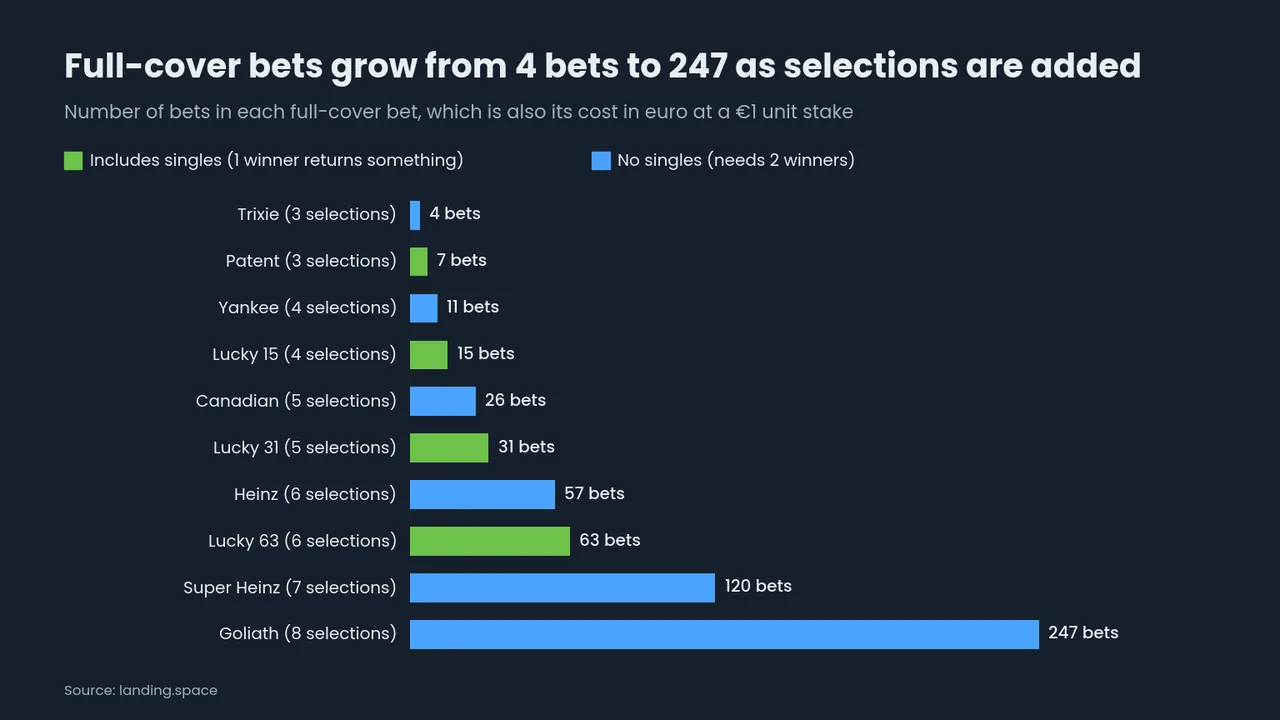
Strip the singles out of a Lucky bet and you have the classic full-cover multiples; scale the selections and the names change. The whole family in one table:
| Bet | Selections | Bets | Singles? | Min. winners for a return |
|---|---|---|---|---|
| Trixie | 3 | 4 | No | 2 |
| Patent | 3 | 7 | Yes | 1 |
| Yankee | 4 | 11 | No | 2 |
| Lucky 15 | 4 | 15 | Yes | 1 |
| Canadian (Super Yankee) | 5 | 26 | No | 2 |
| Lucky 31 | 5 | 31 | Yes | 1 |
| Heinz | 6 | 57 | No | 2 |
| Lucky 63 | 6 | 63 | Yes | 1 |
| Super Heinz | 7 | 120 | No | 2 |
| Goliath | 8 | 247 | No | 2 |
The choice between neighbours in this table is always the same question: pay extra units for the singles (Patent over Trixie, Lucky 15 over Yankee) and one winner keeps you alive; skip them and the same total stake buys bigger units on the combination bets. With strongly fancied selections at fair prices, the singles earn their keep; with speculative prices, most of their value sits in the doubles upward anyway. Definitions for every bet named here are in the betting glossary.
Frequently asked questions
What is a Lucky 15 bet?
How much does a €1 Lucky 15 cost?
How does a Lucky 15 work if only one horse wins?
What is the difference between a Lucky 15 and a Yankee?
What is an accumulator bet?
What happens to an accumulator if one leg is a non-runner?
Can you do a Lucky 15 each-way?
Related questions
Guides are for information only; consolations and bonuses on Lucky bets are promotions that vary by operator and can change. 18+. Gambling involves risk - please play responsibly. Content reflects the rules and market terms as of 18 September 2026.