
Each-Way Betting Explained: What It Really Pays
An each-way bet is two bets of equal stake: one on your selection to win, one on it to place (finish in the top positions the race pays). A "€5 each-way" bet costs €10. The place part pays at a fraction of your odds - usually 1/4 or 1/5 - over 2, 3 or 4 places depending on the field size.
An each-way bet is two bets on one slip: one on your pick to win, one on it to finish in the places. It doubles the cost, softens the miss, and confuses more punters than any other bet type. Here is exactly how both halves settle, and a calculator that does it for you.
Each-way is the workhorse of racing betting: it turns a long shot from an all-or-nothing gamble into a bet that can pay even when your pick gets touched off. It is also the bet most often misunderstood - what it costs, what a "place" is, and what a placed horse actually returns. This guide settles all three, walks through the payouts for every outcome, sets out the standard place terms, and includes a calculator that does the arithmetic for any each-way bet in any sport. If you came here from the casino side instead, our Irish online casino rankings and casino reviews cover that ground.

What does each-way actually mean?
"Each way" is literal: you are backing the selection each way it can succeed - by winning, and by placing. The bookmaker treats the slip as two independent bets and settles them independently. That has three immediate consequences that catch people out:
It costs double. The stake you enter is per part. €5 each-way means €5 on the win plus €5 on the place: €10 leaves your balance.
A winner pays both parts. A horse that wins has also placed, so you collect the win part at full odds and the place part at the fractional odds. Some punters believe the place part is "absorbed" on a winner; it is not.
A placed horse pays one part. If your pick finishes second in a race paying three places, the win half loses and the place half pays. Whether that leaves you in profit overall depends on the odds - the maths is below.
How an each-way bet settles: the three outcomes
Take the standard example: €5 each-way at 10/1, in a 10-runner race paying 3 places at 1/5 of the odds. Total outlay €10. The place odds are 10/1 ÷ 5 = 2/1.
The horse wins. Win part: €5 at 10/1 returns €55 (€50 profit + stake). Place part: €5 at 2/1 returns €15 (€10 profit + stake). Total back: €70, a €60 profit.
The horse finishes second or third. Win part loses its €5. Place part: €5 at 2/1 returns €15. Total back: €15, a €5 profit on the €10 outlay - the long shot missed and you still made money.
The horse finishes fourth or worse. Both parts lose: €0 back.
Run the same bet at 2/1 instead of 10/1 and the picture changes: a placed horse returns €5 × (2 ÷ 5) + €5 = €7 on a €10 outlay - a loss. That single comparison is the heart of each-way judgement, and the reason the bet suits outsiders far better than favourites.
Place terms: how many places pay, and at what fraction
Place terms are set by the race type and the number of runners at the off, and printed wherever the bet is offered. The standard scale:
| Race | Places paid | Fraction of odds |
|---|---|---|
| Fewer than 5 runners | Win only | - |
| 5-7 runners | 1st, 2nd | 1/4 |
| 8 runners or more | 1st-3rd | 1/5 |
| Handicaps, 12-15 runners | 1st-3rd | 1/4 |
| Handicaps, 16+ runners | 1st-4th | 1/4 |
Non-runners can move a race down the scale: an 8-runner race that loses one at the off becomes a 7-runner race paying two places, not three, and bets are settled on the terms at the off. Big meetings work the other way - on races like the Irish Grand National at Fairyhouse or Aintree's Grand National, bookmakers compete by paying 5, 6 or more places, and those extra places apply to each-way bets struck while the offer stands.

Each-way calculator
Enter the stake per part, the odds and the place terms, choose how the selection finished, and the calculator settles both halves.
When is each-way worth it?
The place part is priced by formula, not by the market, and that creates both good and bad each-way bets. Under 1/5-odds terms, a horse that only places returns exactly your total outlay at 5/1: at shorter prices the whole bet loses money even when the horse places, and at longer prices a place alone shows a profit. Under 1/4-odds terms the break-even is 4/1. Hence the old rule of thumb: below about 4/1, bet win-only; from 4/1 up, each-way earns its keep.
The genuinely strong spots are structural. Big-field handicaps paying four places at 1/4 odds give the place part real value on any horse priced 8/1 or bigger. Extra-place offers push it further - each place added beyond the standard terms is pure concession, paid out of the bookmaker's margin. And in small fields, watch the other direction: two places at 1/4 in a 5-runner race is a thin proposition unless your pick is a big price.
Each-way in golf, football and beyond
Each-way is not a racing exclusive; it works in any market with a finishing order, and the mechanics are identical - only the standard terms change.
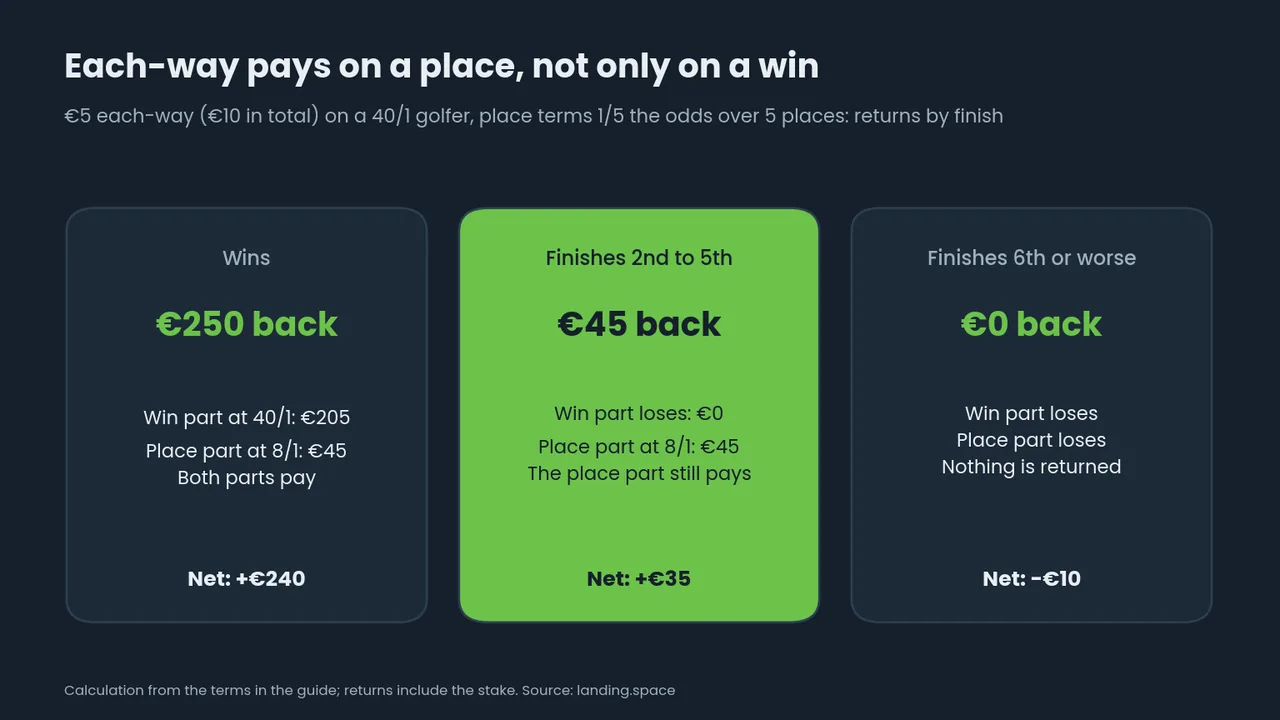
Golf is the model each-way sport: fields of 150+, winners at 25/1 routinely, and standard terms of 1/5 the odds over 5 or more places (7, 8 or 10 places are common in majors). A 40/1 player finishing fifth pays 8/1 on the place half - the reason experienced golf punters bet almost exclusively each-way. Dead-heats for the final place are settled by dividing the stake, which is normal in golf's tied finishes.
Football outrights (league winner, top scorer) usually pay 1/4 or 1/3 the odds over 2-3 places. The terms are meaner than racing's, so check them before assuming the usual fractions.
Each-way accumulators settle as two multiples: an all-win acca and an all-place acca, each rolling its own returns leg to leg. All selections placing without all winning still pays the place acca - frequently the difference between a blank Saturday and a decent one. How doubles, trebles and full-cover multiples work is covered in our Lucky 15 and multiple bets guide.
Each-way, non-runners and Rule 4
Two race-day events can adjust an each-way bet after you strike it. If a rival horse is withdrawn, a Rule 4 deduction may be taken from the winnings of both halves, at the standard scale. And if the field shrinks past a threshold, the place terms at the off apply - which can mean fewer places than when you bet. Neither touches your stake; both must be itemised on the settled slip. If your own horse is withdrawn, the bet is void and the stake returned (or held onto the ante-post terms you chose - the difference is explained in the Rule 4 guide).
Frequently asked questions
How does each-way betting work?
What does each-way mean in horse racing?
How much does a €5 each-way bet cost?
What happens if my each-way horse wins?
How many places does each-way pay?
Is each-way betting worth it?
How does an each-way accumulator work?
Related questions
Guides are for information only; place terms shown are the standard scale and individual bookmakers and races may differ. 18+. Gambling involves risk - please play responsibly. Content reflects the rules and market terms as of 18 September 2026.