
Wagering requirements are falling because regulators are capping them



Since 19 January 2026, operators licensed by the Gambling Commission in Great Britain have not been allowed to set a bonus wagering requirement above 10 times. The same rule change banned promotions that require customers to use more than one type of gambling product. Lower wagering is no longer just a selling point for some brands: in Britain it is a licence condition, and several other European regulators already limit bonuses in their own ways.
For years the wagering requirement, the number of times bonus money has to be staked before it becomes withdrawable, was the least visible and most important term in a casino offer. Multiples of 35x or more were common. The verifiable reason multiples are coming down is not competition between brands, for which there is no reliable market-wide data, but regulation. This piece sets out what changed in Britain, how other markets handle bonuses, and how to work out what a wagering requirement actually costs.
What the Gambling Commission changed
On 26 March 2025 the Gambling Commission published its response to a 2023 consultation on socially responsible incentives. It confirmed two changes to Social Responsibility code 5.1.1 (Rewards and Bonuses) of its Licence Conditions and Codes of Practice: wagering requirements capped at a maximum of 10 times, and a ban on mixing gambling products within a single incentive. The Commission's own worked example was a 10 pound bonus with a 50x requirement, which would demand 500 pounds of play before any withdrawal.
The original start date was 19 December 2025. The Commission moved it to 19 January 2026 in an update dated 24 July 2025, and the rules have applied since then. The current licence text says operators must not apply wagering requirements "over a maximum of 10 times".
Why 10x and not zero
The Commission had consulted on several options, including a 1x limit, a 5x limit and an outright ban. In its response it said some licensees applied wagering requirements of up to 60 times, and that one operator's data showed 75 percent of its offers already sat between 1 and 10 times. It concluded there was limited evidence to justify 5x over 10x, and chose 10x as the level that removes the extremes. It also dropped a proposed extra duty on operators to ensure the design of incentives did not lead to excessive intensity of gambling.
That is useful context: the 75 percent figure describes one operator, not the market, so it should not be read as an industry average.
The mixed-product ban
The second change targets cross-sell offers, for example a football bet that unlocks casino spins. Under the new wording, an incentive must not include more than one type of gambling product, the Commission's categories being betting, casino, bingo and lottery. In a blog for operators on 12 December 2025 it clarified one exception: an offer is still allowed when the customer alone decides which product the bonus money goes on. The post also asked operators to keep terms clear and easy to find.
How other markets limit bonuses
Britain is not the first regulator to cap wagering. Denmark's Spillemyndigheden says a playthrough requirement must not be more than 10 times, must be completed within 60 days, and that the value of a bonus cannot exceed DKK 1,000. Its guidance shows the requirement counting deposit and bonus together, so a DKK 1,000 deposit plus DKK 1,000 bonus at 10x means DKK 20,000 of play.
Sweden goes further on frequency. Under the Gaming Act (2018:1138), a licence holder may offer a bonus only the first time a customer plays with it. Spelinspektionen's Q&A treats any economic incentive, discount or rebate linked to play, including loyalty programmes and VIP offers, as a bonus. On 30 April 2026 it issued a formal reprimand to Polar Limited for giving Swedish customers bonuses on two separate occasions.
The Netherlands may end up with no bonuses at all. The Hague set out the plan on 12 June 2026: no more online gambling adverts, and no sign-up incentives such as free credit for new accounts. It still has to be written into law by State Secretary Claudia van Bruggen, so nothing has changed for players yet.
Spain shows that restrictions can also be reversed. Madrid's welcome-bonus ban lasted until the Supreme Court struck down parts of Royal Decree 958/2020 in April 2024, the consumer ministry says. The ministry then tried to restore the ban through the customer service bill in August 2025, yet the version that became law at the end of 2025 (Ley 10/2025) left gambling out entirely.
| Market | Bonus rule | Status |
|---|---|---|
| Great Britain | Wagering on bonus funds capped at 10x; no mixing of betting, casino, bingo or lottery in one incentive | In force since 19 January 2026 |
| Denmark | Playthrough max 10x, completed within 60 days; bonus value max DKK 1,000 | In force |
| Sweden | One bonus, when the customer first plays; rebates and loyalty rewards are treated as bonuses too | In force |
| Netherlands | Sign-up incentives to be banned under a June 2026 plan | Announced 12 June 2026, needs legislation |
| Spain | Bonus restriction annulled by Supreme Court; 2025 attempt to reinstate not in final law | No general bonus ban in force |
The maths behind a wagering requirement
Two multiplications explain almost everything. First, bonus multiplied by the wagering multiple gives the turnover you must stake. Second, turnover multiplied by the house edge gives the amount you should expect to lose, on average, while getting there. On a game returning 96 percent (a 4 percent edge), every 1,000 pounds staked costs about 40 pounds on average. You can check any game's return with our RTP checker.
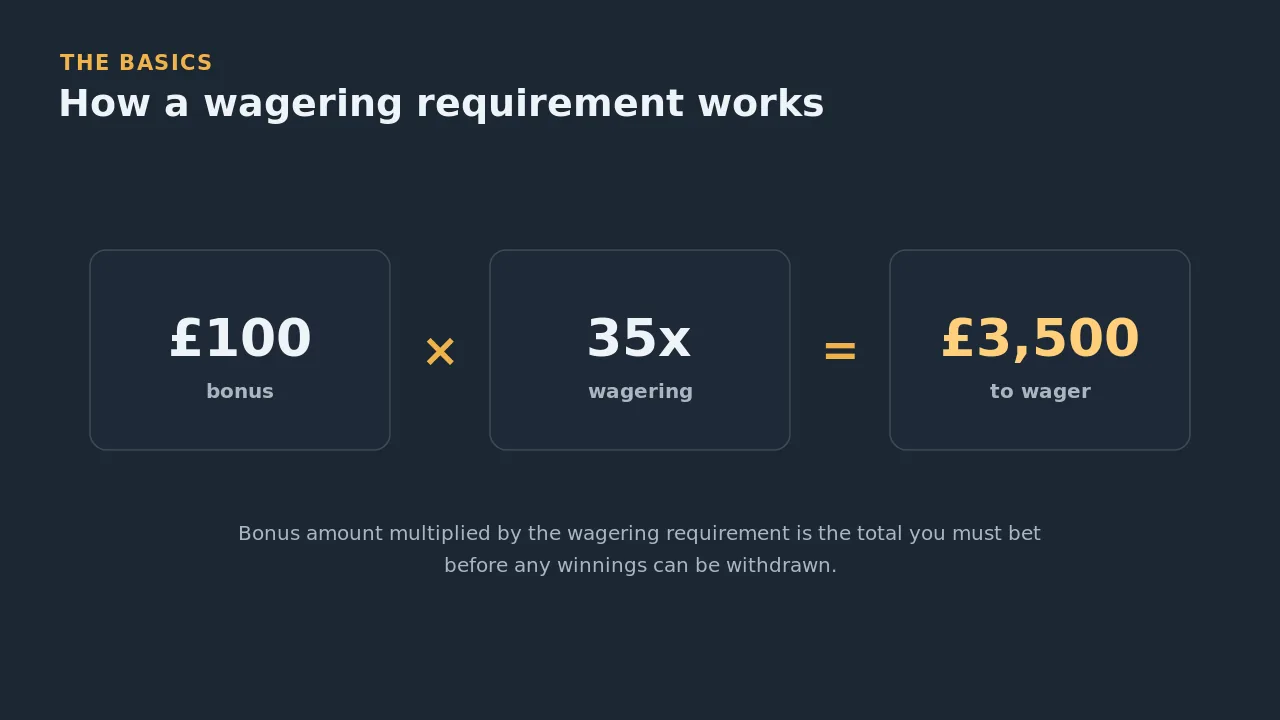
The table below applies that to a 100 pound bonus. It is an illustration, assuming a 96 percent return and every bet counting in full, not data about any operator.
| Wagering multiple | Turnover on a 100 pound bonus | Expected cost at 4% edge |
|---|---|---|
| 5x | 500 pounds | 20 pounds |
| 10x (GB maximum) | 1,000 pounds | 40 pounds |
| 35x | 3,500 pounds | 140 pounds |
| 60x (highest level cited by UKGC) | 6,000 pounds | 240 pounds |
At 35x the expected cost is larger than the bonus itself, which is why high multiples so often ended with the bonus balance used up. At 10x, on these assumptions, a player keeps roughly 60 pounds of the 100 on average. Individual results swing widely either way, especially on high-volatility slots, as our RTP and volatility guide explains. Our bonus calculator runs the same sums for any offer.
What the multiple does not tell you
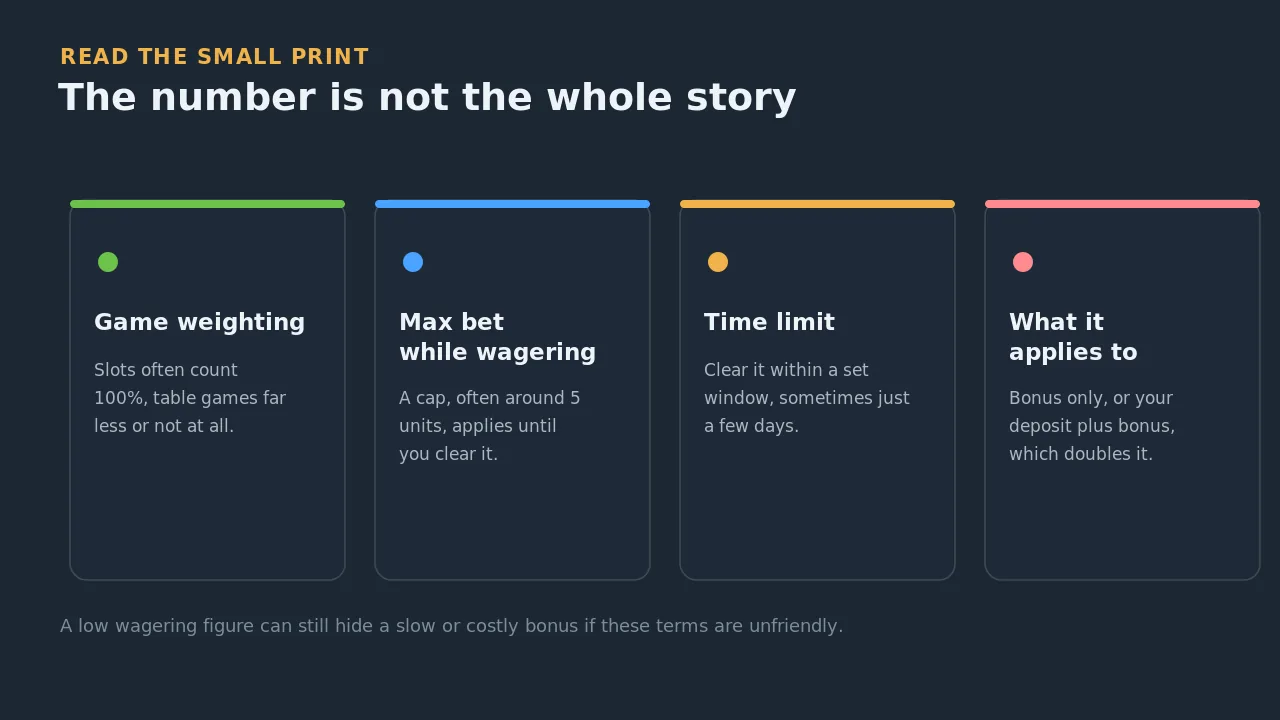
A low number can still hide a costly offer. Denmark's guidance notes that not all games contribute to playthrough, and the same is true elsewhere: if table games count at 10 percent, the effective turnover on them is ten times higher. A maximum bet while wagering, a short time limit, or a requirement that applies to deposit plus bonus rather than bonus alone all change the real cost.
What is confirmed and what is not yet known
- Confirmed: since 19 January 2026 no GB-licensed bonus can carry more than 10x wagering or tie two product types together; Denmark caps playthrough at 10x within 60 days; Sweden permits one bonus per customer, at the start of the relationship.
- Not yet known: the final text and start date of the Dutch bonus ban, and whether the Commission will publish any review of how the 10x cap has worked.
- Not claimed here: an average wagering multiple across the market. We found no reliable public dataset, so we do not publish one.
What it means for players
On a GB-licensed site, any wagering above 10x on bonus funds should no longer appear, and a single offer should not push you from a sportsbook into a casino. Outside Britain the rules differ by market, so read the terms. Our bonus pages show the wagering next to each offer, and the welcome bonus list is a quick place to run the maths above on a real offer. Whatever the multiple, a bonus is a way to play longer, not a way to profit on average. If bonus terms are pulling you into more play than you planned, our responsible gambling guide lists tools that help.
Frequently asked questions
What is the maximum wagering requirement in the UK now?
For operators licensed by the Gambling Commission in Great Britain, 10 times. The limit has applied since 19 January 2026 under SR code 5.1.1.
Can a UK casino still combine a sports bet and casino spins in one offer?
Not if the customer has to use both. An offer may not tie two product types together unless the customer picks where the bonus is used.
Does a 10x cap mean I will keep most of my bonus?
Not necessarily. On average a 10x requirement on a 96 percent game costs about 40 percent of the bonus, but individual results vary widely and other terms such as game weighting add to the cost.
Do other countries cap wagering?
Denmark caps playthrough at 10x within 60 days. Sweden allows only one bonus, at the first occasion a player plays. The Netherlands has announced a plan to ban bonuses.
Why did the Commission not ban wagering requirements entirely?
It said there was limited evidence to justify a lower limit and chose 10x to remove extreme levels, noting some offers had used up to 60x.
Where can I work out the real cost of an offer?
Multiply the bonus by the wagering multiple, then by the house edge. Our bonus calculator does this automatically.
Sources
- Gambling Commission - Gambling promotions to be safer and simpler (26 March 2025, updated 24 July 2025)
- Gambling Commission - Socially responsible incentives consultation response, executive summary (26 March 2025)
- Gambling Commission - Consultation response, Proposal 1: ban or limit wagering requirements
- Gambling Commission - LCCP condition 5.1.1 SR code
- Gambling Commission blog - Socially responsible incentives: what operators need to know (12 December 2025)
- Spillemyndigheden - Marketing of gambling
- Spelinspektionen - Polar Limited far anmarkning for otillatna bonuserbjudanden (30 April 2026)
- Spelinspektionen - Fragor och svar for aktorer
- Rijksoverheid - Kabinet scherpt beleid online kansspelen flink aan (12 June 2026)
- Ministerio de Consumo, CEC Spain - Ministry warns of surge in online gambling after reintroduction of welcome bonuses (5 August 2025)
- BOE - Ley 10/2025, de 26 de diciembre, servicios de atencion a la clientela
Go deeper

Turn any bonus and its wagering requirement into the real amount you must bet.
Read more →
Playthrough, weighting, max cashout and the rest of the bonus vocabulary, explained.
Read guide →
How to enjoy bonuses without letting them nudge you past your budget.
Read guide →This article is independent editorial coverage and is not sponsored; no operator or supplier paid for inclusion. The facts were checked against the sources listed above on 24 September 2026, and rules, programmes and offers can change after that date. Nothing here is legal or betting advice. 18+ only; if you gamble, set your limits in advance.