
Machine Games Duty and the 28 October Budget: what is proposed and who it would hit



The Treasury is reported to be modelling a higher Machine Games Duty, the tax on gaming machines in betting shops, arcades and other licensed venues, before Chancellor John Healey's Budget on 28 October 2026. Nothing has been announced. In the month since the report, Entain has cut up to 400 jobs, Betfred has ended its Super League sponsorship and the industry has launched a campaign against the rise, while a think tank argues it would raise up to £458m a year.
What has been reported, and what has not been announced
On 7 September 2026 The Times reported that Treasury officials were working out how much a higher Machine Games Duty (MGD) would raise from Category B machines, the higher-stake machines found in betting shops, arcades and casinos. Earlier proposals had put the standard rate at 40%, double today's 20%. A government source quoted in the coverage said further gambling tax rises were being considered. The Treasury has not confirmed a rate, a machine category or a start date, and a tax change only exists once the Chancellor announces it.
The date itself is fixed. HM Treasury told the Treasury Select Committee on 31 July that the Budget will be held on 28 October 2026. It will be John Healey's first: he was appointed Chancellor on 20 July 2026, the day Andy Burnham became Prime Minister. His predecessor Rachel Reeves raised the online gambling duties in November 2025 and left machines unchanged.
The duties as they stand before 28 October
Britain taxes gambling businesses, not players. Most of the duties are charged on gross profit: the stakes a business takes in, minus the winnings it pays out (our guide to how casinos make money explains the term). The November 2025 Budget nearly doubled the rate on online casino games from April 2026 and will raise it on most online betting from April 2027. The table sets the current rates beside what each duty collected in the financial year to March 2026.
| Duty | What it taxes | Rate today | Change already set | Receipts 2025-26 |
|---|---|---|---|---|
| Remote Gaming Duty | Online casino games and slots | 40% | Up from 21% on 1 April 2026 | £1,321m |
| General Betting Duty | Fixed-odds and other bets | 15% | Online bets 25% from 1 April 2027 (UK horseracing stays 15%) | £685m |
| Machine Games Duty | Gaming machines in licensed venues | 5% / 20% / 25% | None; a rise is reported to be under consideration | £641m |
| Gaming Duty | Land-based casino gaming | Banded, top band 50% | None | £174m |
| All betting and gaming duties | Including Lottery Duty | - | Bingo Duty abolished 1 April 2026 | £3,831m |
Who pays Machine Games Duty
MGD is paid by the business that makes machine games available, typically on premises licensed for gambling or for alcohol, and it has three rates: 5% for the lowest-stake machines, 25% for machines allowing stakes over £5, and 20% for everything in between. Almost all of it is standard-rate money. In 2025-26 the 20% band accounted for £630.5m of £638.2m in liabilities, or 98.8%. That allows a simple static check. At 20%, £630.5m of duty means about £3.15bn of taxed machine takings, so doubling the rate with no change in play would add about £630m a year. No serious estimate is that high, because players, machines and venues would not stay where they are.
The first quarter at 40%: online receipts doubled
HMRC's statistics, published on 30 September, give the first look at how the online increase has worked. Remote Gaming Duty is accounted for in three-month periods and paid within 30 days of each period's end, so most of it arrives in four months of the year: January, April, July and October. July 2026 is the first of those months to cover a quarter taxed entirely at 40%, and it brought in £589.7m, against £283.0m in July 2025.
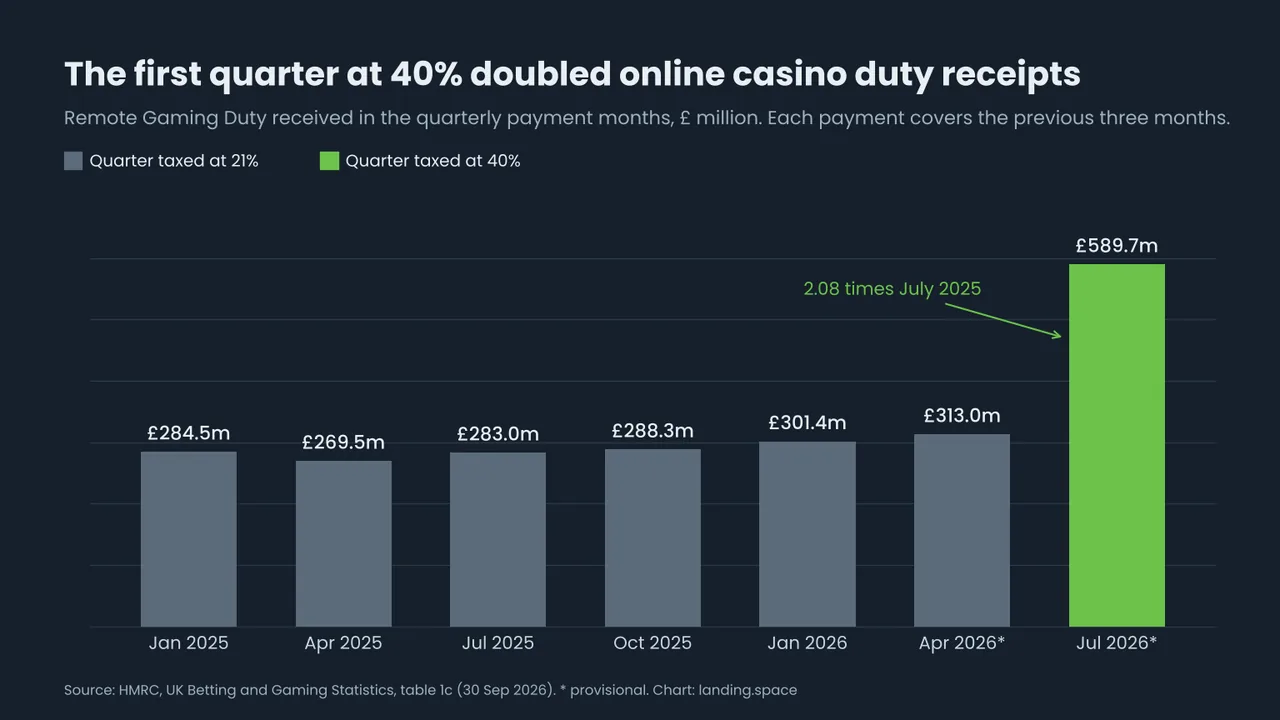
The rate rose 1.9 times; the July receipts rose 2.08 times. Dividing each payment by its rate gives the profit it was charged on: about £1,348m for April to June 2025 and about £1,474m for the same quarter of 2026, a rise of roughly 9%. On these figures, the profit taxed in the first quarter at 40% was higher than a year earlier, not lower. The caveats are real: the 2026 figures are provisional, the method assumes each July payment covers the April to June quarter, and one quarter is not a trend.
The industry's warning: shops, jobs and a sponsorship
Operators have made their case loudly since the report. On 16 September Entain, the Ladbrokes owner, said it would cut up to 400 of its 2,000 UK customer-care roles, describing it as a simplification driven by the new tax burden. Its chief executive Stella David wrote to the Prime Minister asking the government to look at the effect on jobs and communities before deciding on MGD. Coverage of the letter said the idea under discussion would double all three rates, to 10%, 40% and 50%.
Three days later Betfred's founder Fred Done told the Racing Post that a 40% rate would force the company to close 495 more shops, with 2,575 jobs, on top of the 132 closures it announced in July. His forecast for the high street was blunter: "I believe that by 2030 we will have no betting shops." On 21 September Betfred said it would end its title sponsorship of rugby league's Super League, held since 2017, after the 2026 season, and put the decision down to last year's Budget and rising wage costs.
The Betting and Gaming Council launched its Back Our Betting Shops campaign on 29 September. It says a 40% rate would put up to 16,000 jobs, nearly 1,500 shops and up to 34 casinos at risk, and that the Treasury would end up £124m a year worse off overall. On 2 October the consultancy Regulus Partners published its own analysis: about £45,000 a year added to an average shop's costs, around 1,500 shops still trading three years later, and about £92m a year lost to British racing in levy and media-rights income. The Gambling Commission counted 5,617 betting shops at the end of March 2026, 3.6% fewer than a year before.
The case for a higher rate
The idea did not start in the Treasury. In June the think tank Social Market Foundation argued for a 40% rate on Category B machines, leaving pub machines out, and estimated it would raise between £275m and £458m a year. Its argument is that machine gambling causes about £2.33bn a year of economic harm, and that money not spent on machines would be spent in sectors that employ more people and pay more tax. A poll it published found 43% of adults in favour of higher taxes on slot machines in betting shops and 11% in favour of cutting them. The BGC replied that a rise would put venues and jobs at risk and push customers towards illegal operators, and Regulus questioned how the harm figure was calculated.
The numbers in this debate measure different things, which is why they look irreconcilable. Set side by side:
| Estimate | Who made it | What it measures | Figure at 40% |
|---|---|---|---|
| Static check | landing.space, from HMRC data | Extra MGD if play did not change | about +£630m a year |
| Think-tank estimate | Social Market Foundation | Extra receipts, Category B only | +£275m to +£458m |
| Industry campaign | Betting and Gaming Council | Net effect on the Exchequer | -£124m a year |
| Consultancy model | Regulus Partners | Shops still trading after 3 years | about 1,500 |
| Company claim | Betfred | Its own extra closures | 495 shops |
Ireland left its betting duty at 2%
Across the Irish Sea the same argument ended the other way, for now. Ireland's Budget 2027, delivered on 6 October, kept betting duty at 2% despite calls for an increase. The Irish Bookmakers Association welcomed the decision but said operators still do not know the rate of the social impact fund levy that the Gambling Regulatory Authority of Ireland will charge from 2027. We relied on the Racing Post's report for this; the Irish government's Budget pages did not load for us.
What is confirmed and what is not yet known
- Confirmed: the Budget is on 28 October 2026; Remote Gaming Duty has been 40% since 1 April 2026; online betting duty rises to 25% on 1 April 2027; MGD rates are 5%, 20% and 25% today.
- Confirmed: Entain's job cuts, Betfred's sponsorship decision and the BGC campaign, from the companies' own statements as reported.
- Not known: whether MGD changes at all, which rates and machine categories would move, and from what date.
- Not known: the government's own costing, which would only be published with the Budget.
- Disputed: the closure and job forecasts, which come from businesses that would pay the tax and their advisers, and the harm cost, which comes from the think tank proposing the rise.
What it means for players
For anyone who plays online, MGD is not a tax on their play: it applies to physical machines in venues. The online changes are already in force or scheduled. Players do not pay any of these duties directly, and the Gambling Commission states that winnings are tax-free for customers in the UK whatever the amount. What higher duties change is the operator's margin, and none of the sources above puts a number on how operators would pass that on. If the Budget does change MGD, players will see it first on the high street, in which shops and arcades stay open. We will update this article after 28 October.
Frequently asked questions
Has the government announced a higher Machine Games Duty?
No. The Times reported on 7 September 2026 that the Treasury was modelling a rise on Category B machines, and a government source said further gambling tax rises were being considered. Nothing has been confirmed; any change would be announced in the Budget on 28 October 2026.
Which venues pay Machine Games Duty?
The business that makes machine games available pays it, typically on premises licensed for gambling or for alcohol: betting shops, adult gaming centres, bingo halls, casinos and pubs among them. The lowest-stake machines pay 5%, machines allowing stakes over £5 pay 25%, and the rest pay the 20% standard rate.
Do I pay tax on my winnings in the UK?
No. The Gambling Commission states that winnings from gambling are tax-free for customers in the UK, regardless of the amount. The duties are paid by operators on their gross profit.
Did the 40% online duty shrink what operators pay?
Not in its first quarter. HMRC's provisional figures show £589.7m of Remote Gaming Duty received in July 2026, against £283.0m in July 2025. Divided by the rate in force, that implies the profit being taxed was about 9% higher than a year earlier. It is one quarter of provisional data.
Why do estimates of the rise differ so much?
They answer different questions. A static check assumes nobody changes behaviour; the think tank estimates extra duty from Category B machines only; the industry campaign estimates the net effect on the Exchequer after closures; the consultancy models how many shops survive. None of them is the government's own costing.
Is Ireland raising its betting tax?
Not in Budget 2027, which kept betting duty at 2% on 6 October 2026. Operators are still waiting to learn the rate of a new social impact fund levy due from 2027.
Sources
- HM Treasury - Chancellor's letter to the Treasury Select Committee on the Budget 2026 date (31 July 2026)
- gov.uk - Chancellor of the Exchequer (read 7 October 2026)
- gov.uk - Prime Minister (read 7 October 2026)
- HMRC - Historical UK betting and gaming duty rates (updated 30 September 2026)
- HM Treasury - Gambling duty changes, policy paper (26 November 2025)
- HMRC - General Betting Duty, Pool Betting Duty and Remote Gaming Duty guidance (updated 1 April 2026)
- HMRC - Machine Games Duty guidance
- HMRC - UK Betting and Gaming Statistics, tables to July 2026 (30 September 2026)
- Gambling Commission - Gambling industry statistics 2025 to 2026 (17 September 2026)
- Gambling Commission - Winnings from gambling for customers (12 May 2026)
- The Times - Treasury modelling a Machine Games Duty rise (7 September 2026, paywalled; not opened by us), as reported by NEXT.io
- Yogonet - UK Chancellor reportedly weighing slot machine tax increase (9 September 2026)
- SBC News - Entain job cuts and letter to the Prime Minister (16 September 2026)
- Racing Post - Betfred founder's warning to the Chancellor (19 September 2026)
- NEXT.io - Betfred ends Super League sponsorship (21 September 2026)
- Gambling.com - BGC launches Back Our Betting Shops campaign (29 September 2026)
- Racing Post - Regulus Partners analysis of a 40% MGD rate (2 October 2026)
- NEXT.io - Social Market Foundation backs a 40% rate on Category B machines (29 June 2026)
- CARE - Two-fifths of people support increasing slot machine taxes (3 July 2026)
- Racing Post - No increase in betting tax in the Irish Budget (6 October 2026)
Go deeper
UK financial risk assessments will start at GBP 5,000 a day. How deposit limits, stake caps and credit bans compare in the Netherlands, Sweden and Finland.
Read article →
Britain has capped bonus wagering at 10x since 19 January 2026. How that rule works, what Denmark, Sweden and the Netherlands do, and the maths.
Read article →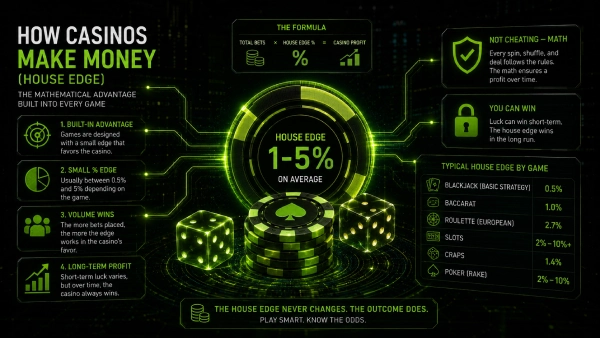
A plain-English guide to the house edge and RTP, with game-by-game figures and why betting systems fail.
Read guide →This article is independent editorial coverage and is not sponsored; no operator or supplier paid for inclusion. The facts were checked against the sources listed above on 7 October 2026, and rules, programmes and offers can change after that date. Nothing here is legal or betting advice. 18+ only; if you gamble, set your limits in advance.