
Instant payouts: rails got faster in 2025, but operator checks still set the pace



Since 9 October 2025, banks in the euro area have been required to send instant euro transfers, completing the rollout of the EU's Instant Payments Regulation. Together with real-time systems that already ran in the UK and Australia and card networks that push money straight to a debit card, it means the payment rail is rarely the slow part of a casino withdrawal any more. What still decides the wait is the operator's own review and verification, and that is where the rules on identity checks and reverse withdrawals matter.
This analysis looks at the rails that make fast payouts possible, what changed in 2025 and 2026, and the parts of the process that no payment network can speed up. We do not quote average payout times: we found no independent, industry-wide data on how quickly casinos pay, and marketing claims are not a substitute.
The EU's instant payments deadlines landed in 2025
Regulation (EU) 2024/886, the Instant Payments Regulation, was adopted on 13 March 2024 with a staggered timetable. Payment providers in the euro area had to be able to receive instant euro transfers from 9 January 2025 and to send them from 9 October 2025. The second deadline also brought Verification of Payee, which checks that the name of the person or business you are paying matches the IBAN before the money moves.
The European Commission said on 10 October 2025 that people and businesses can now transfer euro "within seconds", and that banks may not charge more for an instant payment than for a standard credit transfer. Providers outside the euro area follow later, with receiving due from 9 January 2027.
| Instant Payments Regulation step | Euro area | EU states outside the euro |
|---|---|---|
| Receive instant euro transfers | 9 January 2025 | 9 January 2027 |
| Send instant euro transfers | 9 October 2025 | 9 July 2027 |
| Verification of Payee | 9 October 2025 | 9 July 2027 |
| No higher charge than a standard transfer | 9 January 2025 | 9 January 2027 |
For casino players the practical effect is that a euro bank transfer from an operator to a player's account no longer has to wait for batch processing. Whether an operator actually uses instant credit transfers for withdrawals is a business choice the regulation does not dictate.
The UK and Australia already had real-time rails
Britain's Faster Payment System dates from 2008 and runs day and night, 365 days a year. Pay.UK says the scheme now allows single payments of up to 1 million pounds, although each bank sets its own limits. In 2025 it processed 5.55 billion transactions worth 4.84 trillion pounds.
In Australia, Osko runs on the New Payments Platform and, according to Australian Payments Plus, moves money between participating banks in under a minute, 24/7, including weekends. PayID lets you receive those payments to a phone number, email address or ABN instead of a BSB and account number, and is offered by more than 100 financial institutions.
The Australian context is different from Europe's, though. Under the Interactive Gambling Act, online casinos may not be offered to people in Australia; licensed online wagering can be. And since 11 June 2024, online and telephone betting services have not been able to accept credit cards, funds linked to credit cards or digital currency such as crypto.
Push-to-card and e-wallets
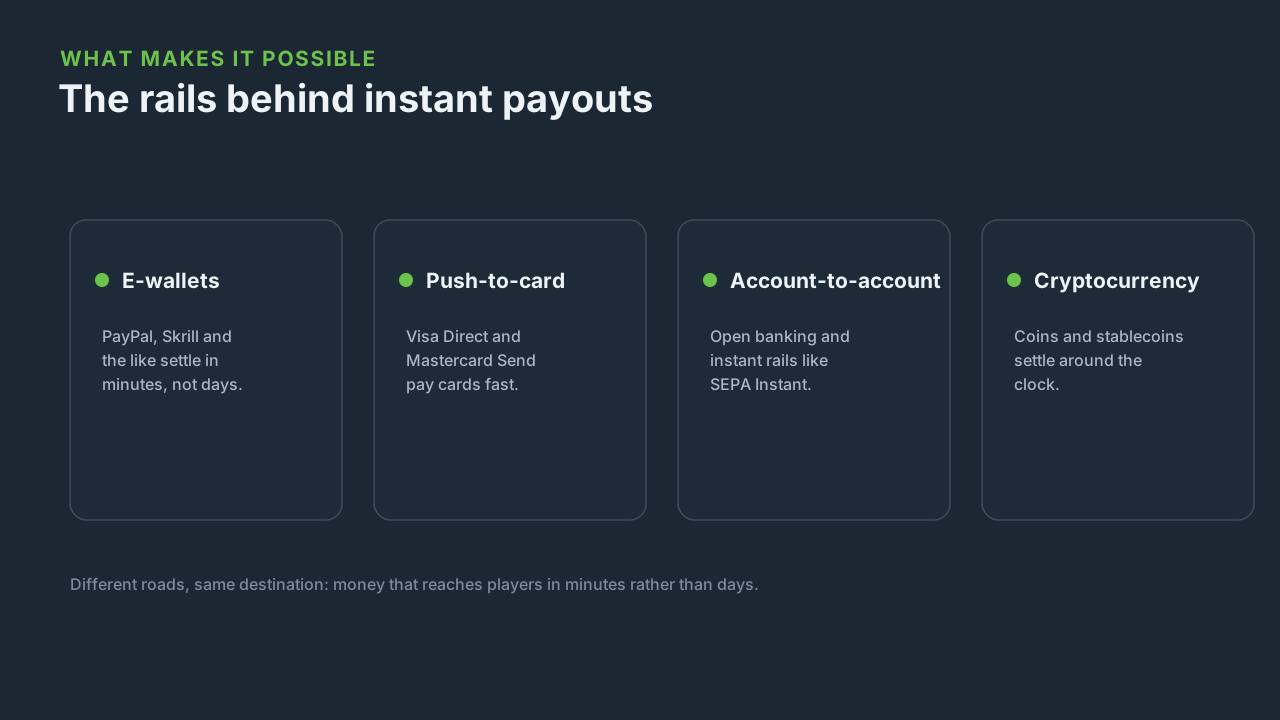
Card networks have built their own fast lane. Visa Direct lets a business push funds to a customer's eligible debit card, and Visa markets it to gaming operators for real-time payouts, with the caveat that actual fund availability depends on the receiving bank and region. Mastercard Move is Mastercard's equivalent portfolio, sending money to cards, bank accounts and digital wallets.
E-wallets sit alongside these rails. Moving money inside a wallet provider's own system can be immediate, but the step from the wallet to a bank account then depends on whichever bank rail the wallet uses.
Crypto: fast on-chain, restricted in regulated markets
Crypto transfers do not depend on bank opening hours, which is why offshore sites promote them for quick cashouts. In licensed markets the picture is more cautious. The UK Gambling Commission's guidance says crypto-assets carry additional risks compared with fiat money, including price volatility and harder source-of-funds checks, and it asks operators to explain how volatility affects safer gambling tools before adding crypto payments.
That position may be moving. In a speech on 26 February 2026, Commission executive director Tim Miller said the regulator wants to create a way for crypto to be used as a payment option for licensed gambling in Great Britain, and had asked its Industry Forum to look at how. No rule change has been published. In the EU, the MiCA regime for crypto-asset service providers has applied since 30 December 2024, with a transition for existing firms that ran until 1 July 2026.
Why the rail is rarely the bottleneck
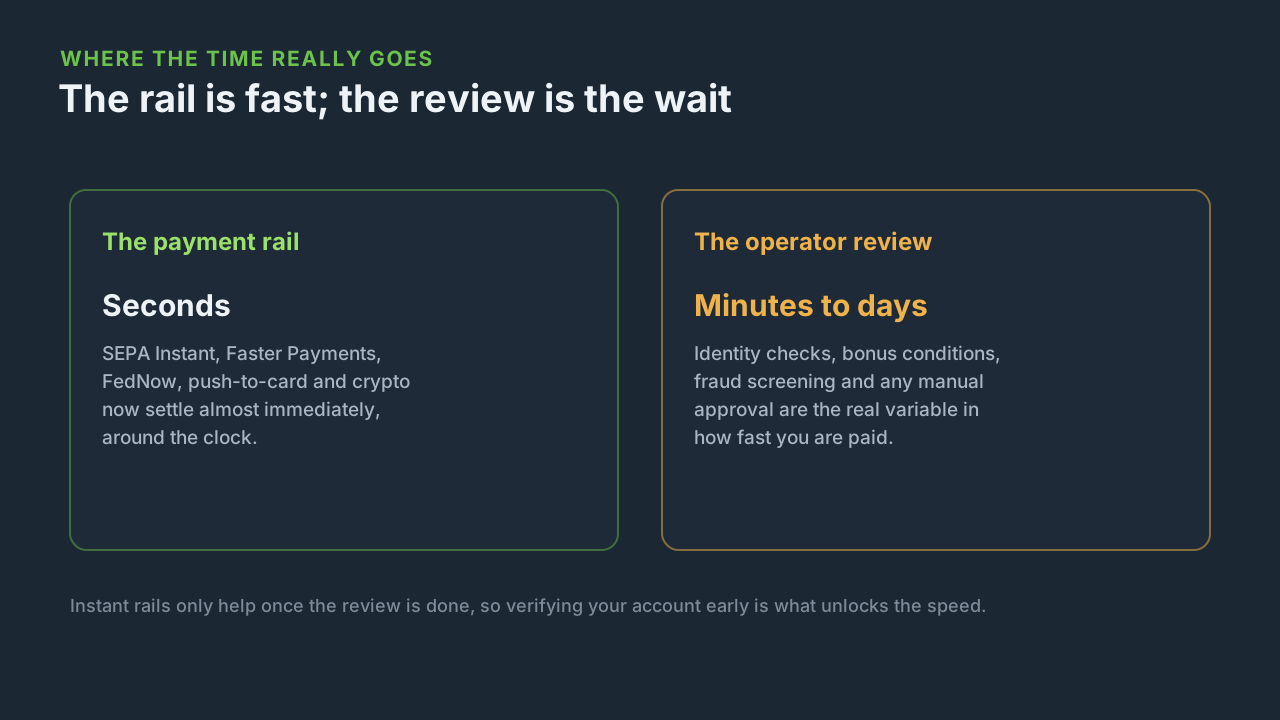
Once money is released, most of these rails settle in seconds or minutes. The delay players notice usually happens before that: pending periods, manual review, identity and source-of-funds checks. In Great Britain the rules push those checks to the start. Since 7 May 2019, online operators have had to verify a customer's name, address and date of birth before allowing them to gamble.
The Commission's player guidance adds that an operator cannot ask you to prove your age and identity as a condition of withdrawing if it could have asked earlier, although some checks can only happen at that point to meet legal obligations, such as anti-money laundering reviews that may involve bank statements. It had already warned operators in June 2017 that asking for documents only at withdrawal could breach their obligations.
The reverse-withdrawal ban keeps a request final
Speed also matters for safer gambling. Since 31 October 2021, remote operators licensed in Great Britain must not give customers the option to cancel a withdrawal request (technical standard RTS 14B). The Commission's guidance says operators should not let customers deposit using funds they have asked to withdraw, and should make withdrawing as frictionless as possible. It described reverse withdrawals as widely recognised as an indicator of harm.
What is confirmed and what is not yet known
- Confirmed: euro-area banks must receive and send instant euro transfers (2025 deadlines); UK Faster Payments and Australia's Osko already run around the clock; the UK reverse-withdrawal ban has applied since 31 October 2021.
- Not known: how many casinos pay out via instant rails, and how long reviews typically take. We found no independent dataset, so any single industry average should be treated with caution.
- Open: whether and how Great Britain will allow crypto payments at licensed operators; the Commission has signalled intent but published no rules.
- Still to come: EU states outside the euro area must receive instant euro transfers from 9 January 2027.
What it means for players
If a withdrawal is slow, the payment method is less likely to be the reason than the operator's own process. Complete verification when you open an account rather than at your first cashout, keep your payment details in your own name (Verification of Payee checks names in the EU), and read an operator's stated processing times before depositing. Our payout speed tool and payments guide explain how methods compare. Our UK and Australia pages cover the payment methods the casinos listed there take. If you find yourself wanting to cancel a withdrawal to keep playing, that is a signal worth taking seriously; our responsible gambling guide lists tools that help.
Frequently asked questions
Does the EU Instant Payments Regulation force casinos to pay out instantly?
No. It requires payment providers to offer instant euro transfers at no extra charge. It does not set how quickly a casino must process or approve a withdrawal before sending it.
What is Verification of Payee?
Since 9 October 2025, euro-area payment providers check that the payee's name matches the IBAN before a euro transfer is processed, and the check must be free of charge.
Can a UK casino ask for ID only when I try to withdraw?
UK rules require identity checks before you gamble. The Gambling Commission says an operator cannot make ID a condition of withdrawal if it could have asked earlier, though some legal checks, such as anti-money laundering reviews, can arise later.
Why can I not cancel a withdrawal at a UK-licensed site?
Reverse withdrawals have been banned for remote operators in Great Britain since 31 October 2021, because the option to cancel was linked to gambling harm.
How fast is Osko in Australia?
Australian Payments Plus says Osko moves money between participating banks in under a minute, 24/7, including weekends.
Are crypto payments allowed at UK-licensed casinos?
The Gambling Commission treats crypto as higher risk and expects operators to meet strict conditions. In February 2026 it said it wants to create a route for crypto payments at licensed operators, but no new rules have been published.
Sources
- European Central Bank - Instant Payments Regulation
- European Commission - New EU rules make instant euro payments faster and safer (10 Oct 2025)
- Pay.UK - Faster Payment System
- Pay.UK - Faster Payments transaction limits
- Australian Payments Plus - Osko
- Australian Payments Plus - PayID
- ACMA - About the Interactive Gambling Act
- ACMA - Credit ban
- Visa - Visa Direct gaming payment guide
- Mastercard - Mastercard Move
- UK Gambling Commission - Blockchain technology and crypto-assets
- UK Gambling Commission - BGC AGM 2026, Tim Miller speech (26 Feb 2026)
- ESMA - Markets in Crypto-Assets Regulation (MiCA)
- UK Gambling Commission - New age and identity verification rules (rules from 7 May 2019)
- UK Gambling Commission - Age, ID and financial verification
- UK Gambling Commission - Commission urges operators to review customer identity checks (21 Jun 2017)
- UK Gambling Commission - Prohibition of reverse withdrawals for all remote operators
Go deeper

Every deposit and withdrawal method compared, with realistic timelines.
Read guide →
The EU AI Act timeline shifted in July 2026, the Dutch regulator plans AI guidelines and UK rules already require automated harm checks. What it means.
Read article →
Why faster payouts help, and the limits that matter more than speed.
Read guide →